Tag Archives: Doris Kinnear

Bunty Annual 1962

Picture Stories

  • The Dance of 100 Heartaches (Pages: 7-15) [Artist: George Ramsbottom]
  • Toots (Page 17) [Artist: Bill Ritchie]
  • Hetty the Hedgehog (Page 22)
  • Pip at Pony School (Pages: 27-32)
  • The Legend of the Bells (Pages: 34-38)
  • Terry and the Terrible Twins (Pages: 43-48) [Artist: Doris Kinnear]
  • Anne Proctor (Pages: 52-55)
  • Little Miss Moffat (Page 60)
  • Pert Gert (Page 64)
  • Poor Kate – She’s Always Late (Pages: 66-72)
  • The Flight of the Snow Geese (Pages: 75-79)
  • Little Mo – The Eskimo (Pages: 81-84)
  • Little Lulu (Page 90)
  • Katy O’Connor (Pages: 91-95) [Artist: Ron Forbes?]
  • Janet’s Jungle School (Pages: 99-103)
  • Babalu (Page 107)
  • Hopeless Harriet (Pages: 109-112) [Artist: Tony Thewenetti]
  • Cinderella of the Orphanage (Pages: 114-119) [Artist: George Ramsbottom]
  • The Four Marys (Pages: 121-124) [Artist: James Walker]

Text Stories

  • Nora’s First Job (Pages: 18-19)
  • Sue of Starholme (Pages: 20-23)
  • Pam and the Pilot (Pages: 24-26)
  • Jill – Junior Reporter (Pages: 49-51)
  • Away in a Manger (Pages: 56-57)
  • Friendly Frances (Pages: 58-61)
  • Danger at the Pottery (Pages: 62-63)
  • The School under Canvas (Pages: 86-89)
  • A Nose for Trouble (Pages: 96-98)
  • Miss Fix-It of TV (Pages: 105-108)

Features

  • Little Town of Bethlehem (Pages: 2-3, 126-127)
  • Stories Behind the Flowers (Pages: 16, 33, 42, 65, 74, 80, 113, 120)
  • Your Birthday Luck (Page 3)
  • Bunty’s Cut-Out Wardrobe (Pages: 40-41)
  • The Dancing Dolls (Page 73)
  • Off to School (Page 85)
  • Wedding Customs (Page 104)


* Thanks to Goof for information and cover picture

Debbie 1983

Picture Stories

  • Mary Brown’s Schooldays (Pages: 4-8) [Art: Pamela Chapeau]
  • Trixie’s Treasure Chest (Pages: 17-21) [Art: Robert MacGillivray]
  • Meg of the Moors (Pages: 24-28) [Art: David Matysiak]
  • Little Sis (Pages: 29-30) [Art: Doris Kinnear]
  • Bionic Horse (Pages: 36-40) [Art: Peter Davidson?]
  • Girl Talk (Pages: 42)
  • Spring-Heeled Jill (Pages: 43-48) [Art: Tony Hudson]
  • The House of Hate [Damian Darke story] (Pages: 54-58) [Art: Norman Lee]
  • Trendy Wendy (Pages: 59-61)
  • The Shop at Shudder Corner (Pages: 68-70) [Art: David Matysiak]
  • Animal Nurse (Pages: 71-74) [Art: Pamela Chapeau]
  • Oh, Brother! (Pages: 81-84) [Art; George Martin]
  • Cactus Kate (Pages: 88-91) [Art: Jim Eldridge]
  • Little Sis (Pages: 99-100) [Art: Doris Kinnear]
  • Girl Talk (Pages: 102)
  • She Danced in Dockland [Madame Marlova story] (Pages: 103-107) [Art: George Martin]
  • Jo and Mo (Pages: 108-112) [Art: Tom Hurst]
  • Trendy Wendy (Pages: 117-119)

Text Stories

  • The Record Run (Pages: 9-10)
  • Gran’s Old Gramophone (Pages: 41-42)
  • Lonely! (Pages: 101-102)

Photo Stories

  • Bright Eyes (Pages: 11-15)
  • Never a Borrower… (Pages: 31-35)
  • Jane at St Jude’s (Pages: 94-98)
  • The Writing in the Sand (Pages: 120-125)

Features

  • Debbie Superpets (Pages: 16)
  • Teazer Time (Pages: 22-23)
  • Debbie Superpets (Pages: 49)
  • Child’s Play (Pages: 50-53)
  • Are You Superstitious? (Pages: 62-64)
  • Tis Sal the Tiswas Gal! (Pages: 65-67)
  • Liz Sharman White Water Champion (Pages: 75-77)
  • What’s Cooking? (Pages: 78-79)
  • Debbie Superpets (Pages: 80)
  • Band Together for French Skipping! (Pages: 85-87)
  • Teazer Time (Pages: 92-93)
  • Debbie Superpets (Pages: 113)
  • Just Great Being a Jockey (Pages: 114-116)

(Click on thumbnails for bigger pictures)

Debbie 1982

Picture Stories

  • Mary Brown’s Schooldays (Pages: 4-9)  [Art: Pamela Chapeau]
  • The Black Tulip (Pages: 12-15)
  • Trixie’s Treasure Chest (Pages: 25-29) [Art: Robert MacGillivray]
  • The Shop at Shudder Corner (Pages: 30-32) [Art: David Matysiak]
  • Little Sis (Pages: 33-34) [Art: Doris Kinnear]
  • The Boy Who Loved Ballet (Marlova) (Pages: 35-39) [Art: Tom Hurst]
  • The Black Tulip Part 2 (Pages: 50-53)
  • All Because of Perky… (Pages: 56- 61)  [Art: Pamela Chapeau]
  • The Puppet Theatre (Damian Darke) (Pages: 63-68) [Art: Norman Lee]
  • Spring-Heeled Jill (Pages: 71-73) [Art: Tony Hudson]
  • The Black Tulip Part 3 (Pages: 76-79)
  • Little Sis (Pages: 87-88) [Art: Doris Kinnear]
  • The Bionic Horse (Pages: 89-94) [Art: Peter Davidson?]
  • My Pal Lou (Pages: 97-101)
  • A Precious Gift (Pages: 104-106)
  • The Black Tulip Part 4 (Pages: 117-120)
  • Lovely to Look at… (Pages: 121-125) [Art: David Matysiak]

Text Stories

  • A Gift of Friendship (Pages: 10-11)
  • When the Snow was Round About. Deep & Crisp & Even…. (Pages: 54-55)
  • Meg of the Moors (Pages: 69-70)
  • Nature’s Own Special Magic (Pages: 95-96)

Photo Stories

  • A Summer Place (Pages: 17-22)
  • My Friend Flappers (Pages: 42-48)
  • Harriet (Pages: 82-86)
  • Unlucky 13 (Pages: 108-112)

Features

  • Debbie Superpets (Pages: 16)
  • Dolly Mixtures (Pages: 23-24)
  • Are You a Good Friend? (Pages: 40-41)
  • Debbie Superpets (Pages: 49)
  • Ribbons and Bows (Pages: 62)
  • What a Spread! (Pages: 74-75)
  • Debbie Superpets (Pages: 80)
  • Teaser Time (Pages: 81)
  • Are You a Party Girl? (Pages: 102-103)
  • Teaser Time (Pages: 107)
  • Debbie Superpets (Pages: 113)

(Click on thumbnails for bigger pictures)

Debbie 1981

Picture Stories

  • The Ice Roses (Pages: 4-8) [Art: David Matysiak]
  • My Pal Lou (Pages: 11-15)
  • Trixie’s Treasure Chest (Pages: 17-21) [Art: Robert MacGillivray]
  • Cat’s Eye Cottage (Pages: 22-24) [Art: Jordi Badia Romero?]
    • Reprinted and translated into Dutch as “Huize Katte-oog” and published in Groot Tina Winterboek 4/1980 (1980)
  • Little Miss Featherfeet (Pages: 33-37) [Art: George Martin]
  • Spooky Towers for Ghost and Glamours (Pages: 40-43)
  • Little Sis (Pages: 45-46) [Art: Doris Kinnear]
  • Meg of the Moors (Pages: 50-54) [Art: “B Jackson”]
  • Mary Brown’s Schooldays (Pages: 57-62) [Art: Pamela Chapeau]
  • Picture, Picture on the Wall… (Damian Darke) (Pages: 65-69) [Art: Norman Lee]
  • Stella From the Stars (Pages: 82-87) [Art: Tom Hurst]
  • The Bionic Horse (Pages: 88-92) [Art: Peter Davidson?]
  • A Bowl of Broth (Pages: 94-96) [Art: George Martin]
  • Jo and Mo (Pages: 97-101) [Art: Tom Hurst]
  • The Shop at Shudder Corner (Pages: 108-112) [Art: David Matysiak]
  • Little Sis (Pages: 113-114) [Art: Doris Kinnear]
  • It Hurts to Say Goodbye (Pages: 120-125) [Art: Tony Hudson]

Text Stories

  • The Spirit of Christmas (Pages: 30-31) [Spot Art: David Matysiak]
  • The Happiest Christmas Ever (Pages: 63-64)
  • The Little White Flower (Pages: 70-71)
  • No Sympathy for Sandie… (Pages: 116-117)

Photo Stories

  • Don’t Laugh at Suzi (Pages: 25-29)
  • Lonely Carol (Pages: 103-107)

Features

  • Poems (Pages: 2-3, 126-127)
  • A Vet’s Best Friend.. (Pages: 9-10)
  • Debbie Superpets (Pages: 16)
  • Teaser Time (Pages: 32)
  • Are You the Practical Type? (Pages: 38-39)
  • What’s Cooking? (Pages: 44)
  • It’s Top of the Pops! (Pages: 47-48)
  • Debbie Superpets (Pages: 49)
  • Girls in Uniform – A Fair Cop! (Pages: 55-56)
  • Saffy and the Puppies (Pages: 72-77)
  • Girls in Uniform – Jenny Wren! (Pages: 78-79)
  • Debbie Superpets (Pages: 80)
  • Teaser Time (Pages: 81)
  • What’s Cooking? (Pages: 93)
  • Teaser Time (Pages: 102)
  • Debbie Superpets (Pages: 115)
  • Girls in Uniform – Jaguar Girl (Pages: 118-119)

(Click on thumbnails for bigger pictures)

Debbie 1980

Picture Stories

  • Mary Brown’s Schooldays (Pages: 4-9) [Art: Pamela Chapeau]
  • The Night Before Christmas (Damian Darke) (Pages: 12-16) [Art: Norman Lee]
  • Skip ‘n’ Rope (Pages: 19-23)
  • Meg of the Moors (Pages: 26-30) [Art: “B Jackson”]
  • Little Sis (Pages: 41-42) [Art: Doris Kinnear]
  • Jo and Mo (Pages: 43-47) [Art: Tom Hurst]
  • The House That Cared (Pages: 50-54) [Art: Jordi Badia Romero?]
  • My Pal Lou (Pages: 57-61)
  • Little Miss Featherfeet (Pages: 64-68) [Art: George Martin}
  • If You Can Help Somebody… (Pages: 72-76)[Art: Carmen Barbara]
  • Little Sis (Pages: 79-80) [Art: Doris Kinnear]
  • Trixie’s Treasure Chest (Pages: 83-87) [Art: Robert MacGillivray]
  • The Bionic Horse (Pages: 90-94)  [Art: Peter Davidson?]
  • The Flower Princess (Pages: 97-99)
    • Reprinted and translated into Dutch (as “De bloemenprinses”) – monthly Debbie Stripstory #4/1980.
  • Polly’s Patches (Pages: 102-104) [Art: Tony Speer]
  • London’s Burning! (Pages: 113-117) [Art: David Matysiak]
  • Swan Song (Pages: 120-125) [Art: Tony Hudson]
    • Reprinted and translated into Dutch as “Zwanezang” –  Groot Tina Lenteboek #1/1981 (1981).

Text Stories

  • The Silver Locket (Abigail’s Tale-1666)  (Pages: 17-18)
  • The Silver Locket (Morag’s Tale-1746)  (Pages: 39-40)
  • …A  Poor Church Mouse… (Pages: 70-71)
  • The Silver Locket (Alice’s Tale-1840)  (Pages: 81-82)
  • The Silver Locket (May’s Tale-1912)  (Pages: 95-96)
  • The Silver Locket (Jane’s Tale-1979)  (Pages: 105-106)
  • Goodbye, Lonliness (Pages: 118-119)

Photo Stories

  • The Wishing Well (Pages: 33-37)
  • The Forbidden Garden (Pages: 107-111)

Features

  • Autumn Poem (Pages: 2-3)
  • Herbs Can Grow On You! (Pages: 10-11)
  • Stepping Out to Stardom (Pages: 24-25)
  • Accidents Will Happen (Pages: 31-32)
  • Superpets (Pages: 38)
  • Teaser Time (Pages: 48)
  • Superpets (Pages: 49)
  • Fabulous Falabellas! (Pages: 55-56)
  • Room for Improvement (Pages: 62-63)
  • Superpets (Pages: 69)
  • These Legs were Meant for Dancing! (Pages: 77-78)
  • Jim Fixed It! (Pages: 88-89)
  • It’s a Knock-Out! (Pages: 100-101)
  • Teaser Time (Pages: 112)
  • Spring Poem (Pages: 126-127)

(Click on thumbnails for bigger pictures)

Debbie 1984

debbie_1984Although Debbie ran for around 10 years, I believe it only had 5 annuals, this is the last one. I am not very familiar with the weekly Debbie issues but there are stories that I recognise, that were originally in Spellbound and Diana. Of course, even if I wasn’t familiar with the regular characters, annuals are very new-reader friendly, so there are no long on-going plots to make sense of.

There are 16 picture stories, 4 photo stories, 3 text stories and 13 features. A lot of the picture stories are humour based, and one of the photo stories is split into three parts, throughout the annual. For just the list of contents click here

Picture Stories

Mary Brown’s Schooldays    (Pages: 4-8)

Art: Pamela Chapeau

Mary Brown first appeared in Diana, she won a scholarship to the exclusive St. Winifred’s School and had many adventures there. The stories of her life in the third form of the school continued in Debbie. In this story Mary and her friends are getting ready for Christmas. Mary has the idea to go carol singing to raise money for the Children’s Home. They have trouble finding places to practice at first and then decide on an old barn near the school. They see a girl skating nearby but she disappears. They see her a few times but she always runs away. One day the see her skating when the ice breaks  and they have to go rescue the girl. She tells them her name is Susan and that she is from the children’s home. She wants to be a skater but there are no facilities at the home and she’s not supposed to skate on her own. After the girls collect enough money for the home, the girl’s also tell the Matron about Susan.  After this Susan is allowed to attend the Winifred’s skating lessons.

I’ve only read a few Mary Brown stories and she isn’t a character that has captured my attention. Perhaps I’ve read too many similar stories, but I think other characters like the Four Marys are more interesting.  The art here is fine but not as eye-catching as the art in some of the Diana issues.

Calculating Cathy    (Pages: 12-14)

Cathy Palmer owns a magical calculator which can help her out and cause lots of trouble. Deciding to take a short cut to her friend Susan’s house, Cathy uses her calculator to “divide” a wall. That allows Susan’s rabbit escape. Using the plus button she enlarges him so she won’t lose sight of him. Which of course causes more trouble. Cathy gets him back to Susan eventually, and she comments he always runs away because he’s lonely. Cathy multiplies him so he can have lots of friends.

calculating Cathy

The Shop at Shudder Corner    (Pages: 20-25)

Art: David Matysiak

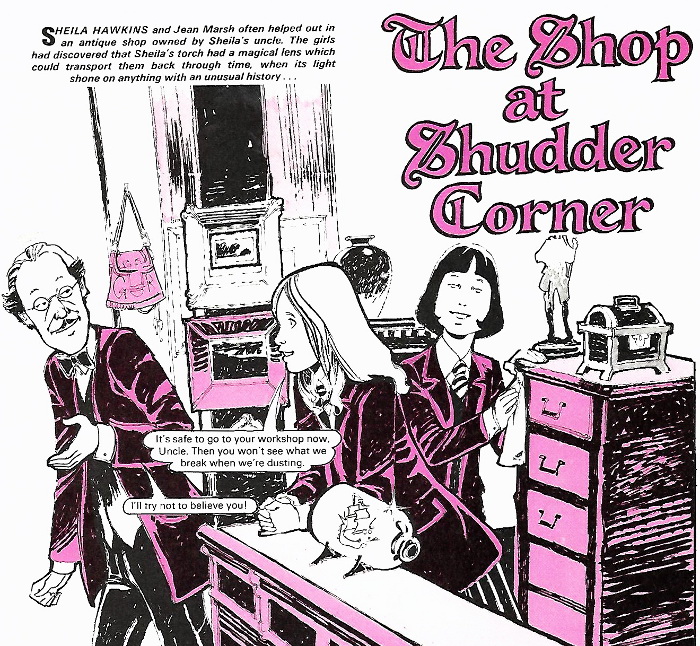
This serial was originally from Spellbound. Sheila Hawkins helps out at her Uncle’s antique shop along with her friend Jean Marsh. Sheila has a mysterious lens in her torch that can take them to the past, when they shine it on an object with an unusual history. Shining the torch on an old broach takes them into 17th century London. They arrive in front of a man on a horse, which nearly knocks him off. He chases them and they hide in a shop. Soon Sir John the man who was chasing them enters but not for the girls he is there to meet with the alchemist. There is mention of devil’s work and he is given a key. The girls are found by the two men and they take them with them so they can unlock a door that may be dangerous.

When they get to the secret building, the girls notice the carving on the door matches the cameo. Sir John wants the girls to throw out the book inside the room to him. They sense the book is evil  and Sheila decides to burn it. The two men rush into stop her and the shadow guardian catches the men, the girls manage to escape back home just in time.

The art by Matysiak is great as always, particularly with the Shadow guardian panels. The story itself is good, both girls have distinct personalities, Jean being less eager to explore and more cautious than Sheila. The method of time travelling seems overly complicated; a special lens in a torch, that has to shine on particular object in a particular shop to allow them to travel… but even with that, it’s still an interesting story.

shop at shudder corner

Little Sis    (Pages: 26-27/ 87-88)

Art: Doris Kinnear

Maisie keeps wondering why her sister Debbie is late. Finally Debbie arrives and she gives her a birthday present. Debbie is delighted only to find the box empty. Maisie says it would have been full of chocolates if she arrived on time!

In the second story Maisie goes to the shop for some fizzy soda for Debbie, but she takes a rough route with her bike so when Debbie opens up the bottle the drink sprays all over her.

The Bionic Horse  (Pages: 30-32)

Art: Peter Davidson

When Sue’s horse, Ben was injured he was  healed by space travelers and developed some amazing powers. During a snowy winter Ben is able to take a vet up to visit a sick dog. The vet is amazed that Ben can carry both him and Sue with no trouble.  When the vet says the dog will need surgery, Ben is able to ski them down the hill and melt any snowdrifts in his way to get the dog to surgery. Again it seems that describing a person or animal with super powers as bionic is very popular in these comics!

panel_of_the_month_14

Spring-Heeled Jill    (Pages: 36-41)

Art: Tony Hudson

In Victorian London, Jillian Smith is a typist at a police station, but she also works as a secret crime fighter “Spring-heeled Jill” – a flying, leaping figure from the fog. On the way from buying a train ticket for a Sergeant,  Jill is robbed. She is puzzled as  it seems no one was near her at the time. Sergeant Drew is in a bad mood and thinks she has just been careless. When she goes to replace the ticket another woman says she’s just been robbed and again no one was around her at the time. Jill decides to investigate, she puts on her costume and stakes out the latest victim’s  house. There has been a number of burglaries recently and she thinks the two things may be connected, using stolen keys to break into the houses. Jill discovers that it is a monkey doing the thefts.  His owner is a fake postman who burgles places during the day rather than night.

spring heeled

A Victorian costumed hero, is an interesting idea, although I don’t think her costume seems fitting for the time period. The art is fine mostly, I think Jill looks better when she’s in her normal clothes rather than her costume. Jill doesn’t have a lot of action, instead she seems to concentrate on detective work. Her leaping out of the fog seems to inspire fear and she sticks to the shadows rather than physically tackle someone…at least in this story. I presume this was an on going story in Debbie and I don’t know if there was an explanation given to where the costume comes from and how she can fly and leap. I presume the “Spring-Heeled” of the title means something in her shoes allow her to launch her self for great leaps, she seems to have some clawed gloves that must allow her to grip onto buildings and the such.  Also although her secret identity is said to be “Spring-Heeled Jill”  in the opening caption box, she is called the Fog Leaper by people in the story (which would make more sense than having your first name in your secret identity). Interestingly she is actually a female version of another D.C. Thomson character “Spring-Heeled Jackson” of Hornet and Hotspur. Jackson was a clerk rather than a typist at the police station and I think he had more physical action, but it could be  intriguing to compare the two. Even with her being a copy of another character, I think Jill is potentially an interesting character, especially being a female hero for that time period, but this particular story could have been better told (especially as this is my introduction to the serial).

Sally Supersneeze    (Pages: 44-45)

Sally Smith has super strong sneezes that can cause trouble, like when she sneezes and blows her netball uniform off the the clothes line into the mud. But they sometimes can be a  help. When she is tripped over by opposing team during a netball game, dust goes up her nose and she sneezes causing the ball to go in the net and win the game

Garden of Glass    (Pages: 53-57)

Art: David Matysiak

A Damian Darke story (i.e. a spooky storyteller story). Firstly I love the art and colours in Debbie 1984 glass gardenthis story and the panel layout (there is some nice use of long narrow panels).

Damian introduces the story talking about glass paperweights. We see two school girls are helping to tidy an old woman, Mrs Brownlee’s house for a community contribution project.  Sharon stops to admire a paperweight. Mrs Brownlee tells her each flower inside the glass has a beautiful face.  Sharon thinks she’s crazy but on a closer look she sees the faces. Afterwards on their way to school it is obvious that Sharon doesn’t share her friend’s enthusiasm with helping the neighbourhood. At the next visit, her  friend can’t come, so Sharon goes alone but she finds Mrs Brownlee’s supposedly house empty. Sharon takes the opportunity to steal the paperweight.  In bed that night she is admiring the paperweight when she finds herself surrounded by flowers. She finds it very beautiful at first, but then starts to panic when she finds it is not a dream. She is trapped inside the paperweight.

The next day Mrs Brownlee comes to visit and ask’s Sharon’s younger sister Beth for the paperweight. Before she leaves she admires Beth telling her she has a pretty face like a flower. Damian Drake concludes the story saying that he hopes Sharon’s little sister never goes to Mrs. Brownlee’s house.

While there are many stories where selfish girls get their comeuppance for being greedy etc. I like that Mrs. Brownlee is not some justice seeking old woman but actually seems to lack morals.  Beth seems perfectly nice but she wouldn’t have any doubts about adding her to her pretty collection of faces.

Trendy Wendy     (Pages: 60-61 / 90-91)

Another humour strip, Wendy is a girl concerned with keeping up to date with all current trends and often starts new trends herself. In the first story she has a problem that her new hairstyle will be ruined by the rain. So she tries to fond a suitable hat to cover it up.  She tries on such hats as her aunt Ethel’s old wedding hat and her granddad’s old bowler hat but it’s too big. Eventually with a bit of customising she uses the roof of an old doll’s house.

trendy wendy

In the second story Wendy decides to learn to ski after hearing its trendy sport now. She keeps embarrassing herself on the artificial slope and she thinks all she needs to do is practice on real snow. Of course that goes worse for her. In the end she invents a new way to ski by tying a chair to the skis and skiing while sitting down.

A Boy and his Dog!   (Pages: 76-78)

Art: Tony Hudson

Julie Harris is training to become a qualified Animal Nursing auxiliary. One day a puppy that was ill treated by some boys is brought into the hospital.  His owner a young boy, Alan, also got roughed up rescuing him and wants to stay with the puppy.  They are able to help Billy but the puppy is nervous and jumpy after the incident.  Julie comes up with a plan so it looks like a fierce dog is attacking Alan and Billy can defend him. Of course the dog attacking is really anig softies but the plan works (altough I wouldn’t think that would be the best method in real life!).

The Lady Maria    (Pages: 92 -96)

Art: Norman Lee

In Rome, a young craftsman, Carlo,  is commissioned to make a cameo broach of a Count’s fiancée. He admires the photo of Lady Maria while he works and he falls in love with her beauty. Carlo longs to see Maria and her wedding day he hopes to catch a glimpse of her, but she has fallen ill and the wedding is off. She recovers from her illness but is left horribly scarred from it. When the Count sees her, he declares he could never marry her now. Maria gives him back the cameo brooch and Carlo sees him drop it. He picks it up and plans to return it to Maria but is drafted into the army before he gets the chance.

Eventually he returns from the war and tracks down Maria, who’s wealth has diminished since her father’s death. When Carlo approaches her she dismisses him at first but is surprised when he returns the next day, as usually one look at her face is enough for most people. He continues to visit her and he explains how when he carved the broach he saw her true nature and he fell in love with her inner beauty. Even with her scarred face he still sees that beauty and Maria agrees to marry him.

Polly’s Patches     (Pages: 104-106)

Art: Tony Speer

Polly has a special pair of jeans with various patches on it. By rubbing a patch she is brought back in time to where the material originated from. In this story while cleaning off water that was splashed onto her, she accidentally rubs a patch and ends up on a Roman ship. The ship is being rowed by Celts that were taken as slaves by the Romans. Polly decides she must free them she manages to knock out a guard and goes to look for something to cut their chains. The rest of the Romans are Busy engaged in battle with a Carthigian ship. Finding some animal fat, Polly greases the slaves wrist so they can slip from their manacles. Then use a mallet to smash their ankle chains. Once freed, the slaves manage to overpower the Romans and Cartigians. Polly notices a Welsh flag with one of the prisoners and realises that’s where her patch came from. The Carthigian’s also have Welsh slaves, Polly tells them she’ll soon have them free they tell her to take the keys from the guard, she realises she could have also done that on the Roman ship!

pollys patches

Like Shudder Corner this is another time-travelling story involving unusual methods. It is a fun story and has a more fun, adventure tone than Shudder Corner’s creepy and somewhat darker tone.

A Girl Like Betsy…    (Pages: 114 -118)

Art: George Martin

Madame Marlova a famous ballet teacher is inspired by her class and a clumsy girl Sally to tell the story of another plump girl Betsy. Betsy really wanted to be in the annual show as her parents say they won’t waste any more money on lessons if she doesn’t make it into the show. Marlova has the idea that she can play the part of a cat as she won’t have to dance on point. During rehearsal Betsy keeps knocking over the other dancers, so Marlova decides to have a sung chorus in the ballet, so Betsy can sit on the fence and miaow with the violins. At the show Betsy does great with her miaowing until she falls off the fence, she gets up and finishes the chorus but is quite upset about it afterwords.  Two critics come back stage to meet the “ham-footed, fat little cat”  and Betsy tired of being mocked all the time runs away and trips on the stairs, hurting her ankle.

betsy

In the present time, Sally thinks that it’s a miserable ending for Betsy and that she will also stay a clumsy nobody like Betsy. But Marlova shows her the cover of a magazine with Betsy now Bettina Bracken a famous opera singer. It turns out one of the critics thought Betsy could be a good contralto and he got her a musical scholarship. Sally tries to sing and the girls comment that her singing is worse than her dancing. Madame Marlova speaks to the reader saying Sally may not become a singer or a dancer but she may become a comedian or actress.

In some ways this story seems to have some mixed messages, it is nice that just because a student doesn’t excel in ballet that doesn’t mean they have other talents. But on the other hand none of the other students and Marlova herself have no problem in calling Betsy and Sally fat and awkward, which isn’t going to build up their confidences! Also while Marlova comes across as helpful and wise, a cynical side of me thinks encouraging girls to stay in her class that will never have dancing talent is a bit wrong, especially as I’m sure the classes aren’t cheap! Of course maybe she believes that there is other things that the students will gain from the class even if they don’t become ballerinas. The art is quite good, I like that the older and younger Marlova are still recognisable as the same person.

Trixie’s Treasure Chest     (Pages: 123-125)

Art: Robert MacGillivray

Trixie Robbins has an old chest that used to belong to her grandfather and is full of magical objects . This was a long running and popular Debbie story. It’s a lot of fun and MacGillivray’s art suits it perfectly. In this story she finds an umbrella that rains when you open it. After getting soaked on this discovery she thinks it is a useless object. She changes her mind when she finds it very helpful during the day. Including getting rid of an annoying visitor, stopping a boy scaring a cat, putting out an fire and using it for an unusual side show for the fete.

trixie's treasure chest

Bunty Annual 1961

Picture Stories

  • Cinderella of the Orphanage  (Pages: 7-14) [Artist: George Ramsbottom]
  • The Four Marys (Pages: 22-27) [Artist: James Walker]
  • Moira Kent (Pages: 34-43) [Artist: Ron Smith]
  • Katy O’Connor (Pages: 54-59) [Artist: Ron Forbes?]
  • The Unwanted Flower Girl (Pages: 66-69)
  • Mary Had a Little Ram (Pages: 70-73)
  • Get Your Skates On, Rosie! (Pages: 76-80)
  • Elvirita (Pages: 86-87)
  • The Pink Piano (Pages: 93-97)
  • Lonely Lena (Pages: 102-106)
  • Jeannie and her Genie (Pages: 107-108)
  • Jackie the Joker (Pages: 113-117) [Artist: Doris Kinnear]
  • Hilda’s Hotch-Potch Pup (Pages: 121-124) [Artist: George Martin]

Features

  • The Songs We Sing At Christmas (Pages: 2-3)
  • Anna Pavlova  (Pages: 15-16)
  • Hair Styles  (Page: 21)
  • Spirit of the Ballet  (Page: 33)
  • Countryside Calendar (Pages: 45-48) [Writer: Alison Christie Fitt]
  • How To Make It  (Page: 52)
  • Wedding Belles  (Page: 53)
  • Amy, Wonderful Amy  (Pages: 60-61)
  • The Stately Swan  (Page: 65)
  • Flowers From?  (Pages: 74-75)
  • Your Hat Through the Tears  (Pages: 118-119)
  • Gipsum Davy (Page: 120)

Text Stories

  • The Girl with the Bing-Bang Bob (Pages: 17-19)
  • Greetings from Santa Sinclair (Pages: 30-32)
  • Miss Fix-It of TV  (Pages: 49-51)
  • The Swans of Sleepy Hollow (Pages: 62-64)
  • Susan of Sunnysides  (Pages: 82-85)
  • Margie and her Melodies (Pages: 88-92)
  • Mice Among the Pots (Pages: 98-101)
  • Kitty of Copperdowne  (Pages: 109-112)

Funny Strips

  • A Poser for Hetty (Page: 19)
  • Toots (Page: 28) [Artist: Bill Ritchie]
  • Babalu  (Page: 31)
  • Hetty (Page: 44)
  • Bonny and her Baby Brother (Page: 63)
  • Pert Gert (Page: 81)
  • Tiny Tina (Page: 90)
  • Little Lulu (Page: 100)
  • Little Miss Moffat (Page: 110)

Bunty Annual 1990

Picture Stories

  • Sister Susie (Pages: 6-15) [Artist: Matias Alonso]
  • Bonnie and Claude (Pages: 17-24) [Artist: Andy Tew]
  • The Wilde Bunch (Pages: 26-32)
  • The Necklace (Pages: 33-44) [Artist: David Matysiak]
  • School’s Out! (Pages: 49-58) [Artist: Terry Aspin]
  • Life in Bunty (Pages: 59-61)
  • Toots (Page: 64) [Artist: Bill Ritchie]
  • Bike Rider (Pages: 65-69) [Artist: Andy Tew]
  • The Four Marys (Pages: 71-80) [Artist: Jim Eldridge]
  • Haggis (Pages: 93)
  • Life With Bunty (Pages: 94-95) [Artist: Doris Kinnear]
  • No Time for Terri (Pages: 97-104) [Artist: Douglas Perry]
  • Bringing Up the Barkers! (Pages: 106-112) [Artist: Andy Tew]
  • Dream Pony (Pages: 113-120) [Artist: Edmond Ripoll]

Photo Stories

  • Ever Had That Shrinking Feeling? (Pages: 81-92)

Features

  • Top Popstrels [Posters] (Pages: 16, 48, 70, 121)
  • Pop the Question (Page: 25)
  • Alton Towers (Pages: 45-47)
  • “As We Were Saying…!” (Pages: 62-63)
  • A Right Royal Crossword (Pages: 96)
  • Lets All Go to Sandy City! (Page: 105)
  • A Photo Story is Born (Pages: 122-123)
  • Design a Fashion (Pages: 124-125)

(Click on thumbnails for bigger picture)

Bunty/ Life with Bunty/Bunty – A Girl Like You

  • Bunty –  Bunty: #01 (18 January 1958) – #1550 (26 September 1987)
  • Life With Bunty –  Bunty:  #1551 (03 Oct 1987) – #1657 (14 Oct 1989)
  • Bunty – A Girl Like You–  Bunty:  #1658 (21 Oct  1989) – ?
  • Art: Doris Kinnear (1958-1987), Andy Tew (1988-2000)

Plot/Thoughts

While a few girl comics had general names like School Friend or Spellbound, the most common thing for the titles was  to be named after girls, i.e. Bunty, Judy, Tracy, Emma, Tammy, Sally  etc. Bunty isn’t the most common girls name, particularly these days,  so I think the name is more likely to bring up memories of the comic than a person. Bunty was represented  by a girl of the same name in the comic. For the majority of the Bunty publication she was the first thing you saw on the covers, but even after revamps, she still  survived  by moving inside the issues and having a comic strip.

The first issue of Bunty had two girls featured on the cover a blonde and a curly black haired girl (the cover art for issue 1 by Doris Kinnear who continued to draw the covers for many years). The emphasis was more on the fact that this was a brand new comic with free gift rather than any cover character. The second issue again emphasized the free gift more than the Bunty character but it was now clear that the blonde girl was the comic’s namesake.

By Issue 3 the cover was dedicated to a Bunty comic strip. It was usually laid out with three small panels and one big panel for the pay off. There was no word balloons instead the story was told in short rhymes.  Sometimes competitions or advertised free gifts would take over the front cover but otherwise this format stayed for over 1500 issues, after which the cover had pictures depicting stories inside the comic instead.

Bunty started off as young girl with long blonde hair in plaits, later her image was updated, with a new shorter haircut. The other regular characters were her two parents, who would often be exasperated with her, in the early covers, she also had an older dark haired sister. She disappeared later, perhaps old enough to move away or just simply forgotten about! Sometimes friends would pop up but mostly just as when it was convenient to the plot.

When the covers started to portray stories from inside the book. Bunty was moved to the back cover, so usually a full colour strip. Although sometimes if an advertisement or Design a Fashion was on the back cover the strip was inside and in black and white, The strip was named Life with Bunty. Her hair was short and curly and now it was a longer strip more of a story and more dialogue with word balloons, no more rhyming captions. It was still wrote as a humour strip.

This only lasted a 100 or so issues, then Bunty got revamped again. With issue 1658, the comic was now being printed  on glossy paper and inside a lot more fully coloured strips appeared. The Bunty strip was renamed again; as Bunty-A Girl Like You. I believe a regular artist for this was Andy Tew. Again Bunty got a new hairstyle to depict the change, this is even commented on on the first strip.

Her parents were still there and still recognizable as their earlier counterparts. Two more regulars were added; friends Lisa and Jo and they became a permanent trio. Jo was a black curly haired girl (I wonder if she was a nod to that black curly haired girl that appeared on the first issue!) and Lisa a red head. Often these strips concentrated on Bunty’s crush of the week, or fashion, so it was a lot more teen aimed than earlier strips. Bunty as a humour strip of a teenage girl also seemed to replace the younger Toots model. Later the srips were re-printed under Girl Zone banner.

Its good to see the comics namesake survived throughout the years and the character of Bunty was a memorable one.

Other Appearances

Annual Appearances

  • A Bite for Bunty – Bunty Annual 1969 [Artist: Doris Kinnear]
  • Life with Bunty – Bunty Annual 1989 [Artist: Doris Kinnear]
  • Life with Bunty – Bunty Annual 1990 [Artist: Doris Kinnear]
  • Bunty- A Girl Like You (x2) – Bunty Annual 1990 [Artist: Andy Tew]
  • Bunty- A Girl Like You (x2) – Bunty Annual 1991 [Artist: Andy Tew]
  • Bunty- A Girl Like You (x2) – Bunty Annual 1992 [Artist: Andy Tew]
  • Bunty- A Girl Like You (x2) – Bunty Annual 1993 [Artist: Andy Tew]
  • Bunty- A Girl Like You (x2) – Bunty Annual 1994 [Artist: Andy Tew]
  • Bunty- A Girl Like You – Bunty Annual 1995 [Artist: Andy Tew]
  • Bunty- A Girl Like You (x2) – Bunty Annual 1996 [Artist: Andy Tew]
  • Bunty- A Girl Like You (x2) – Bunty Annual 1997 [Artist: Andy Tew]
  • Bunty- A Girl Like You (x2) – Bunty Annual 1998 [Artist: Andy Tew]
  • Bunty- A Girl Like You (x2) – Bunty Annual 1999 [Artist: Andy Tew]

Summer Specials

  • Life with Bunty – Bunty Summer Special 1988 [Art: Doris Kinnear]
  • Life with Bunty – Bunty Summer Special 1989 [Art: Doris Kinnear]
  • Bunty – a Girl Like You – Bunty Summer Special 1988 [Art: Andy Tew]
  • Bunty – a Girl Like You – Bunty Summer Special 1991 [Art: Andy Tew]
  • Bunty – a Girl Like You – Bunty Summer Special 1992 [Art: Andy Tew]
  • Bunty – a Girl Like You – Bunty Summer Special 1993 [Art: Andy Tew]
    • Reprinted as Girl Zone – Bunty Holiday Special 2003
  • Bunty – a Girl Like You – Bunty Summer Special 1994 [Art: Andy Tew]
  • Bunty – a Girl Like You – Bunty Summer Special 1995 [Art: Andy Tew]
    • Reprinted as Girl Zone – Bunty Holiday Special 2001
  • Bunty – a Girl Like You – Bunty Summer Special 1996 [Art: Andy Tew]
    • Reprinted as Girl Zone – Bunty Holiday Special 2004
  • Bunty – a Girl Like You – Bunty Summer Special 1997 [Art: Andy Tew]
  • Bunty – a Girl Like You – Bunty Holiday Special 1998 [Art: Andy Tew]
  • Girl Zone – Bunty Holiday Special 2002 [Art: Andy Tew]

Debbie and Maisie

Plot

The stories of cover girl Debbie and her troublesome little sister Maisie.

debbie-and-maisie

Notes

  • Art: Doris Kinnear

Appeared

  • Debbie and Maisie – First Appearance – Debbie: #186 (4 September 1976)

Other Appearances:

  • Little Sis (x2) – Debbie Annual 1980
  • Little Sis (x2) – Debbie Annual 1981
  • Little Sis (x2) – Debbie Annual 1982
  • Little Sis (x2) – Debbie Annual 1983
  • Little Sis (x2) – Debbie Annual 1984