Tag Archives: Pamela Chapeau

Mandy Annual 1987

Picture Stories

  • The Guardian Tree (Pages: 4-16) [Art: Hugh Thornton-Jones]
  • Atlanta’s Tale (Pages: 19-23) [Art: Tom Hurst]
  • The Delemere Diamonds (Pages: 24-31) [Art: David Matysiak]
  • Mother Martin’s Recipe (Pages: 35-42) [Art: Guy Peeters]
  • Angie’s Angel (Pages: 43-48) [Art: Wilf Street]
  • Emma’s Umbrella (Pages: 49-53) [Art: Norman Lee]
  • To Tell the Truth.. (Pages: 54-63) [Art: Ron Lumsden]
  • Lucky & Co, Detectives (Pages: 67-75) [Art: Robert MacGillivray]
  • Petra and the Pearl of Power (Pages: 76-80) [Art: Jim Eldridge]
  • Valda and the Elephants of Destiny (Pages: 82-95) [Art: Dudley Wynne]
  • Lucy’s Loving Cake (Pages: 97-102) [Art: Richard Neillands]
  • A Prize for Poppy (Pages: 104-112)
  • No Rest for Rosie (Pages: 114-118) [Art: Pamela Chapeau]
  • Bootle (Pages: 119-125) [Art: Andrew Wilson]

Text Stories

  • Midsummer’s Day (Pages: 17-18)
  • Summer of Beauty (Pages: 32-34) [Art: Claude Berridge?]
  • The Loser’s Smile (Pages: 64-66) [Art: George Martin]

Features

  • Fine Feathers (Pages: 81 and 96)
  • Christmas Puzzles (Page 103)
  • My Rainbow (Page 113)
  • In the Wild! (Pages: 126-127)


* Thanks to Goof for information and cover picture

Diana 1965

Picture Stories

  • Jane Model Miss (Pages: 6-11)  [Art: Pamela Chapeau]
  • Dixie and the Good Deed (Pages: 15-20)  [Art: George Martin]
  • Nursing with Norma (Pages: 27-31)
  • Susan and the Sea Stars (Pages: 55-58) [Art: Don Walker]
  • The Twisted Racquet (Pages: 62-65)
  • When Unbeatable Brenda Met Goal-Getter Gertie (Pages: 67-70)
  • The Silent One (Pages: 71-75) [Art: John Burns]
  • Little Amy’s Secret Weapon (Pages: 80-81, 84-86)
  • A Skating Adventure with Yum-Yum (Pages: 87-92) [Art: Giorgio Letteri]
  • The Cat and the King (Pages: 107-110)
  • A Lucky Day for Delia (Pages: 117-121)

Text Stories

  • Dancing with Dianne (Pages: 45-48)
  • Angela and the Pantomime Princess (Pages: 97-99, 101-103) [Art: Don Walker]
  • Along Came a Spider! (Pages: 114-115)

Features

  • Every Song has a Story (Pages: 2-3, 126-127)
  • Five Little Animals (Pages:4)
  • Heads for the Tammy! (Pages: 12-13)
  • Four for Fashion (Pages: 14)
  • Getting to Know Ballet – Questions and Quotations (Pages: 21)
  • The Chinese Ballet (Pages: 22-23)
  • Ballet on Tour (Pages: 24-25)
  • Background to the Ballet (Pages: 26)
  • Getting to Know Famous Nurses – Brave Nurses in War and Peace (Pages: 32)
  • The Satisfaction of Being a District Nurse (Pages: 33-34)
  • Training a Pony (Pages: 35-42)
  • Over the Jumps (Pages: 43)
  • Ponies of Britain (Pages: 44)
  • Getting to Know Dances- The Dancing Hands (Pages: 49)
  • Getting to Know Dances- The Dance of the Gypsy Guitar (Pages: 50)
  • Dressed to Dance (Pages: 51)
  • Invitation to Dance (Pages: 52-53)
  • Dancing Puzzle Page (Pages: 54)
  • King of the Big Waves (Pages: 59)
  • Riders on White Horses (Pages: 60-61)
  • Down the Slippery Slope (Pages: 66)
  • The Shy Champion (Pages: 76)
  • Pen and Ink (Pages: 77)
  • Royal Gardens Seeing’s Believing (Pages: 78-79)
  • Like Mother – Like Daughter (Pages: 82-83)
  • Chimps with Everything (Pages: 93)
  • Starlet Corner (Pages: 94-95)
  • Acrobats on Ice (Pages: 96)
  • Acting in the Open Air (Pages: 100)
  • The Great Drama on the Hill (Pages: 104-105)
  • Anything You Can Do We Can Do Better! (Pages: 106)
  • Find the Foe (Pages: 111)
  • Alive-Alive-Oh! (Pages: 112-113)
  • The Story of the Bird in the Hand (Pages: 116)
  • Musical Mistakes (Pages: 122-123)
  • The Wonderful Life of Handel (Pages: 124-125)

(Click on thumbnails for bigger pictures)

Debbie 1983

Picture Stories

  • Mary Brown’s Schooldays (Pages: 4-8) [Art: Pamela Chapeau]
  • Trixie’s Treasure Chest (Pages: 17-21) [Art: Robert MacGillivray]
  • Meg of the Moors (Pages: 24-28) [Art: David Matysiak]
  • Little Sis (Pages: 29-30) [Art: Doris Kinnear]
  • Bionic Horse (Pages: 36-40) [Art: Peter Davidson?]
  • Girl Talk (Pages: 42)
  • Spring-Heeled Jill (Pages: 43-48) [Art: Tony Hudson]
  • The House of Hate [Damian Darke story] (Pages: 54-58) [Art: Norman Lee]
  • Trendy Wendy (Pages: 59-61)
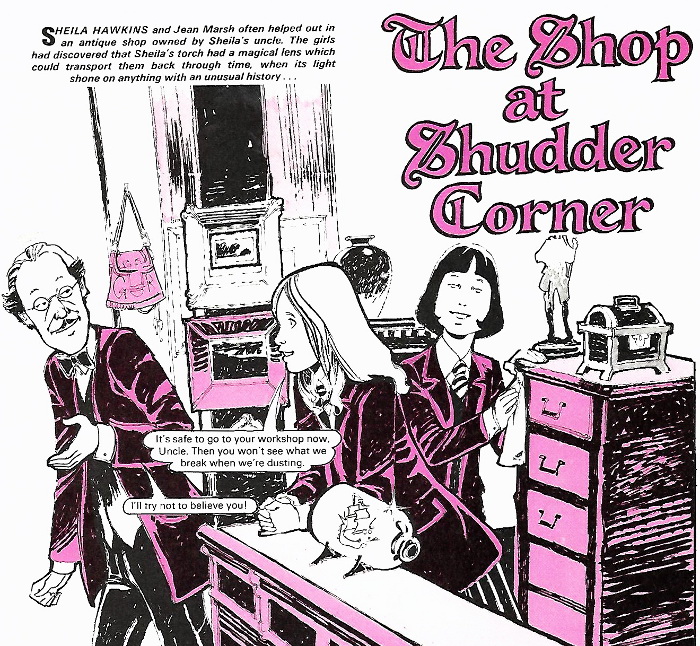
  • The Shop at Shudder Corner (Pages: 68-70) [Art: David Matysiak]
  • Animal Nurse (Pages: 71-74) [Art: Pamela Chapeau]
  • Oh, Brother! (Pages: 81-84) [Art; George Martin]
  • Cactus Kate (Pages: 88-91) [Art: Jim Eldridge]
  • Little Sis (Pages: 99-100) [Art: Doris Kinnear]
  • Girl Talk (Pages: 102)
  • She Danced in Dockland [Madame Marlova story] (Pages: 103-107) [Art: George Martin]
  • Jo and Mo (Pages: 108-112) [Art: Tom Hurst]
  • Trendy Wendy (Pages: 117-119)

Text Stories

  • The Record Run (Pages: 9-10)
  • Gran’s Old Gramophone (Pages: 41-42)
  • Lonely! (Pages: 101-102)

Photo Stories

  • Bright Eyes (Pages: 11-15)
  • Never a Borrower… (Pages: 31-35)
  • Jane at St Jude’s (Pages: 94-98)
  • The Writing in the Sand (Pages: 120-125)

Features

  • Debbie Superpets (Pages: 16)
  • Teazer Time (Pages: 22-23)
  • Debbie Superpets (Pages: 49)
  • Child’s Play (Pages: 50-53)
  • Are You Superstitious? (Pages: 62-64)
  • Tis Sal the Tiswas Gal! (Pages: 65-67)
  • Liz Sharman White Water Champion (Pages: 75-77)
  • What’s Cooking? (Pages: 78-79)
  • Debbie Superpets (Pages: 80)
  • Band Together for French Skipping! (Pages: 85-87)
  • Teazer Time (Pages: 92-93)
  • Debbie Superpets (Pages: 113)
  • Just Great Being a Jockey (Pages: 114-116)

(Click on thumbnails for bigger pictures)

Debbie 1982

Picture Stories

  • Mary Brown’s Schooldays (Pages: 4-9)  [Art: Pamela Chapeau]
  • The Black Tulip (Pages: 12-15)
  • Trixie’s Treasure Chest (Pages: 25-29) [Art: Robert MacGillivray]
  • The Shop at Shudder Corner (Pages: 30-32) [Art: David Matysiak]
  • Little Sis (Pages: 33-34) [Art: Doris Kinnear]
  • The Boy Who Loved Ballet (Marlova) (Pages: 35-39) [Art: Tom Hurst]
  • The Black Tulip Part 2 (Pages: 50-53)
  • All Because of Perky… (Pages: 56- 61)  [Art: Pamela Chapeau]
  • The Puppet Theatre (Damian Darke) (Pages: 63-68) [Art: Norman Lee]
  • Spring-Heeled Jill (Pages: 71-73) [Art: Tony Hudson]
  • The Black Tulip Part 3 (Pages: 76-79)
  • Little Sis (Pages: 87-88) [Art: Doris Kinnear]
  • The Bionic Horse (Pages: 89-94) [Art: Peter Davidson?]
  • My Pal Lou (Pages: 97-101)
  • A Precious Gift (Pages: 104-106)
  • The Black Tulip Part 4 (Pages: 117-120)
  • Lovely to Look at… (Pages: 121-125) [Art: David Matysiak]

Text Stories

  • A Gift of Friendship (Pages: 10-11)
  • When the Snow was Round About. Deep & Crisp & Even…. (Pages: 54-55)
  • Meg of the Moors (Pages: 69-70)
  • Nature’s Own Special Magic (Pages: 95-96)

Photo Stories

  • A Summer Place (Pages: 17-22)
  • My Friend Flappers (Pages: 42-48)
  • Harriet (Pages: 82-86)
  • Unlucky 13 (Pages: 108-112)

Features

  • Debbie Superpets (Pages: 16)
  • Dolly Mixtures (Pages: 23-24)
  • Are You a Good Friend? (Pages: 40-41)
  • Debbie Superpets (Pages: 49)
  • Ribbons and Bows (Pages: 62)
  • What a Spread! (Pages: 74-75)
  • Debbie Superpets (Pages: 80)
  • Teaser Time (Pages: 81)
  • Are You a Party Girl? (Pages: 102-103)
  • Teaser Time (Pages: 107)
  • Debbie Superpets (Pages: 113)

(Click on thumbnails for bigger pictures)

Debbie 1981

Picture Stories

  • The Ice Roses (Pages: 4-8) [Art: David Matysiak]
  • My Pal Lou (Pages: 11-15)
  • Trixie’s Treasure Chest (Pages: 17-21) [Art: Robert MacGillivray]
  • Cat’s Eye Cottage (Pages: 22-24) [Art: Jordi Badia Romero?]
    • Reprinted and translated into Dutch as “Huize Katte-oog” and published in Groot Tina Winterboek 4/1980 (1980)
  • Little Miss Featherfeet (Pages: 33-37) [Art: George Martin]
  • Spooky Towers for Ghost and Glamours (Pages: 40-43)
  • Little Sis (Pages: 45-46) [Art: Doris Kinnear]
  • Meg of the Moors (Pages: 50-54) [Art: “B Jackson”]
  • Mary Brown’s Schooldays (Pages: 57-62) [Art: Pamela Chapeau]
  • Picture, Picture on the Wall… (Damian Darke) (Pages: 65-69) [Art: Norman Lee]
  • Stella From the Stars (Pages: 82-87) [Art: Tom Hurst]
  • The Bionic Horse (Pages: 88-92) [Art: Peter Davidson?]
  • A Bowl of Broth (Pages: 94-96) [Art: George Martin]
  • Jo and Mo (Pages: 97-101) [Art: Tom Hurst]
  • The Shop at Shudder Corner (Pages: 108-112) [Art: David Matysiak]
  • Little Sis (Pages: 113-114) [Art: Doris Kinnear]
  • It Hurts to Say Goodbye (Pages: 120-125) [Art: Tony Hudson]

Text Stories

  • The Spirit of Christmas (Pages: 30-31) [Spot Art: David Matysiak]
  • The Happiest Christmas Ever (Pages: 63-64)
  • The Little White Flower (Pages: 70-71)
  • No Sympathy for Sandie… (Pages: 116-117)

Photo Stories

  • Don’t Laugh at Suzi (Pages: 25-29)
  • Lonely Carol (Pages: 103-107)

Features

  • Poems (Pages: 2-3, 126-127)
  • A Vet’s Best Friend.. (Pages: 9-10)
  • Debbie Superpets (Pages: 16)
  • Teaser Time (Pages: 32)
  • Are You the Practical Type? (Pages: 38-39)
  • What’s Cooking? (Pages: 44)
  • It’s Top of the Pops! (Pages: 47-48)
  • Debbie Superpets (Pages: 49)
  • Girls in Uniform – A Fair Cop! (Pages: 55-56)
  • Saffy and the Puppies (Pages: 72-77)
  • Girls in Uniform – Jenny Wren! (Pages: 78-79)
  • Debbie Superpets (Pages: 80)
  • Teaser Time (Pages: 81)
  • What’s Cooking? (Pages: 93)
  • Teaser Time (Pages: 102)
  • Debbie Superpets (Pages: 115)
  • Girls in Uniform – Jaguar Girl (Pages: 118-119)

(Click on thumbnails for bigger pictures)

Debbie 1980

Picture Stories

  • Mary Brown’s Schooldays (Pages: 4-9) [Art: Pamela Chapeau]
  • The Night Before Christmas (Damian Darke) (Pages: 12-16) [Art: Norman Lee]
  • Skip ‘n’ Rope (Pages: 19-23)
  • Meg of the Moors (Pages: 26-30) [Art: “B Jackson”]
  • Little Sis (Pages: 41-42) [Art: Doris Kinnear]
  • Jo and Mo (Pages: 43-47) [Art: Tom Hurst]
  • The House That Cared (Pages: 50-54) [Art: Jordi Badia Romero?]
  • My Pal Lou (Pages: 57-61)
  • Little Miss Featherfeet (Pages: 64-68) [Art: George Martin}
  • If You Can Help Somebody… (Pages: 72-76)[Art: Carmen Barbara]
  • Little Sis (Pages: 79-80) [Art: Doris Kinnear]
  • Trixie’s Treasure Chest (Pages: 83-87) [Art: Robert MacGillivray]
  • The Bionic Horse (Pages: 90-94)  [Art: Peter Davidson?]
  • The Flower Princess (Pages: 97-99)
    • Reprinted and translated into Dutch (as “De bloemenprinses”) – monthly Debbie Stripstory #4/1980.
  • Polly’s Patches (Pages: 102-104) [Art: Tony Speer]
  • London’s Burning! (Pages: 113-117) [Art: David Matysiak]
  • Swan Song (Pages: 120-125) [Art: Tony Hudson]
    • Reprinted and translated into Dutch as “Zwanezang” –  Groot Tina Lenteboek #1/1981 (1981).

Text Stories

  • The Silver Locket (Abigail’s Tale-1666)  (Pages: 17-18)
  • The Silver Locket (Morag’s Tale-1746)  (Pages: 39-40)
  • …A  Poor Church Mouse… (Pages: 70-71)
  • The Silver Locket (Alice’s Tale-1840)  (Pages: 81-82)
  • The Silver Locket (May’s Tale-1912)  (Pages: 95-96)
  • The Silver Locket (Jane’s Tale-1979)  (Pages: 105-106)
  • Goodbye, Lonliness (Pages: 118-119)

Photo Stories

  • The Wishing Well (Pages: 33-37)
  • The Forbidden Garden (Pages: 107-111)

Features

  • Autumn Poem (Pages: 2-3)
  • Herbs Can Grow On You! (Pages: 10-11)
  • Stepping Out to Stardom (Pages: 24-25)
  • Accidents Will Happen (Pages: 31-32)
  • Superpets (Pages: 38)
  • Teaser Time (Pages: 48)
  • Superpets (Pages: 49)
  • Fabulous Falabellas! (Pages: 55-56)
  • Room for Improvement (Pages: 62-63)
  • Superpets (Pages: 69)
  • These Legs were Meant for Dancing! (Pages: 77-78)
  • Jim Fixed It! (Pages: 88-89)
  • It’s a Knock-Out! (Pages: 100-101)
  • Teaser Time (Pages: 112)
  • Spring Poem (Pages: 126-127)

(Click on thumbnails for bigger pictures)

Diana Annual 1966

Picture Stories

  • The White Stag (Pages: 7-12)
  • The World Beyond (Pages: 20-25) [Art: John Burns]
  • Wendy Who? (Pages: 27-31) [Art: Mollie Higgins]
  • The Poor Miller’s Boys (Pages: 49-52)
  • The Spells of Pauline (Pages: 53-56)
  • Jane – Model Miss (Pages: 57-61)  [Art: Pamela Chapeau]
  • Mystery with Anita (Pages: 70-74)
  • Handy Mandy and Pal Val (Pages: 82-86)
  • The Eileen Joyce Story (Pages: 94-96)
  • Nursing with Norma (Pages: 107-108)

Text Stories

  • Humphrey the Story of a Donkey (Pages: 38-39)
  • Learn a Lesson From – A Pony Called Fizzle (Pages: 44-45)
  • The Lucky Lollipops (Pages: 87-90)
  • The Gondoliers (Pages: 92-93)
  • After the Long Sleep (Pages: 98-99)
  • A Million to One (Pages: 103-106)
  • The Small Men (Pages: 120-121)

Features

  • Capital Cities from the Air (Pages: 2-3,126-127)
  • Diana for Girls (Pages: 4-5)
  • Sport (Pages: 6-7)
  • Ups and Downs (Pages: 13)
  • Olympiad (Pages: 14-15)
  • Looking for a New Sport? Y’Ought to try a Yacht (Pages: 16)
  • Many Hands (Pages: 17)
  • Puzzles (Pages: 18-19)
  • Looking Forward (Pages: 26)
  • Sally the Laugh of the Ballet (Pages: 32)
  • London Dance Theatre (Pages: 33)
  • Underwater Ballet (Pages: 34-35)
  • Ballet Rambert (Pages: 36)
  • Pony Parade (Pages: 37)
  • A Horse – About the House (Pages: 40-41)
  • Pony Care (Pages: 42-43)
  • Pony Puzzle Time (Pages: 46)
  • Witches at War (Pages: 47)
  • Be My Ghost (Pages: 48)
  • Wedding Belles (Pages: 62)
  • Camera Cat (Pages: 63)
  • Hits and Misses 1900-1965 (Pages: 64)
  • Film Fashions (Pages: 65)
  • Mad-Caps (Pages: 66)
  • Going Places, Helping People (Pages: 67)
  • Big Dusty (Pages: 68-69)
  • Survival Course (Pages: 75)
  • Bali (Pages: 76)
  • Pretty as a Picture in a Cosy Polo Collar (Pages: 77)
  • Let’s Make a Picture (Pages: 78-79)
  • Cupboard Care (Pages: 80)
  • Handy Mandy’s Star Tip (Pages: 81)
  • The Language of Music (Pages: 91)
  • Home Sweet Home (Pages: 97)
  • Animal Antics (Pages: 100-101)
  • On Guard! (Pages: 102)
  • Smart Girls! (Pages: 109)
  • Home Nurse (Pages: 110)
  • The Teeny-Weeny Ones (Pages: 111)
  • Dogs’ Tales (Pages: 112)
  • Dog Stars (Pages: 113)
  • Good Show! (Pages: 114-115)
  • Pixie Goes to School (Pages: 116)
  • Pictures in the Sky (Pages: 117)
  • The Quest for the Golden Fleece (Pages: 118-119)
  • What Others Believe (Pages: 122-125)

(Click on thumbnails for bigger pictures)

Mandy 1971

mandy annual 1971This is the first Mandy annual.  Although the weekly Mandy issues started in 1967, it took a few years for the release of an annual. It has a colourful dust jacket with Mandy and her dog Patch on the front (a theme that would last up to the 1993 annual).  The very clear distinctive picture on the white background and the use of simple primary colours; the yellow on her jacket, headband and the “Mandy” title makes it an eye catching cover. The Mandy comic was a very story focused book and most of it’s annuals, particularly the early ones had very little features. This book has no features at all, just picture and text stories. So there is a lot of reading in the annual, it also has the common theme of having an extended story split up over the annual in this case  a 4 part text story (No Time to Dream) and a three part picture story (King Cat). As well as the longer stories there are classic characters, Valda, Mandy and Wonder Girl! Throughout the book there is some high quality artwork. (For just a list of contents click here)

Picture Stories

Valda     (Pages: 6-10)

Art: Rab Hamilton

A strong start to the annual with a story about popular character, Valda. Usually Valda stories focused on one of two themes, either proving herself the best at a sport or revealing secrets about a lost place.  This is a story that focuses on a sport.

Valda arrives at a tennis tournament, where the trophies are to be presented by the undefeated tennis star Jeanne Cartier nee Duval. Jeanne is surprised when she sees Valda, she says her mother must be the Valda that she faced thirty years ago just as the war broke out. Their match was never completed as the appearance of an enemy  aircraft put an end to the game. Jeanne introduces Valda to her daughter Michelle and declares she is going to carry on the family tradition and be an undefeated champion.  Both Valda and Michelle do well in the tournament, Valda observes that Jeanne pushes her daughter too hard. Valda and Michelle meet in the final round. Valda knows she can defeat her but in the end she lets her win because she knows losing will break her confidence altogether.

Again the mother mentions family tradition of being undefeated. Valda decides she must put a stop to this as Michelle won’t be able to keep this up.  Valda confronts Jeanne and shares with her the fire of life to put her at her peak again, so they can continue the game they started years ago. Valda defeats her and Jeanne learns her lesson and realises she shouldn’t put so much pressure on her daughter.

valda M71

I usually prefer Valda helping out in lost cities than stories focused on sports, but I do like this one. The art is quite pretty and even though it’s not by usual artist  Dudley Wynne, it does a good job capturing Valda. It has a ice storyline with Valda choosing to help Michelle rather then winning. It also shows a nice lesson for mother and the matches themselves are well drawn.

Captain of St. Crispin’s       (Pages: 11-13)

An unusual regular story of Mandy; Aggie Morton is the captain of St Crispin’s school, this is unusual because she is an oil millionaire, hillbilly granny from America! She is keen for the school to keep up all its old customs and is helped out by her young English relative Gwen.  Aggie wants to ring the old school bell which is rung by the school captain on special occasions. Aggie decides to send letters to queens and presidents to visit the school but on inspection the bell is unsafe.  Aggie saves a workman, who comes to look at the bell, with a lasso and gets the honour of ringing the new bell.

captain of st crispins M71

While the stereotype hillbilly played up for laughs in the story, it gets points for not being ageist. Of course we have Gwen as the young girl point of view, but it’s old Aggie who sets things in motion and saves the day.

A Miracle for Marie          (Pages: 14-16)

Art: Pamela Chapeau?

Marie lives with her grandmother in a small attic room in Marseilles. She is very sick but is happy to see a little bird visit her. Her grandmother buys her birdseed even though they really can’t afford it, but she knows Marie hasn’t long left and wants to help her last days  happy. When Marie leaves out the seed some of it falls in the gutter and a plant sprouts from it. Some time late the grandmother collapses down town and is brought home by a doctor. The doctor recognises the rare plant by Marie’s window as one from his home county that will be able to cure Marie.

miracle for marie M71

It’s a short story and is quite nice read. Of course filled with coincidences, and is something that is seen again and again with the sudden miracle cure, but when the annual first came out the story was more fresher.

There Was a Young Girl Who Lived in a Shoe     (Pages: 21-24)

In Victorian times, Bessie Shepherd lives with five orphans in a house that is shaped like a shoe. Money is tight so when a storm hits up Bessie’s quick to round up their livestock. The next day the house has taken some damage with broken windowsand no money to repair them. This is stressful for Bessie so she gets cross when she discovers a chicken is missing, as she had Jack count them. Jack apologises that he was tired when he counted them. Bessie has an outburst at Jack. He runs away and finds the missing chicken but breaks his leg. Bessie is very sorry for her outburst but can’t get through to Jack. To make it up to him she makes her last nice dress into a kite for him. Jack is sorry he let his pride in the way. While out flying the kite the squire’s son offers money to get kites made for him and his cousins, which will be enough to fix the windows.

girl who lived in shoe M71

King Cat     (Pages: 25-28, 57-60 & 97-100)

Art: Claude Berridge

This is a 3 part story told throughout the annual. Judy Pace and her kitten Sam are to stay with her Gran during the holidays. She is surprised when her Gran’s cat Ginger attacks Sam and scratches her. Her Gran tells her to stay away from cats. Later Judy takes a walk down town she notices other people being followed and threatened by cats. She comes to an old unused house but is scared off by several cats. It keeps getting stranger as Judy goes to shops to see cats have wrecked the place and stolen food. The owner doesn’t want to go to police and Judy notices she seems scared that a cat on the windowsill is listening. When she gets home Sam is missing. She figures he must be at the old house. She goes there and sneaks pass the cats only to be bizarrely confronted by a man in a cat suit, calling himself King Cat. It turns out he is a scientist/crook who has built a machine to control all the cats and now he wants to test his machine on Judy. But she manages to smash it and all the cats turn on King Cat, so Judy can go call the police.

king cat M71

The mystery of what’s happening in the town is good and the cats do seem intimidating and threatening, which is shown well by the art. The conclusion is a bit odd, it’s not really clear why King Cat is dressed up in a cat suit, though presumably he has some mental problems. It is also unclear why the people in the village never called the police to check out the old house or at least animal control!

Mandy      (Pages: 33 / 87 / 113)

Art: Peter Kay

The title character appears in 3 amusing strips, each with its common theme. The first strip Mandy is fed up of getting wet while waiting at the telephone box, but when they get a phone installed she still stands out around wet as she has to get out of the bath. Then a dog chases her not appreciating she is out collecting money to help animals. Finally visiting a museum Mandy looks at old torture methods and glad she doesn’t live there but it seems her new shoes are just as much as a torture!

mandy M71

Something Borrowed, Something Blue     (Pages: 34-40)

Art: Tony Thewenetti

Sally Durrant lives with her mother and her ambition is to become a dress designer. Sally takes some evening art classes but has to work in a shop as she can’t afford to go to college full time. There is an art school ball coming up and she buys cheap material for a dress. It was cheap because it has a stain on it so she takes it to dry cleaners  but a mix up ends up with a different dress and no time to change it before the  ball. Her mother convinces her to try on the dress it fits so she wears it. Her teacher introduces her to a man Mr Lennox he compliments her dress but she down plays it as she does not want to draw attention to herself. The next day a newspaper article shows Lady Daphne Staite in her dress. Sally is horrified that the dress she wore was an expensive House of Cleve design. She returns the dress, and Lady Daphne offers to get her an interview at the House of Cleve as she was impressed with the dress. Another shock for Sally is when she recognises owner as Mr Lennox but he promises to keep her secret that she wore the dress. and laughs that she’d called it “this old thing” at the dance.  She gets a job offer and is delighted. She brings flowers to the dry cleaners to thank them for the mix up.

something borrowed M71

I like the colours and inking in this story, it also has some funny moments. Again it’s nothing new but it has a nice pace and does its job well.

Jill- Junior Reporter    (Pages: 41-43)

Art: Robert MacGillivray

Jill Cooper is a reporter for the Daily Echo and often finds interesting stories by following up adverts in the personal column. In this story the ad is for an expedition to see Sahara cave paintings by truck. When they arrive at the caves Jill is wary of their new guide Hussan who has replaced the other guide due to sickness. She is right to be suspicious of him as he sneaks away while in the caves to steal their stuff. Jill spots him in time and leaves a trail of paper for the others to follow. She manages to stop him which is good the only down side is she is left having to piece her story back together as those were the papers she made her trail with!

jill junior reporter M71

This is a fun little adventure story. Jill is a fun resourceful character and it has a good ending, being amusing and not just ending with everything sorted.

Wendy the Winner     (Pages: 44-48)

Art: Andy Tew

Wendy Blake’s hobby is entering competitions and winning though it can cause some problems. Her father isn’t happy when she is collecting alphabet soup labels for a competition. Not only is there too much soup in the house but there is other trouble like a display gets knocked over, a can accidentally gets thrown a window and she knocks her dad over running to the post. In the meantime prizes from previous competitions arrive, a barbecue, picnic rugs, windbreak and a vacuum ice bucker. her father suffering from a cold isn’t too happy for what will they do with that in winter.  Her father perks up when she wins the soup competition and finds out the prize is central heating and double glazing for the whole house. But the catch again is the workmen have to rip up floorboards and the work will take a few days. Lucky all the summer prizes come in handy after all, as they cosy around the barbecue with blankets and soup.wendy the winner M71
Baby Went Too!     (Pages: 53-56)

Barbara Bunting had special permission to bring her baby brother to school while their mother was in hospital. Baby was making a nuisance of himself trying to help out while the girls decorated the classroom for Christmas. He causes so much problems Miss Powell says Barbara will have to keep him out of the classroom. She is disappointed she can’t help with the decorations. Then after baby’s bubble bath she gets the idea to dress him up as Santa with a sleigh. The class win as best decorated.

baby went too M71

This was a regular story in Mandy and one I never really understood. Why would having a young girl bringing a baby to school be a good solution, seems unfair on everyone involved.  Also poor Baby Bunting didn’t appear to be deserving of a name, only being referred to as Baby.  But I suppose the point was to create some drama or some laughs and not to be grounded in reality.

Friend or Foe?     (Pages: 65-71)

Art: Len Potts

Jim Dalton is a huntsman and his best Lakeland terrier died leaving  a 4 week old puppy Turk. He gave his daughter Jean the job of raising him. She isn’t to encourage him to be a pet as he has to be tough to hunt foxes. He also has to stay in the barn not the house. Later Jean finds an orphan fox cub and she saves him and names him Amber. She hides him in the barn loft away from Turk but the two orphaned animals find each other and comfort each other. Amber helps Turk kill a big rat that attacks them. Amber is clever enough to hide from strange voices and not to be seen with Turk. When the barn catches on fire, Amber and Turk raise the alarm and the Daltons are able to save the house. Jim says the barn or Turk won’t be saved but Jean smashes a window so they may be able to escape. Both Amber and Turk jump through the window surprising Jim. One of the hunting dogs goes for Amber but Turk holds him back and Amber escapes. Jean is worried her father will put down Turk because he’ll be a useless hunting dog now he doesn’t know foxes are the enemy. But because he saved their lives Jim lets Turk off and gives him to Jean as a pet.

friend or foe M71

This is a well told story and while Jim Dalton could have come across as cruel and hard, even Jean sees him more as practical and understands why Turk can’t be raised as a pet.

Junkyard Jenny     (Pages: 74-76)

Jenny Todd runs her father’s junkyard business while he is in hospital. On one of her pickups she gets an old bike and is fixing it up when she sees a family watching her, in particular the eldest girl. The next day Jenny catches the girl with the bike in the junkyard. Sheila says she was only riding it not stealing it. Jenny isn’t convinced though she feels sorry the girl, when she sees what little money her family have. Sheila arrives to help around the yard to make up for things. Jenny is cynical thinking she is doing it to soften her up and get the bike cheap. She decides to test her by saying she can have the bike for five Bob or a cot, knowing her baby brother sleeps in a drawer. She takes the cot and Jenny gives her the bike as a present, she’s delighted.

junkyard jenny M71

I like that Jenny is cynical of Sheila at first. She is not going to be fooled by anyone or get taken advantage of. Sheila does turn out to be a good person but has to learn from mistakes.

Wonder Girl!    (Pages: 81-86)

Art: “B Jackson”

Jay Smith was brought up by a scientist Dr Harriet Pugh on a scheme of diet and training designed to make her exceptional both physical and mentally. Jay quickly made a name for herself in athletics. The story starts with Jay practicing yoga, after which Jay and Dr Pugh are on their way to an event. Outside the stadium when they notice an advert for Vigrus the vitamin food and a girl who resemble Jay. The stewards won’t allow Jay to race because of the ad, until they are sure of her amateur status. Jay stills wants to test herself against the other runners so Jay starts at the finish line and is at the starting line before the rest of the girls.

wonder girl M71

Then Dr Pugh and Jay set out to confront the advertisers.  Mr Wilcox the crafty advertiser insist on Jay trying the food first before disregaring it. Although she says reading the ingredients you’d get more vitamins from an orange, when she does go to try some a photographer takes a picture of her with the spoon in her hand. Mr Wilcox then tries to blackmail them saying that they’ll have a hard time proving innocence with that photo, so they can either not interfere with his lookalike ad or come  aboard and get paid. Jay agrees his won and tells him to get a picture of her actually eating the food. When she takes a bite She collapses and her breathing and pulse slow down. Jay winks at Dr Pugh and she picks up on it, saying Jay is used to a very strict diet and does Mr Wilcox still want to claim she eats his food. He destroys the photos and signs a statement saying she is no way associated with Vitrus so they can’t sue him. Once it is signed Jay jumps to her feet, leaving Mr Wilcox dumbfounded.

I really like the art in this story, just really nice use of colours and good expressions on the people. Jay Smith has some similarities to Valda, she has above average human abilities and likes to test herself against others in sports, of course her origins are rooted in science rather then the mystical. I like her novel idea of how to compare herself to the other runners when she isn’t allowed race. She also shows her intelligence by finding such solutions and also when she easily outsmarts Mr Wilcox.

Mum on Wheels!     (Pages: 88-92)

June Burton is a trained nurse and housekeeper, who travels in a well equipped van to look after children whose parents are absent due to illness or injury. She is meant to be looking after three children and is surprised by their two chimp pets. She doesn’t get off to a good start with the chimps. and they hold a grudge despite her efforts to make friends. When they throw her clothes out the window for a second time, June figures their problem is she is in the parents bedroom and they thinks she’s a permanent replacement. She moves things into the guest bedroom and that seems to solve the problem.

mum on wheels M71

That Imp Angela!     (Pages: 93-96)

Art: Richard Neillands

Little Angela Lister won the title of Little Miss Loveliness and was in demand for public appearances. Only her sister Karen knew how mischievous she really was. She is to open the Roselea swimming pool, where Mrs Ponsoby expresses her  unhappiness about the pool which is opened just behind her house.  Nobody else is pleased either as Mrs Ponsoby has restricted the pool to a 1 hour opening per day. During her speech Angela lets a bar of soap on the ground, so Mrs Ponosby slips into the pool and Angela also throws bubble balls into the pool (although Karen is the only one who knows who is responsible). After this Mrs Ponosby is determined have the pool closed.

that imp angela M71

While Mrs Ponosby goes to dry off, Angela sees her house on fire. Karen suggests they form a water chain and save the house. It turns out Angela locked Pinsoby in the room she was drying off in, she saw everything and is so grateful she lets the pool be open all the time.

No Good at Games!      (Pages: 104-108)

Art: Andy Tew

Violet Timson is no good at games which is unfortunate as she attends Athleet Hall where games are taken very seriously and merits given for good performances each week. (Of course with a name like Athleet Hall what else would they be obsessed with!). The only thing Violet has learned is how to hit the hockey ball into a rabbit hole, so practice has to be stopped. Later at a match she passes out scared of the opposing Welsh team. She come across a teacher putting in the office. Been actually good at it (after her rabbit hole trick) she helps out. She then finds out she’s a famous hockey star and through a misunderstanding, she  thinks Violet has been selflessly  missing out on her hockey. She awards her merits for the week and presents her with a hockey stick! This is a funny story, my favourite part is Violet being intimidated by the chanting Welsh team, who turn out to be very nice and friendly.

no good at games M71
Go, Girl-Go!    (Pages: 114-119)

Art: Douglas Perry

14 year old, Vanessa Coombes is keen bout go-karting but her 18 year old brother Terry has strong views on women drivers especially with his kart. He stops every attempt she tries. She decides to take his go-kart one night and ends up crashing. Terry’s mad at first but is happier when he realises there was a part missing on the kart and if he had driven it in a race he could have been seriously injured. A few days later Vanessa sees a poster for a gala with £20 cash prize. Knowing he borrowed money from their father to fix the go-kart she tells Terry about it. But on the way to the race, a dog jumps out in front of the car and Terry crashes. He’s taken to hospital with a cracked rib. Vanessa decides she will win the money for him. Things are a bit more difficult than she thought she runs off the track and is left a lap behind. She doesn’t want that to be the humiliating end to her first race, so she decides she needs to catch up to the other drivers. She doesn’t win the race but does win the money, as the prize was for the fastest lap not who crossed the finish line first.

go girl go M71

The art by Douglas Perry is great of course. I really like who the race ends, instead of winning the first time she drives a go-kart, she struggles at the start and it is her determination to at least make a respectable finish that ends with her getting the fastest lap.

Bunch and Judy     (Pages: 120-125)

Judy and her horse Bunch are often asked to do comic routines at local horse shows. At one show they have a run in with snobbish Gloria, but impress a film producer Mr Perry who wants them in his film. When they arrive for filming they aren’t too happy to see Gloria there too. Turns out they want Judy and Bunch to do the entertaining part of how riding shouldn’t be done before Gloria shows the correct way. Gloria takes great pleasure in putting them down and Bunch knocks Gloria’s hat off after she hits him. She backs her own horse into a cigar while looking for the hat, which causes the horse to bolt. It is Bunch and Judy that ride after her and clear hedges and walls beautifully and stops Gloria before she goes onto traffic. This is all caught on film and the director is so impressed he uses this as the example of good riding.

bunch and Judy M71

Debbie 1984

debbie_1984Although Debbie ran for around 10 years, I believe it only had 5 annuals, this is the last one. I am not very familiar with the weekly Debbie issues but there are stories that I recognise, that were originally in Spellbound and Diana. Of course, even if I wasn’t familiar with the regular characters, annuals are very new-reader friendly, so there are no long on-going plots to make sense of.

There are 16 picture stories, 4 photo stories, 3 text stories and 13 features. A lot of the picture stories are humour based, and one of the photo stories is split into three parts, throughout the annual. For just the list of contents click here

Picture Stories

Mary Brown’s Schooldays    (Pages: 4-8)

Art: Pamela Chapeau

Mary Brown first appeared in Diana, she won a scholarship to the exclusive St. Winifred’s School and had many adventures there. The stories of her life in the third form of the school continued in Debbie. In this story Mary and her friends are getting ready for Christmas. Mary has the idea to go carol singing to raise money for the Children’s Home. They have trouble finding places to practice at first and then decide on an old barn near the school. They see a girl skating nearby but she disappears. They see her a few times but she always runs away. One day the see her skating when the ice breaks  and they have to go rescue the girl. She tells them her name is Susan and that she is from the children’s home. She wants to be a skater but there are no facilities at the home and she’s not supposed to skate on her own. After the girls collect enough money for the home, the girl’s also tell the Matron about Susan.  After this Susan is allowed to attend the Winifred’s skating lessons.

I’ve only read a few Mary Brown stories and she isn’t a character that has captured my attention. Perhaps I’ve read too many similar stories, but I think other characters like the Four Marys are more interesting.  The art here is fine but not as eye-catching as the art in some of the Diana issues.

Calculating Cathy    (Pages: 12-14)

Cathy Palmer owns a magical calculator which can help her out and cause lots of trouble. Deciding to take a short cut to her friend Susan’s house, Cathy uses her calculator to “divide” a wall. That allows Susan’s rabbit escape. Using the plus button she enlarges him so she won’t lose sight of him. Which of course causes more trouble. Cathy gets him back to Susan eventually, and she comments he always runs away because he’s lonely. Cathy multiplies him so he can have lots of friends.

calculating Cathy

The Shop at Shudder Corner    (Pages: 20-25)

Art: David Matysiak

This serial was originally from Spellbound. Sheila Hawkins helps out at her Uncle’s antique shop along with her friend Jean Marsh. Sheila has a mysterious lens in her torch that can take them to the past, when they shine it on an object with an unusual history. Shining the torch on an old broach takes them into 17th century London. They arrive in front of a man on a horse, which nearly knocks him off. He chases them and they hide in a shop. Soon Sir John the man who was chasing them enters but not for the girls he is there to meet with the alchemist. There is mention of devil’s work and he is given a key. The girls are found by the two men and they take them with them so they can unlock a door that may be dangerous.

When they get to the secret building, the girls notice the carving on the door matches the cameo. Sir John wants the girls to throw out the book inside the room to him. They sense the book is evil  and Sheila decides to burn it. The two men rush into stop her and the shadow guardian catches the men, the girls manage to escape back home just in time.

The art by Matysiak is great as always, particularly with the Shadow guardian panels. The story itself is good, both girls have distinct personalities, Jean being less eager to explore and more cautious than Sheila. The method of time travelling seems overly complicated; a special lens in a torch, that has to shine on particular object in a particular shop to allow them to travel… but even with that, it’s still an interesting story.

shop at shudder corner

Little Sis    (Pages: 26-27/ 87-88)

Art: Doris Kinnear

Maisie keeps wondering why her sister Debbie is late. Finally Debbie arrives and she gives her a birthday present. Debbie is delighted only to find the box empty. Maisie says it would have been full of chocolates if she arrived on time!

In the second story Maisie goes to the shop for some fizzy soda for Debbie, but she takes a rough route with her bike so when Debbie opens up the bottle the drink sprays all over her.

The Bionic Horse  (Pages: 30-32)

Art: Peter Davidson

When Sue’s horse, Ben was injured he was  healed by space travelers and developed some amazing powers. During a snowy winter Ben is able to take a vet up to visit a sick dog. The vet is amazed that Ben can carry both him and Sue with no trouble.  When the vet says the dog will need surgery, Ben is able to ski them down the hill and melt any snowdrifts in his way to get the dog to surgery. Again it seems that describing a person or animal with super powers as bionic is very popular in these comics!

panel_of_the_month_14

Spring-Heeled Jill    (Pages: 36-41)

Art: Tony Hudson

In Victorian London, Jillian Smith is a typist at a police station, but she also works as a secret crime fighter “Spring-heeled Jill” – a flying, leaping figure from the fog. On the way from buying a train ticket for a Sergeant,  Jill is robbed. She is puzzled as  it seems no one was near her at the time. Sergeant Drew is in a bad mood and thinks she has just been careless. When she goes to replace the ticket another woman says she’s just been robbed and again no one was around her at the time. Jill decides to investigate, she puts on her costume and stakes out the latest victim’s  house. There has been a number of burglaries recently and she thinks the two things may be connected, using stolen keys to break into the houses. Jill discovers that it is a monkey doing the thefts.  His owner is a fake postman who burgles places during the day rather than night.

spring heeled

A Victorian costumed hero, is an interesting idea, although I don’t think her costume seems fitting for the time period. The art is fine mostly, I think Jill looks better when she’s in her normal clothes rather than her costume. Jill doesn’t have a lot of action, instead she seems to concentrate on detective work. Her leaping out of the fog seems to inspire fear and she sticks to the shadows rather than physically tackle someone…at least in this story. I presume this was an on going story in Debbie and I don’t know if there was an explanation given to where the costume comes from and how she can fly and leap. I presume the “Spring-Heeled” of the title means something in her shoes allow her to launch her self for great leaps, she seems to have some clawed gloves that must allow her to grip onto buildings and the such.  Also although her secret identity is said to be “Spring-Heeled Jill”  in the opening caption box, she is called the Fog Leaper by people in the story (which would make more sense than having your first name in your secret identity). Interestingly she is actually a female version of another D.C. Thomson character “Spring-Heeled Jackson” of Hornet and Hotspur. Jackson was a clerk rather than a typist at the police station and I think he had more physical action, but it could be  intriguing to compare the two. Even with her being a copy of another character, I think Jill is potentially an interesting character, especially being a female hero for that time period, but this particular story could have been better told (especially as this is my introduction to the serial).

Sally Supersneeze    (Pages: 44-45)

Sally Smith has super strong sneezes that can cause trouble, like when she sneezes and blows her netball uniform off the the clothes line into the mud. But they sometimes can be a  help. When she is tripped over by opposing team during a netball game, dust goes up her nose and she sneezes causing the ball to go in the net and win the game

Garden of Glass    (Pages: 53-57)

Art: David Matysiak

A Damian Darke story (i.e. a spooky storyteller story). Firstly I love the art and colours in Debbie 1984 glass gardenthis story and the panel layout (there is some nice use of long narrow panels).

Damian introduces the story talking about glass paperweights. We see two school girls are helping to tidy an old woman, Mrs Brownlee’s house for a community contribution project.  Sharon stops to admire a paperweight. Mrs Brownlee tells her each flower inside the glass has a beautiful face.  Sharon thinks she’s crazy but on a closer look she sees the faces. Afterwards on their way to school it is obvious that Sharon doesn’t share her friend’s enthusiasm with helping the neighbourhood. At the next visit, her  friend can’t come, so Sharon goes alone but she finds Mrs Brownlee’s supposedly house empty. Sharon takes the opportunity to steal the paperweight.  In bed that night she is admiring the paperweight when she finds herself surrounded by flowers. She finds it very beautiful at first, but then starts to panic when she finds it is not a dream. She is trapped inside the paperweight.

The next day Mrs Brownlee comes to visit and ask’s Sharon’s younger sister Beth for the paperweight. Before she leaves she admires Beth telling her she has a pretty face like a flower. Damian Drake concludes the story saying that he hopes Sharon’s little sister never goes to Mrs. Brownlee’s house.

While there are many stories where selfish girls get their comeuppance for being greedy etc. I like that Mrs. Brownlee is not some justice seeking old woman but actually seems to lack morals.  Beth seems perfectly nice but she wouldn’t have any doubts about adding her to her pretty collection of faces.

Trendy Wendy     (Pages: 60-61 / 90-91)

Another humour strip, Wendy is a girl concerned with keeping up to date with all current trends and often starts new trends herself. In the first story she has a problem that her new hairstyle will be ruined by the rain. So she tries to fond a suitable hat to cover it up.  She tries on such hats as her aunt Ethel’s old wedding hat and her granddad’s old bowler hat but it’s too big. Eventually with a bit of customising she uses the roof of an old doll’s house.

trendy wendy

In the second story Wendy decides to learn to ski after hearing its trendy sport now. She keeps embarrassing herself on the artificial slope and she thinks all she needs to do is practice on real snow. Of course that goes worse for her. In the end she invents a new way to ski by tying a chair to the skis and skiing while sitting down.

A Boy and his Dog!   (Pages: 76-78)

Art: Tony Hudson

Julie Harris is training to become a qualified Animal Nursing auxiliary. One day a puppy that was ill treated by some boys is brought into the hospital.  His owner a young boy, Alan, also got roughed up rescuing him and wants to stay with the puppy.  They are able to help Billy but the puppy is nervous and jumpy after the incident.  Julie comes up with a plan so it looks like a fierce dog is attacking Alan and Billy can defend him. Of course the dog attacking is really anig softies but the plan works (altough I wouldn’t think that would be the best method in real life!).

The Lady Maria    (Pages: 92 -96)

Art: Norman Lee

In Rome, a young craftsman, Carlo,  is commissioned to make a cameo broach of a Count’s fiancée. He admires the photo of Lady Maria while he works and he falls in love with her beauty. Carlo longs to see Maria and her wedding day he hopes to catch a glimpse of her, but she has fallen ill and the wedding is off. She recovers from her illness but is left horribly scarred from it. When the Count sees her, he declares he could never marry her now. Maria gives him back the cameo brooch and Carlo sees him drop it. He picks it up and plans to return it to Maria but is drafted into the army before he gets the chance.

Eventually he returns from the war and tracks down Maria, who’s wealth has diminished since her father’s death. When Carlo approaches her she dismisses him at first but is surprised when he returns the next day, as usually one look at her face is enough for most people. He continues to visit her and he explains how when he carved the broach he saw her true nature and he fell in love with her inner beauty. Even with her scarred face he still sees that beauty and Maria agrees to marry him.

Polly’s Patches     (Pages: 104-106)

Art: Tony Speer

Polly has a special pair of jeans with various patches on it. By rubbing a patch she is brought back in time to where the material originated from. In this story while cleaning off water that was splashed onto her, she accidentally rubs a patch and ends up on a Roman ship. The ship is being rowed by Celts that were taken as slaves by the Romans. Polly decides she must free them she manages to knock out a guard and goes to look for something to cut their chains. The rest of the Romans are Busy engaged in battle with a Carthigian ship. Finding some animal fat, Polly greases the slaves wrist so they can slip from their manacles. Then use a mallet to smash their ankle chains. Once freed, the slaves manage to overpower the Romans and Cartigians. Polly notices a Welsh flag with one of the prisoners and realises that’s where her patch came from. The Carthigian’s also have Welsh slaves, Polly tells them she’ll soon have them free they tell her to take the keys from the guard, she realises she could have also done that on the Roman ship!

pollys patches

Like Shudder Corner this is another time-travelling story involving unusual methods. It is a fun story and has a more fun, adventure tone than Shudder Corner’s creepy and somewhat darker tone.

A Girl Like Betsy…    (Pages: 114 -118)

Art: George Martin

Madame Marlova a famous ballet teacher is inspired by her class and a clumsy girl Sally to tell the story of another plump girl Betsy. Betsy really wanted to be in the annual show as her parents say they won’t waste any more money on lessons if she doesn’t make it into the show. Marlova has the idea that she can play the part of a cat as she won’t have to dance on point. During rehearsal Betsy keeps knocking over the other dancers, so Marlova decides to have a sung chorus in the ballet, so Betsy can sit on the fence and miaow with the violins. At the show Betsy does great with her miaowing until she falls off the fence, she gets up and finishes the chorus but is quite upset about it afterwords.  Two critics come back stage to meet the “ham-footed, fat little cat”  and Betsy tired of being mocked all the time runs away and trips on the stairs, hurting her ankle.

betsy

In the present time, Sally thinks that it’s a miserable ending for Betsy and that she will also stay a clumsy nobody like Betsy. But Marlova shows her the cover of a magazine with Betsy now Bettina Bracken a famous opera singer. It turns out one of the critics thought Betsy could be a good contralto and he got her a musical scholarship. Sally tries to sing and the girls comment that her singing is worse than her dancing. Madame Marlova speaks to the reader saying Sally may not become a singer or a dancer but she may become a comedian or actress.

In some ways this story seems to have some mixed messages, it is nice that just because a student doesn’t excel in ballet that doesn’t mean they have other talents. But on the other hand none of the other students and Marlova herself have no problem in calling Betsy and Sally fat and awkward, which isn’t going to build up their confidences! Also while Marlova comes across as helpful and wise, a cynical side of me thinks encouraging girls to stay in her class that will never have dancing talent is a bit wrong, especially as I’m sure the classes aren’t cheap! Of course maybe she believes that there is other things that the students will gain from the class even if they don’t become ballerinas. The art is quite good, I like that the older and younger Marlova are still recognisable as the same person.

Trixie’s Treasure Chest     (Pages: 123-125)

Art: Robert MacGillivray

Trixie Robbins has an old chest that used to belong to her grandfather and is full of magical objects . This was a long running and popular Debbie story. It’s a lot of fun and MacGillivray’s art suits it perfectly. In this story she finds an umbrella that rains when you open it. After getting soaked on this discovery she thinks it is a useless object. She changes her mind when she finds it very helpful during the day. Including getting rid of an annoying visitor, stopping a boy scaring a cat, putting out an fire and using it for an unusual side show for the fete.

trixie's treasure chest

Mandy Annual 1982

Mandy_Ann_1982Picture Stories

  • Paula’s Pictures (Pages: 4-9) [Art: Pamela Chapeau]
  • Mandy- (a story without words) (Pages: 10, 33) [Art: Peter Kay]
  • Tu-Li and the Dragon [4 parts] (Pages: 11-16, 34-39, 81-84, 121-126) [Art: Dudley Wynne]
  • Dilly the Daily (Pages: 17-21) [Art: Richard Neillands]
  • The Staircase [3 parts] (Pages: 22-27, 53-58, 98-103) [Art: Don Walker]
  • Jill at Castleton (Pages: 42-48)
  • Judy’s Joker (Pages: 59-64) [Art: George Ramsbottom?]
  • Hilary of the Happy Bus (Pages: 68-71) [Art: Tony Higham]
  • Lonely (Pages: 72-80)
  • Tracey and the Tree (Pages: 85-96) [Art: Claude Berridge]
  • Dottie and her Dad (Pages: 97)
  • Mum’s Bargains (Pages: 106-111) [Art: Tom Hurst]
  • Dottie and her Dad (Pages: 112)
  • A Change of Name (Pages: 113-116) [Art: George Martin]
  • Not a Clue! (Pages: 117-120) [Art: Wilf Street]

Text Stories

  • When Cousin Colette Came to Stay… (Pages: 28-32)
  • Split Personality (Pages: 49-52)
  • Auntie Bella’s Best Hat (Pages: 65-67) [Art: Claude Berridge]

Features

  • Creatures of the Night (Pages: 40-41)
  • I Hate Boys Who… (Pages: 104-105)