Text Stories
Big Sister (Pages: 17-21)
Janet Masters is employed as an escort….. an escort in this instance being completely innocent, no shady ambiguity. She provides guidance/leadership for people who need it. In this instance she is looking after 12 girls on a trip to Paris, who were meant to go with a teacher but she fell ill. You would think they would need at least 2 people to look after 12 girls in a foreign country, but apparently not! As always there is a problem child in the group, Penny a lame girl, causes trouble with the other girls. Including accusing one of the girls Sally of tripping her up, getting herself lost at the train station and pretending to be sick, so they have to cancel their first outing out. Again this is why you should really have more than 1 person in charge, if a girl was really sick then you wouldn’t have to cancel everyone’s plans because you have to stay together.
Janet talks to Penny, telling her she knows she’s faking sickness and asks her why she is making things difficult for the other girls. Penny is feeling useless and sorry for herself because of her disability. The next day Penny doesn’t cause trouble and they go to visit the Notre Dame. While they are in the lift it gets stuck. Janet thinks they will just have to wait it out until they are rescued but hearing cries of fire and seeing smoke, she tries to wedge open the door. It’s Penny who saves the day asking Janet to hold her up, she has strong arms and uses her calliper (leg brace) to wedge the doors open. Luckily the fire is quickly put out.
All the girls are impressed with Penny so she gets a boost of confidence and the group set off to enjoy the rest of their trip in Paris.
Anna, Junior Miss (Pages: 42-46)
Anna Junior Miss known also as “The Girl with the Golden Smile”, is the youngest trainnee at Westerby’s department store. She is 15 and small for her age so she often has trouble convincing people she can do a good job. Though they are soon won over be her radiant smile, helpfulness and bright ideas.
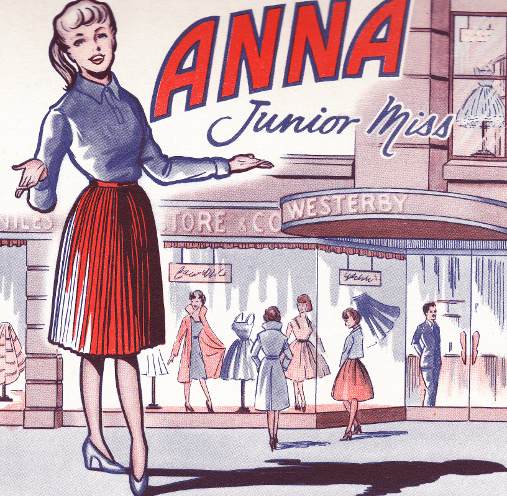
As a trainee Anna is sent to various departments, in this story she is in the bedding department, which is run by Mr. Harrow an unpleasent man who refers to trainees as “useless creatures”. After helping out a stereotyped large boisterous American woman, Anna comes across a lost toddler. From talking to the little girl she figures out her mother is in the linen department and phones down to an assitant to find the mother. In the meantime she also finds out the girl is upset thar her new baby brother is getting her cot. Anna convinces her how great it is to be a big girl in a big bed showing her bunkbeds with pictures of dogs on it. The Mother arrives and is delighted to find her lost child and also that she is now happy to give up her cot.
Mr. Harrow has still been dealing with the American customer while this is going on. Her cheery manner quickly turns when she can’t find her bag, she accuses Mr. Harrow of moving it and insists on calling the police. Luckily Anna finds it by a bed the woman was testing out earlier, before the police is called.
Anna isn’t all pure and good thoughts she does get some satisfaction out of Mr. Harrow getting told off, after all the unkind things he said to her. She does feel sorry for him when she realises how much the store and its reputation means to him. After she finds the bag, Mr. Harrow is a bit shaken up and lets Anna ring up the order. When the woman questions it, Mr. Harrow assures her of Anna’s capability and that though she’s still in training she will be a credit to the store.
There are nice rounded characters here, Anna could have come off as been much sweet and a goody two shoes, but she doesn’t. She is irritated by people reffering to her small size and she isn’t eager to help Mr. Harrow out at first, after him being unfriendly to her. That makes her more realistic. She can still at the same time she can be compassionate and helpful, which also makes her likeable, it’s a good balance.
Mr. Harrow may seem to be a nasty sort, he does have his flaws but he is also passionate about loyalty to the store, which is also why he doesn’t like trainees, who might do damage to the stores reputation. The American woman is written in a stereotyped way she is loud and cheery at first and says such phrases as “Gee” and “Well, if that isn’t the most”. While at first her cheery, friendly manner seems to be there to further contrast to Harrow’s uptight and unfriendly attitude, she takes a turn to be more antagonistic. Threatening to call the police and questioning Anna’s competency.
Its an enjoyable story, the Anna character lasted into to the 90s (though changed into picture story format) and the premise of the story got a bit repetitive, but looking to the early days where this formula came out of, it was a strong story and a good character to follow.
The Queens’ Champion (Pages: 57-61)
Susan Queen loves listening to the tales of her grandfather Bill’s wrestling days. Being the apple of his eye Bill is also eager to help Susan as she is crippled (another calliper wearer!). He works as a porter for a famous hotel. He is happy when Dr. Lucien Gray comes to stay a famous childrens doctor, who looks after disabled children (lucky coincidence). He takes the opportunity to ask him for advice. Dr. Gray offers to do an operation for free, as a demonstration for colleagues, but Bill will have to come up with the £50 nursing charge himself. Another lucky coincidence Susan sees a poster for a wrestling match challenging new comers to take on a champ for the exact sum of money they need!
There is a hitch when Bill admits to a fellow worker that he may have exaggerated his glory days to Susan. He did a bit of wrestling before but mostly just helped around the ring. He decides to get some training in while at work and the Manager fires him. Having no time to worry about this he has to go on with the match. On the day of the match, he catches a break when he runs into an old friend, who advises him on how to take the champ by surprise. So Bill wins the money and also gets offered a new job at the gym, his old friend now owns. Susan operation is of course successful. A lot of lucky coincidences in this story, but still a nice light story.
Val of the Valley (Pages: 81-85)
This is another story that started in prose form but later was revised as a picture story. Here Val is teaching a first aid to a group of young children. The vicar needs to raise money for the local hall and asks Val if the she would be willing to get the class to do a demonstrarion and sell tickets. Val is eager to help, but of course things don’t run smoothly. On the evening of the demonstration Val is visiting a rich old woman Mrs. Treharne. Mrs. Treharne’s horse takes a bad fall, Val helps out but misses the demonstration. The kids are dissappointed and the villagers think that Val was just flaking out so she could rub shoulders with the more wealthy locals.
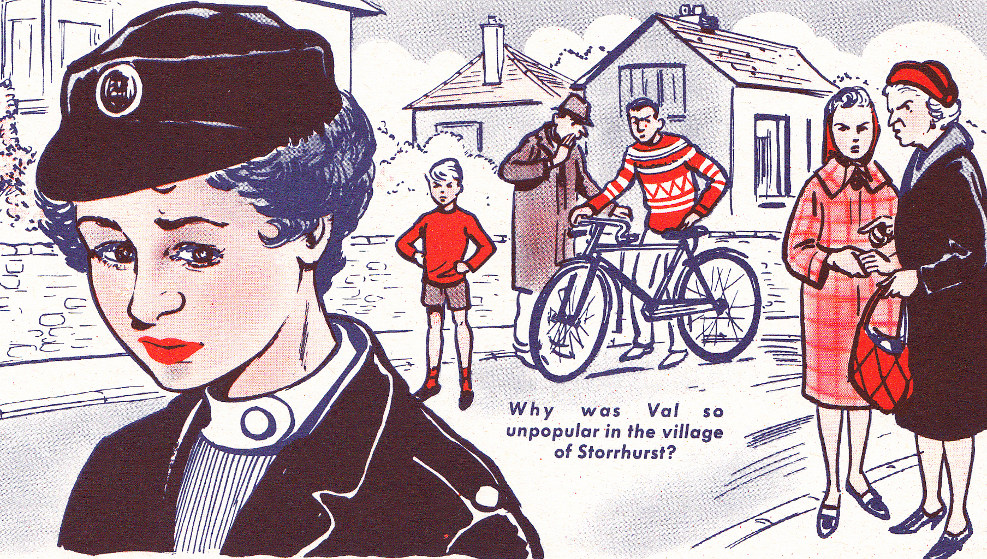
Of course the misunderstanding is cleared up when Mrs. Treharne hears the gossip. She sets everyone straight and pays the rest of the money to do up the hall.
Thoughts of a Lonely Ice Star (Pages: 95-96)
This is the thoughts of Pat a skater during a big competetion, her nerves, mistakes and victories. It is apparently written by a professional who knows what they are talking about. It does seem to be a realistic account of competition nerves.
Trombone Tillie (Pages: 105-108)
Tillie is the youngest and only female member of the Beverley Band. She is also a daughter of an Earl, her father lets her play with the band on the condition that none of her family find out about it. On this particular occasion they are playing on a floating band stand. As bad luck would have it, Tillie spots her Uncle Sir Charles and has to quickly hide away. She tries to earn her fair home by playing on a sidewalk only to be caught by a police officer. Lucky the Sargent agrees to let everything go if she plays for the Police Concert in a few weeks.
I am really impressed with comparing the first Judy annual to the last one. I wonder what the results would be if we did the same with the Bunty and Mandy annuals? I imagine the contrast would be even stronger because there would be an even longer span of time between them.
Your character Bumble from Colleen and the Last Witch sounds like she comes from a long tradition of witches being portrayed as nuisances (and sometimes even bungling characters) than than evil sorceresses and the effect is more funny than frightening. Sometimes the witches are not even villainous – they are just magical beings, as in Bunty’s ‘Maisie’s Magic Aunt’ or Jinty’s ‘Sue’s Daily Dozen’. But of course there are the really evil ones, such as the ones in Suzy’s ‘The Curse of Carmina’ or Jinty’s ‘Golden Dolly – Death Dust!”.
A few names for this year:
• Sandra and the Sleeping Beauty [Art: Paddy Brennan]
• Colleen and the Last Witch [Art: George Ramsbottom]
• Backstage Betty [Art: Don Walker]
• Heather in Italy [Art: Giorgio Letteri]
Does the story ‘Joan All-Alone’ in the Judy Annual 1962 include a scene where Joan, who has got lost on the prairie, encounters a group of native American girls who she thinks are going to be hostile toward her but who actually help her on her way? I have a vivid memory of reading a story like this in my sister’s annual. Thanks if you can help!
Afraid not. Joan is daughter of a Pony Express rider who is contemptuous of her because he wanted her to be a boy. When he is shot and wounded by “Indians” while trying to take a message about an attack on the cavalry, Joan takes it instead, taking advantage of a cloak of leaves which enables her to avoid “Indian” pursuit and spy on their encampment, and delivers the message which saves the cavalry.
This sounds rather different from your story. Do you have any further clues as to what annual this might have been in?