Monthly Archives: July 2013

The Doomed of Brangwen

  • The Doomed of Brangwen – Judy: #904 (07 May 1977) – #913 (09 July 1977)
  • Artist: Oliver Passingham

Plot

When Kathie’s mother has to go to hospital, she tells Kathie to go with her two younger brothers to her home village Brangwen,and that she will be looked after there. Unfortunately the village is cursed with ghostly apparitions of smugglers haunting the streets each night. After seeing these ghosts go by Kathie finds her brothers missing. She asks around the village for help looking for her brothers, but everyone denies their existence telling her she arrived alone. That night she sees her brothers with the ghosts.

doomed of brangwen_01

When the villagers find out who her mother is they are more open with her as she is one of them.  They bring her to her grandmother who lives in a big house up on the cliffs. Her grandmother, Manfraya, explains that centuries ago, villagers of Brangwen, lured ships onto the rocks and plundered the goods. One night Jamie Trevellyan (an ancestor of theirs) joined the smugglers and got shot by Excisemen, his companions left him to die. His grieving mother, Roberta Trevellyan,  in turn cursed the whole village. The smugglers soon died and were condemned to walk the streets for eternity. Along with them some of the living villagers are chosen to walk with them at night, continuing the smuggling trade. Those who are not chosen to walk with them cannot see where the ghosts reside or they will be taken. This happened a boy by the name of Young Willie years ago and he was never seen again. Later Kathie meets Young Willie but he warns her away from the path she is taking. That night Some of the villagers decide to take Kathie to the dead as they believe that she is making the dead uneasy since she arrived. Although Kathie argues that even if they got rid of her they will still be cursed.

doomed of brangwen_02

Kathie is saved by the appearance of the ghost of Roberta, who for some reason doesn’t want the Dead to get Kathie. Soon after that a stranger turns up in the village, he turns out to be Kathie’s uncle, Roger. Manfraya faked his death as a baby and sent him away as she was afraid the dead would have taken him. Helped by Young Willie’s mother Beth Hewitt, Kathie and Roger try to find the place of the dead. Roger hurts his leg, but Kathie carries on and she finds the cave but an evil apparition tells her she will never leave. Roberta comes to rescue her rescue again. Later some village men decide to defy the dead, and not walk with them. As long as they stay at the Trevellyan house, with Kathie they will be safe. But Kathie is tricked into seeing her brothers and runs to them leaving the men unprotected.

doomed of brangwen_03

Beth tells her she is the only one able to break the curse, as she is under Roberta’s protection. She has to go to the Dead’s secret place while they are still roaming the streets. Kathie finds her brothers, who are no worse for wear after their adventures. Manfraya,  Beth and Roger round up the villagers to get them to defy the dead.  Kathie encouraged by the help of the villagers, manages to convince Roberta to let go of the past, the dead disappear and the curse is lifted.

Thoughts

Oliver Passingham is one of my favourite artists, he could portray a variety of stuff from comedy/slapstick to horror. He did seem to draw a lot of supernatural stories, such as Skeleton Corner stories and was very good at creating shadowy and creepy atmospheres. Throughout this story the ghosts are very eerie, as is the cave where they reside. There is some great detailed scene shots that make the environment look threatening and creepy. I like the panel where the villagers bring Kathie to her grandmother’s house. Even though its during the day, so a bit less creepy, there is a sense of isolation about the house, and potential danger of the cliffs.

doomed of brangwen_04

The flashback to the original curse is also great, first the image of the wrecked ships and the people left to drown.  Then when Roberta finds her son and curses the village, you never see her face, its always in shadow. Apparently a grieving mother’s curse is one of the most powerful things in the world. Although I would argue that Jamie, hardly deserves such wrath. The smugglers were despicable people, wrecking ships off the cliff and of course they left Jamie to die, but Jamie chose to go with them, so that doesn’t say much for his character.

doomed of brangwen_05

The curse itself seems needlessly complicated and doesn’t make sense in a lot of ways.

  1. The smugglers die and are forced to spend their afterlife walking the streets of Brangwen. This seems fitting for Roberta’s revenge.
  2. The Dead then chose living people to walk with them and keep smuggling, apparently they can have the living under their control as well. This makes less sense, why would Roberta want to keep smuggling activities going, but I suppose it could be that as she has cursed the whole village and this will make even the innocent doomed and continue the curse.
  3. If anyone not chosen to walk with the Dead, looks upon them and sees where they are going, then they are taken. When Kathie looked they apparently don’t take her because she fainted and didn’t see where they went. Young Willie is kept with them by a combination of  both the Dead and the living. He also has to guard the path to their cave. Apparently the Dead’s cave is a secret, yet all the villagers know to avoid that area and when some of the villagers try to give Kathie to the Dead they go up near the cliff path.
  4. The curse is sustained only as long as Trevellyans stay in the village. When Kathie’s mother, Emily left, the ghosts became more uneasy and troublesome. This is why some of the villagers don’t like Kathie. Also the Dead don’t take Roger apparently because they need him to live on in the village to keep the curse going. This makes the least amount of sense. If all it takes to break the curse was the Trevellyans to move away, then why don’t they leave? I know it would be hard to leave their big house and maybe money had something to do with it, but still the entire village is cursed!

Also it seems odd that Emily would send her children to Brangwen, sure their only living relative is there, but there had to be some better option then sending them to a cursed village.  Also its unclear why Roberta decides to save and listen to Kathie, maybe its because she is the only ancestor that actually tried to do something about the curse.

doomed of brangwen_06

Despite these logical flaws and unnecessary complications, I do like the story. This is in most part because of the amazing art, but there is a lot to like in the story as well.  I like that the villagers are nearly as antagonistic as the ghosts themselves. They get rid of all evidence of the boys so Kathie has no way to prove to the police that her brothers are missing. The villagers are motivated by fear, but there is a sense of community with them and they look after their own. They do try to comfort Kathie when she discovers her brothers with the Dead.

I like Beth Hewitt’s character, she is a wise woman, but also quite broken hearted about her son. She is the one who really riles the villagers up to make a stand, telling them Willie was better off with the Dead then been raised with a bunch of cowards. Manfraya has some parallels to Beth, she lost her son as well, but through choice she sent him away in attempt to save him, but similarly she has been quite heartbroken about it. Kathie is our typical hero, strong, right-minded and determined, but she can be rash at times. After promising to stay with the village men she nearly dooms them by running after what she thinks are her brothers. Overall it is a nice creepy story with some good characters.

Follow-My-Leader Lil

  • Follow-My-Leader Lil – Judy:  #905 (14 May 1977) –  #914 (16 July 1977)

Plot

Lil Lavender lives in an industrial area of  town. The closest thing they have to a playground is a waste ground nearby named the Forstal. Lil is confined to a wheelchair and she likes to sit under an old tree and watch the nature around her.  But Marsdon a local councillor and developer wants to build on the land. Lil takes the lead in a campaign to try and stop this. First her and the local kids try and track down a deed to prove that the space is common land, but Marsdon is one step ahead of them and has taken all the records out on loan. The kids try to track down  any other copies of the deed. They manage to find an old copy but its in Latin. They get it translated and discover the land can be used to host a fair or festival indefinitely on St. Peters Day, as long as it is done with no more of a 75 years elapse.

follow my leader lil_01

At the same time of this discovery, Marsdon’s men are ready to cut down the old tree and start development.  Some of the boys climb up the tree to delay them while Lil and the others got to the council offices to present their discoveries.  They manage to put a hold on the work. They only have 2 weeks to find out if there was a fair held in the last 75 years. They manage to find proof but it seems the last fair was held just within the 75 years, so they have only bought them selves an extra 18 days then the deed will lapse. But Lil isn’t one to give up so she says they will just have to organise a festival themselves.

follow my leader lil_02

Marsdon tries to put a stop to the festival, by ruining all their attractions. They arrange a gymnastic display, dancers and a local marching to appear, but these acts rely on council grants and buildings to get by. So Marsdon makes sure they won’t risk helping out the festival. Similarly the choir backs out,  as most of them are Marsdon’s employees and fear they’d lose their jobs. Lil’s still not going to give up though and decides to turn it into a youth festival. To counter this, Marsdon sets up a free seaside trip for the same day. When it looks like the festival will fail, Lil wonders if she can get the old tree marked for preservation. They go to the local newspaper to ask about preservation, the staff  can’t help with that but they do think the festival and campaign make a good story. So they help with the festival, getting a popular band to come play and writing an article about it. The day is a success, keeping the area safe for another 75 years and Marsdon resigns from the council.

follow my leader lil_03

Thoughts

It is good to see a story with lead character who is disabled but not have that define the plot. Stories with disabled characters usually fell into a few categories. The plots would involve; trying to find a cure or trying to overcome the disability, using their disability (or faking one) to exploit people or exact revenge, or being exploited themselves. In this story Lil’s disability is not really key to the plot, she could have still been the leader of the campaign and been able to walk. She is not being discriminated against because of her disability, she is in the same position as the other local kids fighting to keep the one green area they have.

That’s not to say her disability is totally inconsequential. They use it to their advantage when needed; such as delaying people so the boys can sneak into a site to find the deed , or gaining sympathy so she can get to see an old woman outside of visiting hours. Even the newspaper reporters make a point of saying a photo of her in her chair (along with the campaign) would be good at pulling at people’s heart strings.

follow my leader lil_04

There have there have been several stories of campaigning girls saving their park/youth clubs from evil developers previous to this. So Lil’s disability may be seen as a a gimmick to differentiate it from these similar stories. Also the word “cripple” is still in use throughout the story.  Still overall it’s quite progressive that it is Lil’s leadership qualities that define her character not the wheelchair. The story itself does have a sense of urgency, with them only having weeks to save the Forstal. Marsdon is your typical antagonist a big business man that steps on the little people and uses underhand methods to get what he wants. The other kids don’t stand out as much, mostly they are there just to follow Lil’s plans. There are two that seem the closest to Lil (one being her brother) acting like second-in-commands, but the rest of the kids are quite interchangeable.

follow my leader lil_05

Throughout the story the Forstal is described as a wasteland, so I find it good that they save the land and they don’t go further by making it into some great playground for the kids. Its just an open space for them to play in. There are some issues raised that without this space the kids are more likely to stray into delinquent activities. Of course it would be great if they had extra facilities but more realistic that they are lucky just have some green area.

Cold As Charity

  • Cold as Charity Judy: #1397 (18 October 1986) – #1408 (3 January 1987)
  • Reprinted (as Judy classic)– M&J:  #176 (24 Sep. 1994) – #187 (10 Dec. 1994)
  • Writer: Marion Turner (under pen-name: Fiona Turner)
  • Artist: Paddy Brennan

Plot

In Victorian times Charity Barton and her young brother Billy are taken in by one of their neighbours, Mrs. Drabble, after they are orphaned. Although she works them hard Charity believes she must be kind as she has given them a home. Charity intends to sell her mother’s wedding ring so she can carry out Billy’s wish of visiting the seaside. Mrs. Drabble offers to sell the ring for her and send Billy to a seaside home for the Summer. Charity is grateful for Mrs Drabble’s help until she later overhears her plans to send Billy to a workhouse and keep Charity on as a cheap servant. Mrs. Drabble is already enjoying the money she got from the pawned ring at this stage as well.

cold as charity_01

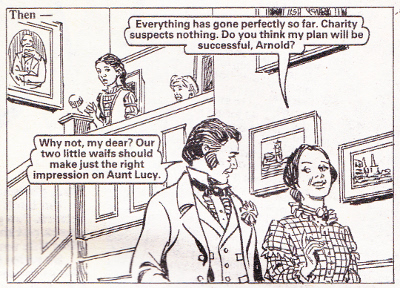
Charity is upset by her heartlessness, and she and Billy runaway. She is determined to get Billy to the seaside but to never trust in people’s kindness again. On their journey they meet people who seem to want to help but through misunderstandings, Charity believes they are only using them and are deceitful. In one instance a couple take her and Billy in, but then Charity overhears the couple talking about a plan and that her and Billy should make  a good impression on Aunt Lucy. She believes they are being used to get a rich older relative’s money. In actuality the Langtons were hoping Aunt Lucy would like the two children and take them to her home by the sea and that they would be good company for the lonely woman.

cold as charity_02cold as charity_06

Usually Charity leaves before these misunderstandings are cleared up. This not only ruins her chances but also at times lets the people who tried to help her in bad situations. Such as a blind man losing his cherished dog. Charity has to accept help from a young school mistress when she hurts her ankle. She believes that Miss Ellen is only concerned with herself and is ready to move on again when she comes across a student, Sam, beaten up. She confronts Miss Ellen about this, thinking she made Sam go against his father’s wishes just so she had her best student at an inspection. But she is soon put right by Hannah (Miss Ellen’s older helper). Sam was going to be put to work as a chimney sweep and Miss Ellen has arranged an education grant for him through the inspector.  Charity realises her mistake and is upset as she begins to think there have been other people she misjudged and acted coldly towards.

Miss Ellen’s kindness continues as she rents a cottage for them at the seaside for a month. The first day is wonderful for Billy and Charity thinks the sea air has done him well as there is colour in his cheeks. Only Hannah recognises it as a flush of fever. That night Billy dies he is later buried by the seaside. Charity has learned a lot from Miss Ellen and she goes on to become a nurse in a children’s hospital.

cold as charity_04

Thoughts

The phrase as cold as charity isn’t something I come across regularly nowadays, but it is fitting with the Victorian setting. I don’t know the exact origin of the saying  but I would guess its around the time, Cringe Or Starve was a nickname for Charity Organisation Society. The title/saying is referenced a lot throughout the story, mostly by people referencing Charity Barton in a bad light. But even in the end when she’s changed it is referenced with Charity being the opposite of cold. These stories liked emphasising the titles a lot (especially if the character’s name was fitting with a clever pun/phrase).

Tragic stories another popular plot for these comics. Of course the best setting for these tragedies was often the Victorian era, with children having to stay out of workhouses, poverty or deal with poor working conditions and cruel employers. Charity comes across many situations that in other stories she would have been right to assume the worse; underhand people using children to get money out of a rich older relative or using a sick child to get sympathy when selling things etc. Other than Mrs. Drabble, they do come across some troublesome people. In one instance, Charity upsets some boys, who get their revenge by messing up their chance of a boat passage. Of course Charity wrongly assumes that the fault is of the woman who promised to put in a word with the captain, and this again reinforces her idea not to rely anyone’s supposed kindness. Why people keep helping her even with her coldness is because they can see goodness in her as well, particularly as she is so protective and caring for her brother.

It is tragic that Charity and Billy suffer many needless hardships because Charity has lost her trust in people. But it also hard on the people who helped her and she betrayed. For example a bunch of runaways get carried off to a workhouse, as she believes the leader is running a scam and gives them up to the police to save herself. The gang sell matchboxes on the street and the leader Tom gets majority of the money.  He is actually keeping money aside so he can buy everyone shoes, though one kid tries to run a scam selling half full boxes. Charity believes Tom is responsible for the half boxes and is keeping money for himself.

cold as charity_05

The “happy” ending is Charity becomes a compassionate nurse and Billy got his one day at the seaside. It is still harsh that they have a cottage booked for a month and Billy only gets one day there, even if it is the best day ever. There’s some great art throughout, Charity and Billy meet a lot of people on their journey and they each have a distinctive look, the crowded busy town streets are vibrant and the seaside is peaceful in comparison. There’s great detail put in to capture the era. It’s a good story, it can be frustrating that Charity keeps making the same mistakes, but she has a reason to be cautious and distrustful after being betrayed. While the situations could have become repetitive, each character and situation are distinct enough to keep interest.

cold as charity_03

Mandy Annuals

Annuals

Mandy Annual 1971                             Mandy Annual 1990

Mandy Annual 1972                              Mandy Annual 1991

Mandy Annual 1973                              Mandy Annual 1992

Mandy Annual 1974                             Mandy Annual 1993

Mandy Annual 1975                              Mandy Annual 1994

Mandy Annual 1976                              Mandy Annual 1995

Mandy Annual 1977                             Mandy Annual 1996

Mandy Annual 1978                              Mandy Annual 1997

Mandy Annual 1979                             Mandy Annual 1998

Mandy Annual 1980                              Mandy Annual 1999

Mandy Annual 1981                             Mandy Annual 2000

Mandy Annual 1982                             Mandy Annual 2001

Mandy Annual 1983                             Mandy Annual 2002

Mandy Annual 1984                              Mandy Annual 2003

Mandy Annual 1985                              Mandy Annual 2004

Mandy Annual 1986                              Mandy Annual 2005

Mandy Annual 1987                              Mandy Annual 2006

Mandy Annual 1988                              Mandy Annual 2007

Mandy Annual 1989

The Quiet One

  • The Quiet One –  M&J:  #224 (26 Aug. 1995) – #330 (07 Oct. 1995)
  • Artist:  Julian Vivas

Plot

Danni Johnson, enjoys bullying and having people scared of her. One thing she doesn’t like is that the teachers’ know she is a troublemaker, so she misses out on trips because she can’t be trusted. When her family move to a new town, she decides to try out a new tactic. She pretends to be sweet and nice, then starts choosing people to bully in secret. Danni is good at sizing up who to target,  and soon she has 3 girls, Sharon, Marion and Lorna, under her control.

the quiet one_03

There is another bully at the school, Carla, but she is considered small time by Dani. Her other new “friends” have had enough of Carla bullying first years and report her. One of the girls brings a tape recorder to school as well so they can catch Carla out if she tries any more bulling. They are surprised to hear Dani is the one threatening Carla, she has decided that she will be her new victim. It is then that the 3 girls admit that they are terrified of Danni. The girls all go to report the bullying to the head. Danni finds things worse than her old school now. The teachers know she is trouble and she has lost power over all the girls

the quiet one_04

Thoughts

So continuing on with the theme of bullies, this is a more unusual approach, to have the narrator the bully herself. Danni is devious and shows no regret for the things she did. the quiet one_05Even at the end she isn’t upset that she is left on her own but that she hasn’t power over people. There doesn’t seem to be any particular reason behind her bullying. What little we see of her home life it seems fine, her mother seems pleasant, though we never see her father. Her motive just seems to be down to her own preference of liking to frighten people and being in control.

It is  interesting in seeing her thought process of how she picks out her victims. She picks girl’s she perceives as weak, and  reinforces the idea that if the tell anyone things will be worse for them . Also by keeping it secret this singles the girls out so they don’t know that anyone else is having a similar experience, and have no support. Of course to Danni’s mind keeping it secret also has the advantage of not being under suspicion from teachers or others.

the quiet one_02

The ending is quite effective, instead of having her expelled and just move onto a new school, she is left there alone and powerless. The girls that were bullied also wish they’d said something sooner, which reinforces the message of telling someone if you are being bullied.

Hateful Harriet \ “Be Nice to Nancy!”

Girls comics were full of bullying, blackmail and nasty girls. As evidenced in this interesting article: http://www.booksmonthly.co.uk/bully.html. So I thought I’d take a look at some of these, starting with two similar stories:

Hateful Harriet

  • Hateful Harriet–  Bunty:  #668 (31 Oct 1970) – # 677 (02 Jan 1971)
  • Reprinted- Bunty: #1164 (03 May 1980) – #1173 (05 July 1980)
  • Art: Andy Tew

Plot

Peg Roberts has to keep Harriet Marlowe out of trouble in school, or else her widowed mother will be fired by middle manager, Mr. Carrick.  Harriet has been expelled from many schools, and is sent to live with the Roberts as well. At the same time as this, Peg   is competing for a drama scholarship, which also relies on her getting a good character reference from her teachers. Of course Harriet causes Peg all sorts of trouble, and has the teachers fooled that she is a sweet girl.   Mrs. Roberts can’t do anything to help as she is also at the beck and call of Harriet. Finally Harriet gets caught out and expelled and Mr. Carrick  fires Mrs. Roberts. Luckily for her she gets a job in a travel agents. Harriet is to be sent to school in Switzerland, though she doesn’t seem happy about it.  On the day of Peg’s big interview for her scholarship, Harriet is in an accident with a bridge collapse. After Peg misses her interview to save her life, Harriet turns over new leaf and helps Peg get a second chance with the scholarship. She in turn is given a second chance with the school and is allowed to come back.

hateful_harriet_03


“Be Nice to Nancy!”

  • “Be Nice to Nancy!” – Judy: #1559 (25 Nov. 1989) – #1573 (03 Mar. 1990)
  • Reprinted as Be Nice to Nikki – M&J: #288 (16 Nov. 1996) – #300 (08 Feb. 1997)
  • Artist:  Andy Tew

Plot

Yvonne Baxter has to be nice to Nancy Norden (Nikki in the reprint), or she fears her father will lose his job. Nancy is openly nasty and a bully and is not popular at school. This of course causes many troubles for Yvonne as she keeps covering for her. She loses friends and gets in trouble in school.  When she tries to explain how nasty Nancy is to her parents, they don’t listen. Only her best friend Maggie knows what’s going on. Eventually Mr. Norden catches Nancy out and he apologises to Yvonne. He was hoping that she would be a good influence on Nancy. He is going to send her to a special school instead and of course Mr. Baxter isn’t going to be fired.

be nice to nancy_02

Thoughts

A girl forced to be friends with a nasty girl for fear of a parent’s job is a common theme. There were ,any variations of this theme such as the family’s reputation, rather than a job, being in jeopardy. The link at the start of this post discusses a lot of the different types of bullying that went on in these stories.

Both Hateful Harriet and Be Nice to Nancy have an overall similar storyline. Even their looks correspond with the long blonde hair for the antagonist and the shorter dark hair of the protagonist. Both Harriet and Nancy get up to similar trouble and share a lot of the same personality traits. At the same time Peg and Yvonne both feel helpless and dislike having to cover for the other girls. There are differences though, in how the stories develop and conclude. In the case of Hateful Harriet, Mrs. Brown knows what Harriet is like but not only can she not help Peg she also has to give into Harriet’s demands. (Incidentally this story would not work today, as Mrs. Roberts boss could be charged with wrongful dismissal, at first he wants to fire her because of her age and only keeps her on as long as she keeps his boss’s daughter out of trouble).

hateful_harriet_02

Yvonne on the other hand tries to tell her parents what Nancy is like but they don’t listen. Her father in particular keeps the pressure on her to be friendly with Nancy. While Nancy does use this to her advantage,  Yvonne seems to feel the most pressure from her father and Mr. Norden rather than Nancy herself.  Harriet likes to constantly remind the Roberts that they have to keep her happy.

be nice to nancy_03

Harriet does get redeemed in the end but Nancy hasn’t learned her lesson. This contrast could be to do with the way their fathers deal with their daughters. While Nancy’s father is actively trying to help her out (though he may be going about it the wrong way!). Harriet’s father doesn’t appear at all, instead his orders are passed through lower manager Mr. Carrick. Clearly Harriet is not used to people being kind to her for no reason, she seems to be following her father’s behaviour of using power and threats to get what she wants. She is used to being shipped around and her behaviour becomes more understandable when it seems she hasn’t had a very caring home life. When Peg shows her friendship, even after Mrs. Roberts gets a new job and then saves her life, Harriet turns her life around and starts to appreciate her friendship.

hateful_harriet_01

Nancy is a less sympathetic character. Mr. Norden does try to help his daughter but he goes about it the wrong way. He puts the pressure on Yvonne to be friends with her thinking that if she is not with a bad crowd then she will be a better person and stay out of trouble. He dosen’t realise that she needs more help than that and that it is unfair to expect Yvonne to be responsible for keeping his daughter on the right path. At least Nancy does get the chance to go to a school that will help her, but she doesn’t have the excuses of Harriet for her bad behaviour.

be nice to nancy_01

Hateful Harriet is a bit more dated, and Peg is such a good person that she goes to support Harriet in a play that she should have been lead in (this is after Mrs. Roberts gets her new job). It’s a bit unbelievable that a girl could be this nice! Harriet’s change of heart may be a bit sudden but after a near death experience not unlikely. Be Nice to Nancy is a story that is remembered pretty well so it must have stuck in people’s mind. It is more realistic in it’s portrayal of characters and everything isn’t all wrapped up neatly in the end. Still most importantly the protagonist gets a happy ending, free of Nancy!

It’s interesting to see how a similar theme can develop differently, and of course very telling is the different time periods as they were first published nearly 2 decades apart.

The Locked Room

  • The Locked Room – Judy: #1153 (13 February 1982) – #1162 (17 April 1982)
  • Reprinted – Judy: #1459 (26 December 1987) – #1466 (13 February 1988)
  • Reprinted (as Judy Classic ) – M&J:  #188 (17 December 1994) – #195 (04 February 1995)
  • Reprinted and translated into Dutch (as “De afgesloten kamer”) – Debbie #48 (1985).
  • Art: Paddy Brennan

Plot

Susan Brown lives with her parents, her older brother Phil and younger sister Linda. They are a close family, helping each other out and sharing everything. That is until one night something strange happens. First Susan hears and accident on the road, she runs out to investigate and finds a puppy on the road and a car driving away. She settles the puppy in the shed, as he seems to be terrified of the house. The next morning she gets up and can’t find any of her family. She finds one of the rooms locked and her family reappear acting peculiar.

lockedroom_01

Her father tells her he has new scientific equipment in the room that can’t be meddled with and that is why it is locked. The family continue to act strangely, they don’t joke or talk naturally. Instead they seem cold and their speech is stilted.  Her mother finds it interesting that Susan thinks they talk strangely, and after this conversation Susan sees them watching a TV programme about learning English.  When she raises concerns with a family friend, already the speech patterns are loosening up. Susan feels very alone and tries to find the secret of the locked room herself.

lockedroom_02

She gets an opportunity to search the house when the family leave looking for samples, for an experiment. She finds a furnace with a very high temperature gauge in her father’s office and she also finds a false eyelash in her parent’s room. Later when her father and Phil are using the furnace she burns her hand on the office doorknob and passes out.  She wakes up locked in her room (with bandaged hand) and gets another chance to investigate as the family are missing again.

Finally she gets into the locked room through a trapdoor in the attic. What she finds in there are her parents, Phil and Linda lying unconscious in the room.  Fearing they are dead Susan cries, and her tears un-paralyses her real family. The fake family were actually copies made by miniature aliens that crashed outside their house. They have collected all the metal they needed to repair their ship and fly away. The copies of themselves just melt away.

lockedroom_06

Thoughts

This is one of my favourite stories, I mean who couldn’t love a story where the explanation for a family acting strangely is because they are copies being controlled by miniature aliens! It is a good sci-fi story, the mystery of what has happened to the family is interesting. Also what the secret of the locked room is, is quite intriguing, I would have guessed some alien technology or something similar at first. In my first reading I assumed the family were being mind controlled rather than copies (which has been the case in other stories like “The Face in the Crystal”). Also nice change to to see there aren’t sinister motivations, the aliens are just trying to get home and have no interest in taking over Earth.

lockedroom_05

So it is a nice pay-off to see what is in the locked room and I do love the image of the little spaceship flying away afterwards. Though one flaw is the ending seems to be full of expository dialogue. First the explanation of why Susan’s tears free the family, then the father’s theory of what has been going on from the aliens crashing and why they locked them up.  Also conveniently the clones melt away clearing up any last bit of evidence. Still other than that it is a solid story.

lockedroom_07

There is a lot great imagery in the story and also the contrast of the family and alien family is handled well. It could have been interesting to see the aliens in their actual form, but I think it works well with just having them fly away, and not interact with the family after they are free. It was good to see them try to fit in, and adjust to human life while they are working on their repairs. The real Mrs. Brown was relaxed and a bit scatty, whereas alien Mrs. Brown tries to follow advice from housekeeping magazines, to try and be the best mother. As Susan was out of the house when they took it over, they were not expecting a fifth member of the family. Although they are cold and wooden to Susan and don’t want to her to interfere with their plans, they don’t actively set out to hurt her.  Fake Mr. Brown bandages up her hand when she is hurt and Mrs. Brown tries to follow housekeeping’s advice in being a mother to Susan. Good characters, intriguing mystery and some nice sci-fi explanations.