Tag Archives: Blackmail

Little Miss Frozen Face

Plot

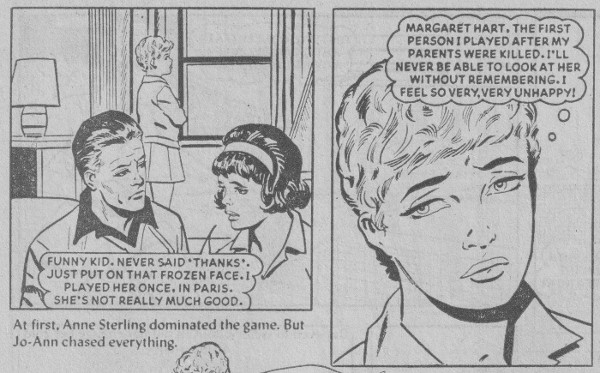
Jo-Ann Morton, a rising tennis star, earns the name “Visage Glacial” (Frozen Face)  in France after she wins the Europa Junior Tournament while her parents died in a crash and she quickly goes on to compete in another competition. Unknown to all the gossipers, Jo-Ann’s aunt had not told her the news during the match and afterwards told her that her father left  lot of debt and embezzled money from a children’s home, so she would need to compete to earn her keep and to make her her father’s good name wasn’t ruined.

Jo-Ann plays but she no longer has a love of the game, and never showing happiness on her face only builds her Frozen Face reputation. Her aunt continues to exploit and blackmail her. She makes a friend with Sir Sam Haigh, a millionaire mill owner, but due to his appearance her aunt Maud thinks he’s a commoner. Finally having a friend to confide in Sam helps clear her father’s name and expose the real culprit, her Aunt Maud. Free from her, Jo-Ann can finally begin to live her life again and play tennis for her own enjoyment.


Notes

  • Story Art: Mario Capaldi.
  • Art Lucky Charm Cover: Ian Kennedy

Appeared

  • Little Miss Frozen Face – Bunty: #784 (20 January 1973) – #803 (2 June 1973)
  • Reprinted – Lucky Charm: #17 (1982)

The Double Life of Coppelia Brown / The Double Life of Dolly Brown [1969/1976]

  • The Double Life of Coppelia Brown – Mandy: #128 (28 Jun 1969) – #138 (06 September 1969)
  • Reprinted as The Double Life of Dolly Brown – Mandy: #482 (10 April 1976) – #492 (19 August 1976)
  • Reprinted as The Double Life of Coppelia Brown – Mandy #818 (18 September 1982) – #828 (27 November 1982)
  • Reprinted as The Double Life of Dolly Brown – Mandy #1188 (21 October 1989) – #1198 (30 December 1989)
  • Reprinted as The Double Life of Dolly Brown (as Mandy Classic) – M&J:  #297 (18 January 1997) – #307 (29 March 1997)

Plot 

Note: The main character went by different names in different prints of the story, in this summary, I’ll just refer to her as  the most commonly used “Dolly Brown”

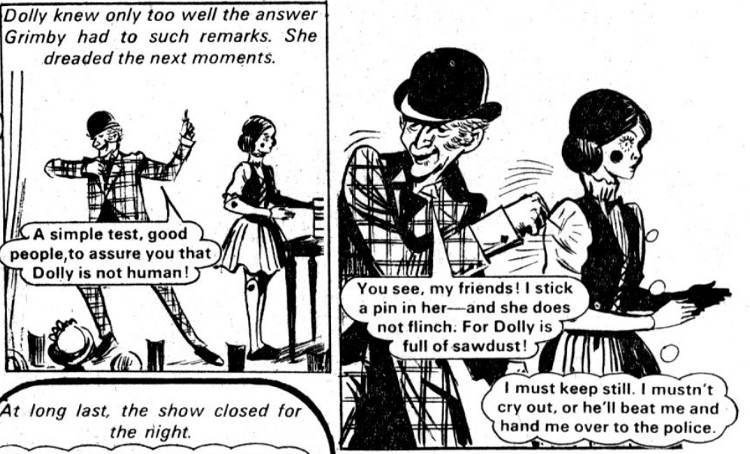
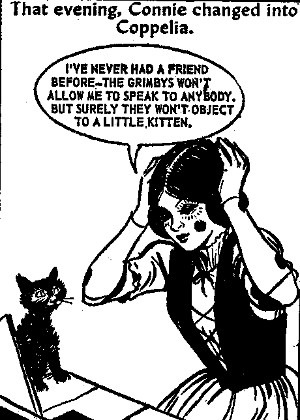
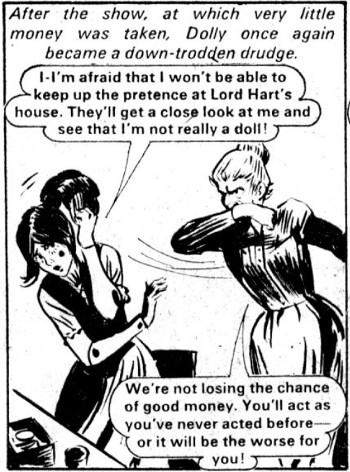
In Victorian times, traveling around fairs Gus Grimby shows off his amazing mechanical doll invention that can walk, talk and obey commands with no strings attached. Although if the audience could look closer, they would see it was actually a girl in makeup, straining to stay still and not blinking. While not on stage Dolly Brown is forced to slave for Gus and Ma Grimby. Dolly cannot remember her past, but has been told by the Grimbys that she committed a crime and she owes them as they protect her from being sent to prison. A torn wanted poster with her picture convinces her that  they are telling the truth, and she must stay being a puppet.

Despite her hard life and supposed criminal past, Dolly still shows kindness to others like pretending to freeze up on stage to point out a thief, being kind to an ill girl or rescuing a kitten, even though it risks punishment later . She is forced by the Grimbys to give a way the kitten to an audience member. The recipient comes back to thank the doll and seeing servant girl, Dolly, the family seem to think she looks familiar, whether they are recognising her as doll or from some place else is unclear, beginning the mystery of who really is Dolly Brown.

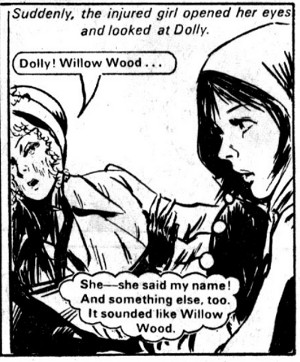
Dolly gets a clue to her past when she helps an injured girl during a storm, the girl seems to recognise her when she says “Dolly! Willow Wood..”. Dolly doesn’t get a chance to see the girl again to question her more, as the police move the Grimbys on. This also raises doubts about the Grimby’s honesty regarding Dolly’s past. Gus Grimby tells Dolly they had to move on because the police were sent after the girl recognising her, but Dolly had overheard the actual conversation, that the police is moving them on because the squire doesn’t want fairs on his land so she knows he is lying.

In the meantime she continues with her double life. She stills shows kindness to others, although she finds out not everyone is deserving of it. She is tricked by a girl into borrowing the dolls shoes, but the girl then tries to sell them, luckily they are returned but that doesn’t stop Dolly getting a beating and the Grimbys implying she was in on the scheme being a criminal herself. She never gets any sympathy from the Grimbys, even when she is sick they ignore her suffering and force her to continue to perform. When she does collapse, not wanting to lose their source of outcome they do temporarily get better lodgings and someone to look after her. After waking up from her fever in a comfortable bed, a confused Dolly first asks if she is at Willow Wood. The woman looking after her remembers a story about Willow Wood,  that a child disappeared from there, alongside valuables.

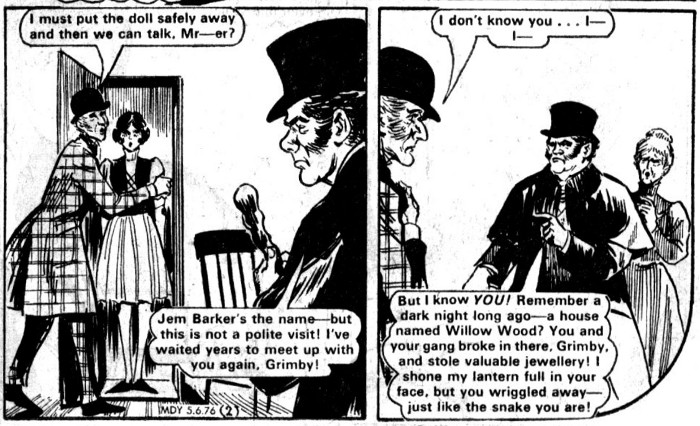
Not wanting to miss a good money opportunity, the Grimbys head towards Maybury, where Dolly supposedly committed her crime. Ma Grimby is nervous about being so close to there and tells Dolly to keep out of sight. Dolly  can’t stay hidden when a fire breaks out at a nearby tent and she rescues a baby, a comment from crowd says she has look of a gentry family named Harding. Deciding to investigate further thinking that Willow Wood must be close by Dolly takes an opportunity to sneak off to look for it. She locates the large house and immediately recognizes it, but before she can look around, the groundskeeper spots her and drives her away, assuming she’s there to pry into others’ misfortunes. Later that evening, the man goes to view the show, Dolly thinks he has recognised her, until realising it is Gus Grimby he is looking at. After the show the man confronts Gus Grimby, as Dolly is still dressed as a doll, Gus is forced to let her stay. The man, Gem Baker claims he remembers him from the night Grimby and his gang robbed Willow Wood. Grimby ever the charming con man, weasels out of it claiming it was his brother that he must have seen. Having heard it all Dolly believes they were all part of robbery.

When they are asked to do longer show, Dolly knows she must endure if she is to stay in Maybury and find out more about her past. Dolly investigates further and she meets a girl, Susie, who’s mother now works at Willow Wood. She feels the house is familiar and a feeling of happiness, when she hears the story of the robbery, that Mr Harding was struck down and crippled during the robbery and the housekeeper’s daughter disappeared at the same time, she concludes she must be that girl who betrayed her mother and Mr Harding by letting the thieves in.She doesn’t wait for Susie to tell her the rest of the story.

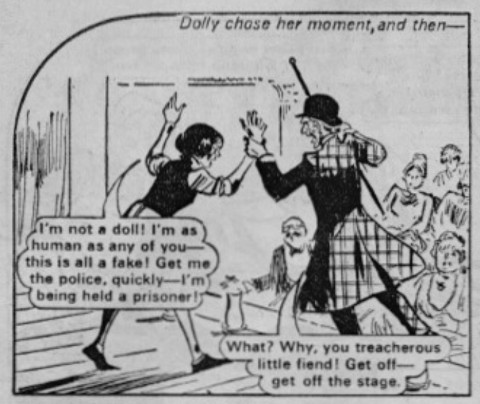
Having enough of her double life and wanting to atone for her crimes, she decides to turn herself in to the police. Suspicious, Ma Grimby catches her and stops her,  when Dolly tells them she knows she was daughter of the housekeeper who betrayed Mr Harding, the Grimbys suddenly act nicer to her. Later she hears them say that they are safe as she still doesn’t remember who she is, they plan to keep a closer eye on her and board up her room’s window. Dolly is surprised she still doesn’t know who she is, but she won’t keep up this life any more and with no other option, in the middle of the act on stage she shouts out for help and give up the ruse.

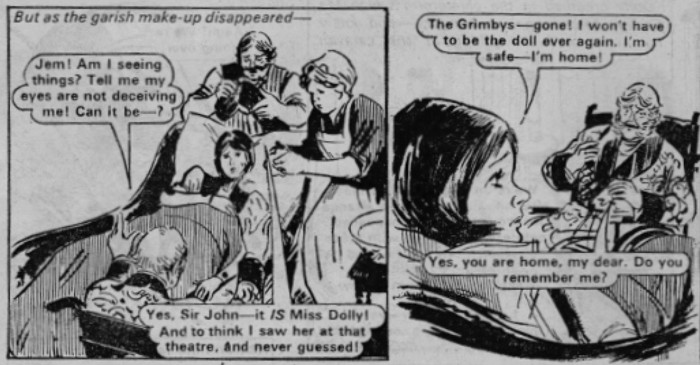
The Grimbys make a quick get away with her, but crash the caravan. Cutting their losses they leave the unconscious Dolly for dead and get away. Dolly wakes and makes her way to Willow Wood, knowing she will be safe there. Collapsing at the house when her makeup is removed, she is revealed to be Mr Harding’s granddaughter. She had seen the robbery and lost her memory with the shock of seeing him struck down. The Grimbys kidnapped her so she wouldn’t be able to give evidence against them. Finally home her memories come back,  the Grimbys are found and arrested and Dolly packs away her doll costume never having to live double life again, but she will not forget her time, and those less fortunate than her.

Thoughts

Clearly a well received story, as it was reprinted 4 times. In the original story the girl’s name was Connie Brown, and the doll was named Coppelia. The doll’s name and title clearly a reference to the Coppélia ballet, where a man becomes infatuated with a mechanical doll that an inventor has created and his previous love, dresses up as the doll to rescue him. In the reprint the name is switched to Dolly Brown, the next reprint has the title changed back to Coppelia Brown again, but oddly in this case the girl is no longer called Connie, instead both her and the doll are called Coppelia. The next two reprints they keep with the Dolly Brown name.

As with other stories, we see variants pop up, such as The Secret of Penny Farthing where a girl is blackmailed into pretending to be a ventriloquist dummy or Ballerina on a String where a girl performs as a dancing puppet. Due to being one of the first or perhaps because of its many reprints, this story is one that sticks in the mind more.  There is also added mystery in this story, as Dolly has amnesia and we don’t know who she is or what she supposedly did. Throughout the story and Dolly’s acts of kindness, despite her own circumstances, the reader must find it hard to believe that she could have committed such a terrible crime. Meanwhile the Grimbys are deceitful, cruel guardians, forcing her to perform and slave for them, beating on her when she doesn’t meet their standards. When the truth comes out, that not only are they blackmailing her with the crime they committed, but also that they kidnapped her from a loving home, they certainly rank top among the despicable villains to appear in these comics.

The build up of clues to Dolly’s past and wondering if she will ever be free of her false life keeps readers engaged. When Dolly finally decides to break away, going to turn herself in to the police, there is one more obstacle as the Grimbys stop her, and it seems she is trapped again. Revealing herself on stage makes for a more exciting climax and the panicked escape with the Grimbys taking Dolly, it is relief to see her finally escape their clutches and get her happy ending. As with a lot of theses older stories, there is a panel of info dump explaining how Dolly ended up with the Grimbys, but overall an exciting and satisfying conclusion to the story.


Dear Dave

Plot

Friends, Gina Wood and Wendy Hall both fancied Dave Bell. When Dave asked Wendy out, Gina was pleased for her friend. But, Dave’s nasty sister, Marsha, got hold of some letters Gina wrote, but never sent, saying how much she liked Dave, and was using them to blackmail Gina.

Notes

  • Photo story

Appeared

  • Dear Dave (photo) – Bunty:  #1918 (15 October 1994) – #1923 (19 November 1994)

A Rider for Red

Plot

Things had gone badly for Kim Lovell since wealthy Mr Symes bought his spoilt daughter, Sandra, for riding lessons at Mrs Lovell’s livery stable. Sandra’s ambition was to ride at Wembley on Red Sunset, a show jumper kept at the stable. Though the horse’s owner refused to sell, Mr Symes threatened to ruin Mrs Lovell s business unless Sandra got what she wanted.

Notes

  • Art:  Julian Vivas

Appeared

  • A Rider for Red – Judy: #1480 (21 May 1988) – #1490 (30 July 1988)

Remember Rhoda

Plot

Jackie Hunter had moved to a school once attended by her now dead sister Rhoda, who had been so popular and talented that everyone expected Jackie to do just as well. But Rena Winters had discovered that Roda was not all she seemed and was making life difficult for Jackie. 

Notes

  • Art: “B. Jackson”

Appeared

  • Remember Rhoda – Judy: #1207 (26 February 1983) – #1216 (30 April 1983)

Forced to Fail

Plot

Jill Danvers brilliantly clever attended St Hilda school where her cousin Marie blackmailed her into doing badly in her own lessons, while doing Marie’s schoolwork for her. Marie had a letter accusing Jill’s father of theft and Jill was desperate to try and get the letter back.

Notes

  • Art: Paddy Brennan
  • Reprinted and translated into Dutch as “Chantage op het internaat” (“Blackmail at the Boarding School”) – Tina #4/1983-13/1983.

Appeared

  • Forced to Fail – Judy: #1143 (05 December 1981) – #1152 (6 February  1982)
  • Reprinted – Judy: #1619 (19 January 1991) – #1628 (23 March 1991)

Hope of the Hundred

Plot

Letty Goodman discovers that someone is blackmailing jockey, Mike Grady, trying to make him lose a race on Hope, the racing colt belonging to the villagers of Heatherfield Hundred. The villagers are using their winnings to modernise their cottages and save them from being condemned. Two property dealers, Lovell and Brewer, want to cheaply buy the land the cottages stand on and they are secretly behind Clancy Wainwright, the girl blackmailing Mike.

Notes

  • Art: Oliver Passingham

Appeared

  • Hope of the Hundred – Judy: #263 (23 January 1965) – #271 (20 March 1965)

Ashamed of Her Mum (1986)

Published: Debbie PSL #100

Reprint: Bunty PSL #418 as “Trapped!”

Artists: Norman Lee (cover); Ron Lumsden (story)

Writer: Unknown

Plot

Thirteen-year-old Meg Ferns and her widowed mother have just moved to Redport. At her new school, Meg is impressed with the looks of Arlene Ainsley and her gang and wants to be friends with them. But they are snobs and don’t think she’s good enough for them.

Moira Samson does offer to be friends with Meg, but Meg declines as she still wants to get in with the Ainsley gang and they wouldn’t like Moira, whose background is not good enough for them either. When Meg sees Arlene’s glamorous mother she wishes her mother were like that instead of being in a factory job and doing nothing but housework when she comes home.

In town, Meg sees a glamorous model at a shoot and learns her name is Lillian Ferns – the same surname as hers. She thinks it would be so marvellous if Lillian were her mother. The snobs come along, talking about the same model. Before she knows what she is saying, Meg brags to them that the model is her mother. The snobs fall for it – except one, Priscilla. The other snobs are all over Meg now, but Priscilla means to investigate Meg’s claims.

So the double life of deception and its complications begin for Meg. And although she does not know it (yet) she has the added handicap of one girl being on to her from the start and determined to catch her out. Priscilla starts by checking out Lillian’s address (and Meg realises that’s more than she did) and having Meg invite them over to her “mum’s” house. At the house she convinces them that “Mum’s” not in, but she sees Priscilla hanging around to see if she does enter the house and realises Priscilla is suspicious. Seeing a key in the door, Meg takes advantage to enter the house, pretend she’s coming home, and hopefully throw Priscilla off the scent.

At this point Lillian catches Meg. Meg blurts out the whole story. Realising how desperate Meg is to keep those snobs from finding out, Lillian proceeds to take full advantage. She agrees to help with the pretence – on one condition. As Lillian has no housekeeper at the moment, Meg is to become her housekeeping slave, and without one penny in payment. It also means getting up extra early, dashing twelve miles to serve breakfast and back to school, back again at four for chores, back at any time Lillian wants her, do any catering she wants, etc, etc, … otherwise, she will tell those snobs the truth. And there is a verbal earbashing whenever Meg doesn’t do the job right. Er, what was that you said about it being so marvellous if Lillian were your Mum, Meg?

Of course this is soon causing difficulties, such as Meg getting lines for being late for school. But Meg is gaining in confidence because she is getting it so good for the Arlene gang and thinks she is real friends with them now. She throws a scare into Priscilla to hopefully throw her off, but Priscilla only pretends that it worked. Moira also warns Meg to be careful about getting on the wrong side of that snobby lot, but Meg doesn’t listen.

As Lillian has given Meg her house key for the chores, Meg has full access to the house to show it off to the snobs while Lillian is out. They lap up all the luxuries it offers. Priscilla takes advantage to do some snooping. As she suspected, she finds no photographs of Meg in the house or any bedroom that looks like hers. She also helps herself to the food Lillian laid out for the party she is going to hold that night. When Lillian finds out about the food, she is absolutely furious with Meg.

At the party Meg has to do all the waitressing. Ironically, one guest, Mr Tolman, comments that she looks photogenic and should consider modelling herself. Meg also spots Priscilla spying outside and rushes to close the curtains in an awful hurry. The trouble is, Lillian pulls them in the opposite direction, which causes the whole thing to come crashing down. Lillian really blows her top at Meg because she wanted to impress Mr Tolman as he owns the advertising company she wants to work for. Meg is also worried about what Priscilla will say the following day.

Next day at school, Priscilla laughs at Meg for dressing as a waitress and “curtain calls”. Meg manages to pass off the waitressing as a punishment for the food Priscilla scoffed, and kindly stop snooping. This makes Priscilla unpopular with the other snobs and Meg thinks she is now safe from her. Meg’s an even bigger hero than ever with them now, especially with Arlene. It now looks like all that slaving for Lillian is worthwhile. However, Priscilla is not only still suspicious but also upset that Meg has pushed her out and wants revenge.

Meg has another close call when Mum waves to her across the street and the Arlene gang comment on how common she looks. They buy Meg’s cover story that she’s the cleaning lady – except Priscilla, who notices that “the char” bears a strong resemblance to Meg and begins to put two and two together.

The same incident has Meg beginning to feel ashamed of the way she is treating her mother because of this deception. For the same reason she begins to get closer to Moira. But the gang warn Meg they will no longer be friends with her if she continues with “peasants” like Moira. At this, Meg realises how wrong she had been to bother with those snobs at all.

So Meg decides to end her deception, starting with revenge on Lillian. Meg tells Lillian she’s had enough of her and then heaves a bucket of dirty scrubbing water all over her. She hears with great satisfaction that she has ruined Lillian’s new Paris outfit, and then walks out.

Next day at school, Meg finds out she ended her deception at just the right time – the game is up anyway. Priscilla snooped into the school records, found Meg’s real address and her mother’s occupation, and has now informed the others. They are ready to confront her, but Meg stands up to them. Moira sees the commotion and rouses a prefect, who tells the snobs to clear off. Meg explains how it was really her fault to start with, but what makes her really ashamed over it all was how she let her mother down. The prefect tells Meg not to worry about that; she’s learned her lesson. Moira’s offer for friendship is still open, and this time Meg accepts.

Remembering how photogenic Meg looked, Mr Tolman tracks her down and gives her a job in TV adverts. Everyone is pleased for Meg – except for certain snobs who are green with envy.

Thoughts

There have been plenty of stories where protagonists run a double life, pretending their backgrounds are grander than they really are, all because of a bunch of snobs. Inevitably the deception gets complicated and there is no way they can keep it up indefinitely. The question is what will happen when the inevitable does happen. “Pop Starr” from Bunty is one example.

It’s unusual to have one girl suspicious of the deception from the start. Usually in these types of stories someone grows suspicious over time. That or the protagonist just gets caught right out. Perhaps it was the 62-page limit, which did not allow for one of the snobs to become suspicious over time. However, it does make the story even more exciting and different, having someone onto the protagonist from the very start. And Meg is quick to realise Priscilla suspects her, which sets a very exciting premise for keeping one step ahead. Meg soon proves she can do it very aptly, and is very deft at thinking quickly to get out things if those snobs get too close and foiling Priscilla’s attempts to catch her out. Unfortunately for Meg, she cannot get Priscilla off her back entirely, especially when Priscilla gets vengeful.

This deception story has the Cinderella and blackmail themes thrown into the mix as well, which makes it even more striking and interesting than a mere string of lies, close calls and complications as the deception snowballs and the protagonist falls deeper and deeper into a sticky web of deceit. The true real-life personality of the glamorous model Lillian Ferns is there to teach Meg to appreciate what she’s got in her own mother and being rich and famous does not necessarily mean an improvement. The lesson is slow in coming, though. It takes Meg’s treatment of her mother as part of her deception to make the lesson sink in.

There are always prices the protagonist has to pay while carrying out her deception. Meg’s biggest one is becoming an unpaid slave to Lillian Ferns. Lillian Ferns comes from another popular theme in girls’ comics: a famous celebrity who is in fact a nasty piece of work in real life. “Aunt Aggie” (Tammy) and “Everyone’s Perfect Mum” (Mandy) are other examples. Not to mention using blackmail to turn the protagonist into their slave, and there are countless examples of that in girls’ comics. It is obvious that Lillian’s treatment of Meg stems from her being tight-fisted, not to mention being a bully and bad employer. She can well afford a housekeeper instead of using Meg as unpaid help, and pay Meg well for what she’s doing. But she does neither. We bet the reason Lillian doesn’t have a housekeeper is that the last one quit because Lillian was just as horrible to her. It would not be surprising if quite a few housekeepers had quit Lillian’s employment already and she’s now on a number of blacklists at employment agencies. With any luck the real-life Lillian will be found out and it won’t just be her new outfit that gets ruined. Lillian’s treatment of Meg has already ruined her chances with Mr Tolman and even got the job in Lillian’s place. Lillian will be absolutely fuming when she finds out. And the irony is, it’s all her own fault because of the way she treated Meg.

There are a few ironies too, in the way Meg develops through her deception. For example, Meg becomes accepted by the snob gang she finds her confidence growing, but in the wrong way. Her true confidence comes when she decides she’s had enough of Lillian and stands up to her. And heaving that bucket of water in Lillian’s face is absolutely priceless! We don’t often see protagonists in blackmail stories turning around and getting their own back on their blackmailers, so we just love seeing it here. Meg also develops quick wits and thinking on her feet in the way she can pull herself out of those sticky situations she get herself into.

We reckon that if the snobs had not found Meg out she would have told them anyway, and tell them to sod their stuck-up ways too. Which is of course what she should have done in the first place when the Arlene gang turned her down because they were so stuck up. But instead she wants to continue pursuing them despite their snobby rudeness to her. Even then she can see there is a good friend waiting in Moira, but keeps throwing it away because she is wasting time and energy trying to get in good with those snobs.

Silver linings do come out of the clouds in this story. As well as becoming more mature, confident and learning what true friends are made of, Meg also gets a glamorous job and possible future career out of it all. So life will become a lot better for Meg and her mother. And we can just see Lillian’s face when she finds out about Meg’s job.
Dina’s Desperate Days [1973]

Plot

Swimming coach Mary Driver, obsessed with training a champion, blackmails Dina Taylor into a merciless swimming regime to turn her into that champion. Things take an unexpected twist when Dina’s art teacher Mr Wright becomes a more kind-hearted second coach to help Dina with her butterfly stroke, and Driver is forced to agree to it.

Notes

  • Artist: Peter Kay

Appeared

  • Dina’s Desperate Days Debbie: #12 (5 May 1973) – #31 (15 September 1973)
  • Reprinted – Debbie: #388 (19 July 1980) – #407 (29 November 1980)

Cathy of Curls & Co.

Plot

16 year old Cathy Jarvis was looking after her mother’s hair dressing salon, Curls & Co, while Mrs Jarvis was in hospital. Cathy uncovered a plot by a businessman called Mr Mantel to force Mrs Jarvis to sell the salon to him. Kay the senior assistant was involved so Cathy had fired her, but then she finds out Kay was being blackmailed by Mr Mantel.

Notes

  • Photo story

Appeared

  • Cathy of Curls & Co. – Suzy: #29 (26 March 1983) – #38 (28 May 1983)