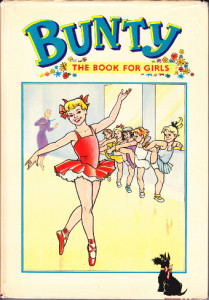
 This is the first Bunty Annual and it is very well put together and has a pretty presentation. There is a dust jacket where the main picture stands out from it’s white frame. In the picture the title character Bunty is doing ballet with Haggis outside the picture. The back of the cover has Bunty representing a montage of months. Including the covers, there is 128 pages, inside the book there are 12 picture stories, 9 funny strips, 8 text stories, and 10 features. There is a contents page, although it does miss out on one story “There will Always Be a Boko”. It is a colourful book, with 62 pages in full colour. Majority of the stories are about characters that reader’s will recognize from the weekly issues; The Four Marys, Moira Kent, Lyn Raymond, Toots etc. The stories cover a variety of themes, such as adventure, animals, ballet, career girls, historical and war. The features often have a tie in to the story such as “Well Done Girls” talks about women’s jobs during the war right after the war based story Lance Corporal Sally. According to the writing inside the cover, the copy that I have belonged to Aileen Beattie dated 1959. (For just the list of contents click here)
Picture Stories & Funny Strips
The Dancing Life of Moira Kent (Pages: 7-14)
Artist: Ron Smith
Moira Kent was the regular ballerina character in Bunty’s early years. The story starts with Moira finishing a tiring dress rehearsal. On her way out she doesn’t stop to sign autographs, as she has a headache, she is then unfairly reprimanded by her grandfather for this. He reminds her that she wouldn’t be where she is without her fans and she promises not to ignore them in the future. If Moira was arrogant and ungrateful about her fans, a reprimand may be in order, but this isn’t the case here! While it is nice to appreciate those that support you, I don’t like if there is a sense of entitlement by fans.
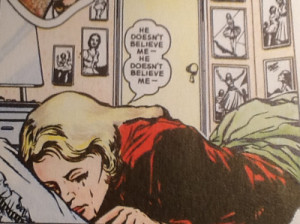
Things get worse for Moira, as unknown to her, a girl in hospital writes to her asking for her autograph but she never receives the letter. Mr Miller, the young girl’s father, a shoemaker, arrives at Moira’s house with new ballet shoes. He tells her, his daughter Gwen asked him to make them for her because she felt bad about bothering Moira for an autograph. He tells her she doesn’t deserve the shoes, as she hadn’t bothered to reply to Gwen. Then both Mr Miller and Moira’s grandfather criticize her and refuse to listen to her protests of never receiving a letter. Moira is understandably upset about these events, so much so that she can’t concentrate at rehearsals. After confiding in the choreographer, Morgan, they take the rehearsal to the children’s hospital and Moira present Gwen with an autographed photo. It’s then that a nurse who was supposed to deliver the letter realizes it’s still in her pocket. Mr Miller and Grandfather look surprised, but if there is any apology from them, we don’t see it. Instead the Grandfather concludes that, that’s the mystery solved, as if he had investigated any other possibility other than Moira ignoring the girl! The men don’t come across great in this story particularly the Grandfather, but Moira doesn’t do herself any favors by not standing up for herself more.
Sunshine Susie in “Girls will be Boys” (Page: 15)
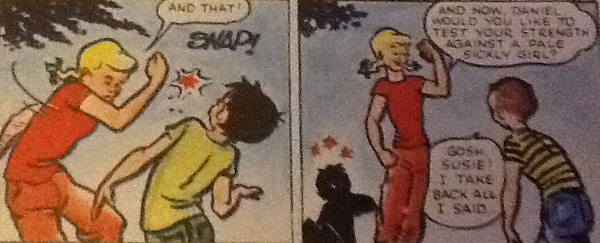
This humour strip is more progressive than the previous story. Susie makes fun of her friend Daniel’s attempts to become a ‘He-Man’, she challenges him to a fight but he says he doesn’t want to fight a sickly girl like her. But when a bully comes along it’s Susie that takes him out and Daniel takes back what he previously said.
Elvirita: The Wishing Well (Pages: 21-22)
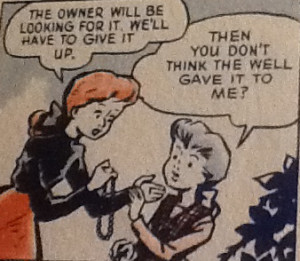 Elvirita a Spanish orphan, is telling stories of a wishing well to neighbourhood children. Rosita, one of the children takes her stories seriously and shows her an old well where she wishes for a puppy. Later she finds a pearl necklace by the well and says the well must have given it to her to buy a puppy. Elvirita tells her that someone must have lost it and they take it to the police station. The owner of the necklace is so grateful for the return of her necklace that she get Rosita a puppy as reward. I like the art style it is simple and sort of cartoonish but not so much that it can’t tackle more serious matters.
Pauline and the Little Nipper (Page: 23)
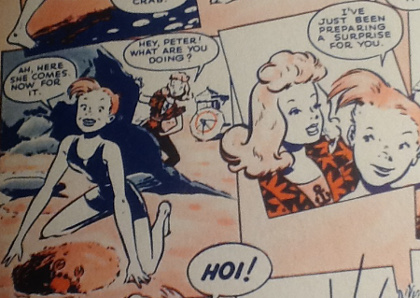
Pauline (a pin-up looking girl) is at the beach. Peter tries to play a trick on her, he plans to get her to put her hand in a hole with a crab in it, but she’s not having it and pushes him into the hole with a crab instead. I do like the art although, when just looking at it at first I didn’t realize Peter was meant to be a boy, he looks very feminine.
The Four Marys (Pages: 26-31)
Artist: James Walker
It wouldn’t be a Bunty Annual without the Four Marys. In this story Mary Radleigh receives a cine camera for an early birthday present. Both her and Cotter film a hockey match which Simpson and Field are playing in. Cotter leaves the camera down during the match, forgetting to switch it off. Meanwhile June a girl that was constantly beating Simpson is injured. Simpson is accused of deliberately tripping her up and is sent to conventry. Only the other Marys stick by her. When Radleigh gets her film back the truth is revealed as it shows June actually fell over goal post. All the third form apologise to Simpson.
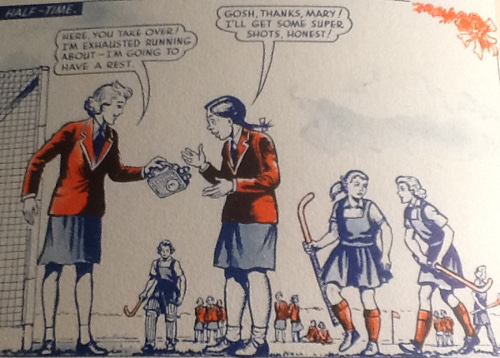
These early Four Marys stories are quaint! I like the distinctive art and in a lot of ways the girls are more caricatures, particularly Cotter, which isn’t a bad thing, they all have an individual look which they lost in later stories. They are also shown to have flaws, Radleigh is quite lazy, while Cotter is clumsy and forgetful. I’m glad that later stories they start using nicknames as calling each other Mary all the time most have been confusing.
There Will Always Be a Boko (Pages: 33-37)
Artist: George Ramsbottom
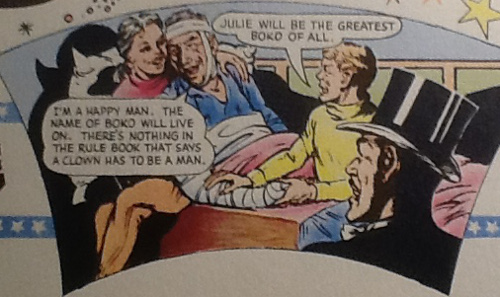
Boko is a legendary clown, whose name is passed down through the circus. The current Boko’s biggest fans are his children, Mark and Julie. Mark worries he won’t live up to the Boko name when it is his turn to take it on. The next day while Julie practices bare horse riding and Mark practices his clown act, but he is too stiff. Then a fire breaks out. Boko runs in to rescue two tiger cubs. There are some nicely drawn action sequences here.
He collapses after the effort and he makes Mark promise the name of Boko will still go on tonight. Mark promises but he is nervous. That night the new Boko is introduced, when Boko hears the laughter from his bed, it helps speed up his recovery, raising his spirits. When the new Boko comes in he says he is proud of Mark but it is revealed to be Julie. Old Boko is surprised but Mark says he just hasn’t it in him to be a clown. The father gets over his surprise and is proud of Julie, he says after all there is no rule that the clown has to be a man. We don’t spend a lot of time with Julie so there is no foreshadowing that she has a talent for clowning but in someways this is better as it makes the reveal in the ending more surprising.
Pat Among the Ponies (pages: 40-47)
Another story involving a fire and animal rescue. This time it is at Moordown Riding School, where a storm breaks out and lightning strike sets the stables on fire. Pat Farley, a student, rallies the girls in her dorm to go rescue the horses. Snip, Pat’s favourite pony is injured during the fire. He goes blind and Major Matthews says he will have be gotten rid of, but Pat convinces him to let Snip stay if she looks after him. On a trek Pat guides Snip. Bad luck for the girls as a another storm, causes water to rise. The girls try to guide their ponies across but they are too scared. Snip blind to the danger is led calmly by Pat and the other horses follow his lead. Snip is hit on the head with a log but manages to get out. When they get back to the stable Snip can see again (the magical trope of – bonk to the head cures all!)
Hetty in “Catch as Cats Can” (Page: 48)
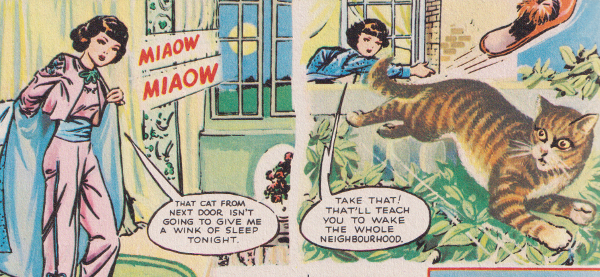
A short funny strip as Hetty, can’t get to sleep because of cat mewing outside she tries shooing him away, when that doesn’t work she feeds him thinking he’s hungry, unfortunately he just brings back more friends for food. Really nice colouring in this one, it is a painted style.
Fan-Fan and Her Friends – Peter’s Christmas (Pages: 49-51)
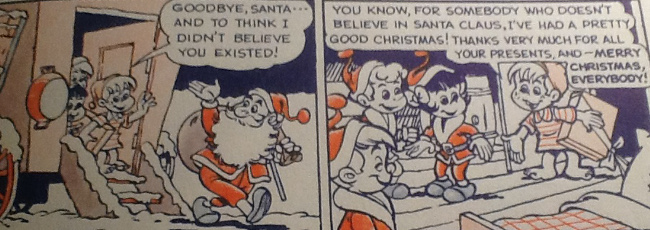
A Christmas story! I assume they don’t put a lot of these type of stories in because it would tie it more to one season, but I still associate the annuals with Christmas, as they were regular present under the tree so I like when there is one. The characters also look very cute. In this story Peter doesn’t believe in Santa as he never comes to his caravan. Sammy decides to fix this by dressing up as Santa and gives him a toy train. Peter is delighted but confused when another Santa turns up and soon figures out what’s going on when a third Santa is revealed to be Fan Fan. Peter is upset and doesn’t believe in Santa again, but then a kindly old man who overheard the kids talking earlier arrives. Peter believes him to be the real Santa Claus and has a good Christmas.
Tess of the Timberlands (Pages: 58-62)
 This is good adventure/action story. Tess Wilson lives in Oregan, on her way to give her dad lunch, she sees a great Eagle snatch a kid goat. She does a daring rescue up the mountain for the goat. When she becomes trapped on narrow ledge the mother goat, who has tracked down her baby, shows Tess the way to safety.
Toots: Mind Your Manners (Pages: 63-64)
Art: Bill Ritchie
A long lasting humour strip. Toots tries to unsuccessfully teach baby some manners. But in the end it is Toots that accidentally makes the most mess at the dinner table.
Kay Hamilton, Show Jumper (Pages: 65-72)
Kay is competing at a novice horse jumping event with Sunset. She is beaten by Pat Martin and his horse Shamrock, while she takes the loss graciously, Jim Scott one of the grooms is suspicious and thinks he recognizes Shamrock as an older ‘Class A’ horse redyed. The two try and investigate at another competition. Pat is not happy with their suspicions and decides its time to clear off, but he also wants to take Sunset as she is the most promising novice he’s seen. That night when robbers try and kidnap Sunset, Kay and Jim try and stop them. They are captured and tied up but Kay manages to break free of the bonds with Sunset’s help. They break out and go to investigate a cottage nearby, where they figure they were being taken to. There it is revealed Pat is involved. He locks Kay into Shamrocks padlock, and she is nearly trampled but luckily Kay manages to calms him by whistling. After escaping the padlock, Shamrock chases Pat down and he is taken away by the police.

Lyn Raymond, Air Stewardess (Pages: 75-80)
Artist: Ron Forbes?
Lyn Raymond is on a stopover in Paris and treats herself to some lipstick. On the flight back to Britain, the pilot informs her there is suspected jewel thief on board, and they have a description. Lyn decides to drop her lipstick to give her an excuse to look at the passengers more closely. Which works except for one grumpy passenger with a newspaper over his head. She finally gets a look at him and he matches the description. She points him out to police on landing but they can’t find diamonds on him. Lyn goes back onto the plane to look for her lipstick, which she seems to have actually lost now. She finds it next to the suspected jewel thief’s seat. Later talking to the police they say they will have to release the man as they have no evidence only he was found with lipstick marks on his hand. That gives Lyn the idea to examine her lipstick and she discovers the diamonds been hidden in the tube, giving the police the evidence they need.

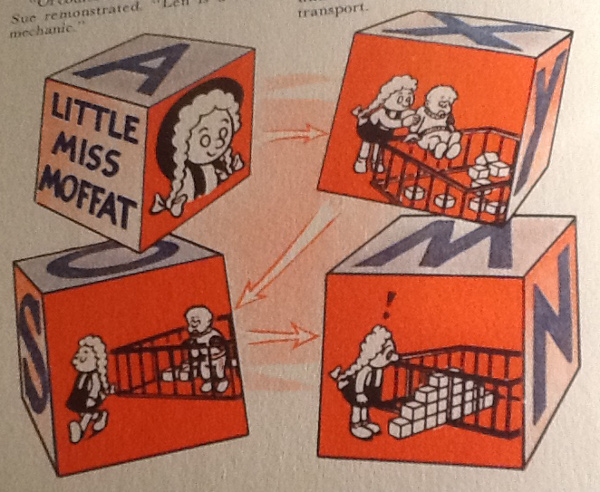
Little Miss Moffat (Page:84)
A very short word free, humour strip, inserted into text story. It makes interest use of framing.
Her Doctor Had 4 Legs (Pages: 86-91)
Artist: Ron Forbes?
Peggy Brooks father brings home a dog Flash to train as champion sheep dog. He is annoyed to see Peggy and Mrs Brooks breaking the rules letting the dog in the house as if Flash is to become a champion he can’t be a pet. Later that night Peggy wakes to Flash barking and her father scaring a burglar away. The next day Peggy seems sick, her parents think its over tiredness but later she collapses. She keeps getting sicker and the doctor can’t figure out what is wrong with her. A week later though Peggy starts feeling better, it is the doctor that discovers Flash has been sneaking in amd sleeping on her bed. It turns out Peggy had been sick with worry about the burgler but with Flash she feels safe. After all is revealed Mr Brooks says she can keep Flash as a pet and he will get a new dog to train as a champion.
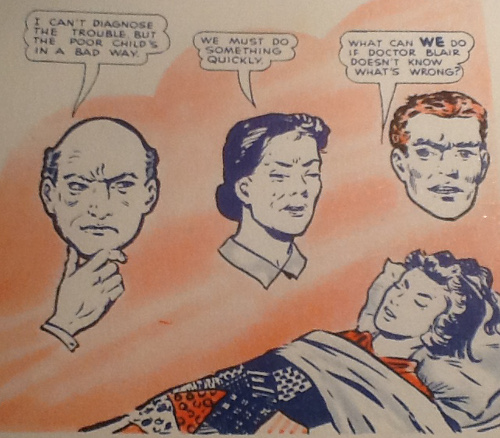
I find this the weakest story, Mr Brooks is painted in a harsh light, but he has spent money on the dog to make a champion, not to be a pet. Peggy’s illness seems a bit far fetched, to get that sick over a burglary attempt and then there is the very convenient cure!
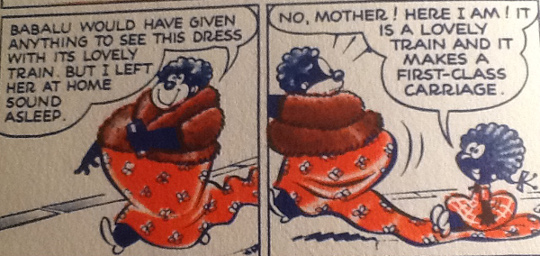
Babalou (Page: 98)
This is one of those funny strips that is product of it’s time that isn’t politically correct in it’s representation. As Babalou’s mother gets new dress, Babalou takes the train part of the dress more literal.
Pert Gert and her Neighbours (Page: 101)
Gert generously lets her neighbours borrow food, but they are soon taking advantage of her kindness. She eventually has to put up a sign that says “Closed – Food Stocks Exhausted”
Maid Marian (Pages: 102-107)
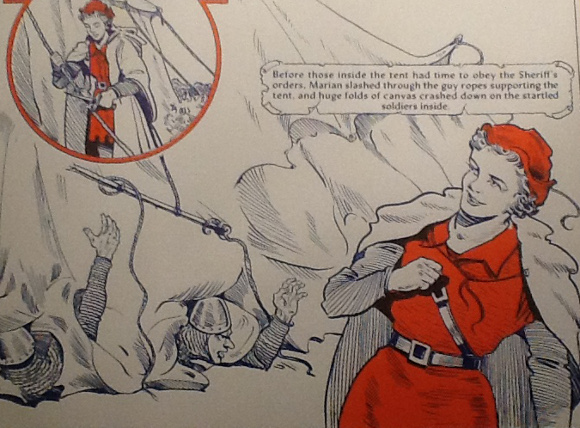
Maid Marian and Sarah her friend and handmaid, are playing bait to the Sherrif and his men. While the Sherriff believes himself to be clever enough to not fall for the bait it turns out the women were just a distraction so Robin Hood and his Merry Men can get into position and take their money. Later the Captain comes up with a plan to enlist Rolf of Navarre to challenge Robin in an archery match. Rolf dresses as an ex-soldier and wanders into Sherwood forest. Marian acts as judge, Rolf wins Robin’s silver arrows. Marian discovers afterwards that Rolf had tampered with Robin’s bow.
Then the sheriff sets up a competition assuming Robin won’t be able to resist trying to win back his silver arrows. At first it looks like he hasn’t shown but playing the fool Robin accepts the challenge. Recognizing Robin’s skill, the Sheriff commands his men to attack but luckily Marian cuts the ropes on the tent the men were hiding in, collapsing it on top of them. Robin and Marian celebrate the return of the silver arrows that night. Bunty would later have a series where Maid Marian led the Merry Men in Robin’s absence, and also a series about their granddaughter Robina Hood. It seems to be a popular myth to be looked at, and it is also nice to see it from a female perspective.
Bess Makes a Dress (Page: 112)
A funny strip about Bess, who throws a tantrum because she wants material to make a dress. Dad gives in, thinking he can bring her to grand mannequin party competition and she will be put off when she loses and is laughed at but to his surprise she wins first prize in the “fantasy” category.
Debbie’s Dream Dress (Pages: 113-117)
Debbie and Grace are members of the junior Red Cross and good friends despite their differences in wealth. On the way to class Debbie admires a dress she would like to wear to a party, but could never afford. The next day on the way to party Debbie wears her old worn dress. While in the taxi a young girl runs out in front of it. Debbie gets out to tend to the girls, she tears strips off her dress in order to bandage her. The girl’s mother comes rushing along and Debbie tells them to take the taxi to the hospital, while she returns home. The woman later tracks Debbie down and tells her that her daughter, Sadie, will be alright and she gives her a new dress to make up for the one she tore up. It’s the dress she previously admired from the shop, it turns out to be the woman’s shop. Debbie is the hit of the party. What a set of coincidences, down to the unlikelihood that the mother would leave her child in hospital, go to her shop and happen to pick out Debbie’s dream dress in the right size and deliver it to her in time for her to get to the party!
Parachute Nurse (Pages: 120-124)
Artist: Ron Forbes?
Susie Peters works in a hospital at Beaver Creek an isolated Mountie post in North West Canada. Susie is disappointed that the only paper available at the local shop is the Farmer’s Gazette as she has no interest in reading about prize bull Rajah being sold. Soon it is very much her concern as the two men delivering the bull, are trapped in a blizzard, they are sent supplies but that night, one of the men Steve is injured by wolves, so Susie will have to parachute down to tend to him. When they flyover they see the pack of wolves have returned, the pilot says she won’t be able to jump now but she says she’ll do it anyway and he needs to fly his plane low after to scare the wolves, she lands expertly. As she tends to Steve the wolves still aren’t giving up Rajah the bull tries to fight them off while Susie makes a giant snowball to scatter them.

That night Susie has a plan prepared for the wolves. She has made little food parachutes, the wolves fight over the meat not knowing its been dosed with medicine. One the roads clear they get to the hospital. Susie gets her picture in the Farmers gazette for saving Rajah. She orders two dozen copies for her families and friends. Always good to see another brave, quick- thinking proactive protagonist who is good at her job


