Tag Archives: Norman Lee

Debbie 1982

Picture Stories

  • Mary Brown’s Schooldays (Pages: 4-9)  [Art: Pamela Chapeau]
  • The Black Tulip (Pages: 12-15)
  • Trixie’s Treasure Chest (Pages: 25-29) [Art: Robert MacGillivray]
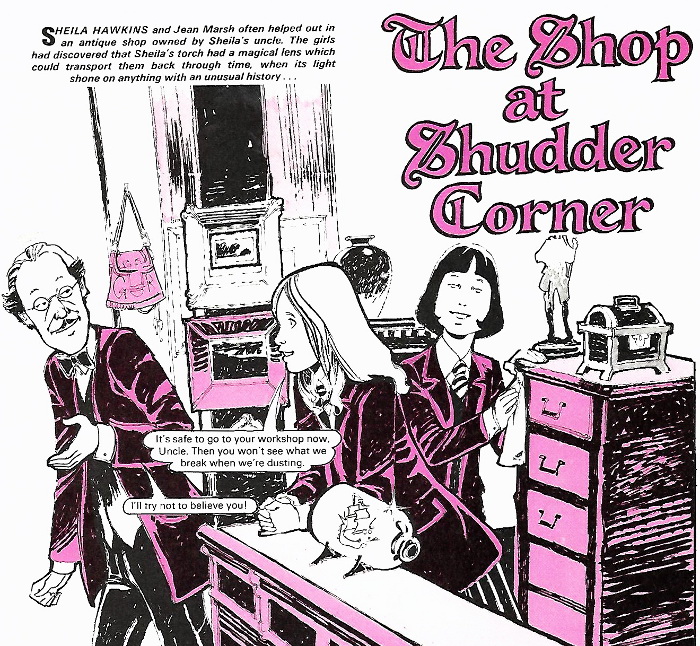
  • The Shop at Shudder Corner (Pages: 30-32) [Art: David Matysiak]
  • Little Sis (Pages: 33-34) [Art: Doris Kinnear]
  • The Boy Who Loved Ballet (Marlova) (Pages: 35-39) [Art: Tom Hurst]
  • The Black Tulip Part 2 (Pages: 50-53)
  • All Because of Perky… (Pages: 56- 61)  [Art: Pamela Chapeau]
  • The Puppet Theatre (Damian Darke) (Pages: 63-68) [Art: Norman Lee]
  • Spring-Heeled Jill (Pages: 71-73) [Art: Tony Hudson]
  • The Black Tulip Part 3 (Pages: 76-79)
  • Little Sis (Pages: 87-88) [Art: Doris Kinnear]
  • The Bionic Horse (Pages: 89-94) [Art: Peter Davidson?]
  • My Pal Lou (Pages: 97-101)
  • A Precious Gift (Pages: 104-106)
  • The Black Tulip Part 4 (Pages: 117-120)
  • Lovely to Look at… (Pages: 121-125) [Art: David Matysiak]

Text Stories

  • A Gift of Friendship (Pages: 10-11)
  • When the Snow was Round About. Deep & Crisp & Even…. (Pages: 54-55)
  • Meg of the Moors (Pages: 69-70)
  • Nature’s Own Special Magic (Pages: 95-96)

Photo Stories

  • A Summer Place (Pages: 17-22)
  • My Friend Flappers (Pages: 42-48)
  • Harriet (Pages: 82-86)
  • Unlucky 13 (Pages: 108-112)

Features

  • Debbie Superpets (Pages: 16)
  • Dolly Mixtures (Pages: 23-24)
  • Are You a Good Friend? (Pages: 40-41)
  • Debbie Superpets (Pages: 49)
  • Ribbons and Bows (Pages: 62)
  • What a Spread! (Pages: 74-75)
  • Debbie Superpets (Pages: 80)
  • Teaser Time (Pages: 81)
  • Are You a Party Girl? (Pages: 102-103)
  • Teaser Time (Pages: 107)
  • Debbie Superpets (Pages: 113)

(Click on thumbnails for bigger pictures)

Debbie 1981

Picture Stories

  • The Ice Roses (Pages: 4-8) [Art: David Matysiak]
  • My Pal Lou (Pages: 11-15)
  • Trixie’s Treasure Chest (Pages: 17-21) [Art: Robert MacGillivray]
  • Cat’s Eye Cottage (Pages: 22-24) [Art: Jordi Badia Romero?]
    • Reprinted and translated into Dutch as “Huize Katte-oog” and published in Groot Tina Winterboek 4/1980 (1980)
  • Little Miss Featherfeet (Pages: 33-37) [Art: George Martin]
  • Spooky Towers for Ghost and Glamours (Pages: 40-43)
  • Little Sis (Pages: 45-46) [Art: Doris Kinnear]
  • Meg of the Moors (Pages: 50-54) [Art: “B Jackson”]
  • Mary Brown’s Schooldays (Pages: 57-62) [Art: Pamela Chapeau]
  • Picture, Picture on the Wall… (Damian Darke) (Pages: 65-69) [Art: Norman Lee]
  • Stella From the Stars (Pages: 82-87) [Art: Tom Hurst]
  • The Bionic Horse (Pages: 88-92) [Art: Peter Davidson?]
  • A Bowl of Broth (Pages: 94-96) [Art: George Martin]
  • Jo and Mo (Pages: 97-101) [Art: Tom Hurst]
  • The Shop at Shudder Corner (Pages: 108-112) [Art: David Matysiak]
  • Little Sis (Pages: 113-114) [Art: Doris Kinnear]
  • It Hurts to Say Goodbye (Pages: 120-125) [Art: Tony Hudson]

Text Stories

  • The Spirit of Christmas (Pages: 30-31) [Spot Art: David Matysiak]
  • The Happiest Christmas Ever (Pages: 63-64)
  • The Little White Flower (Pages: 70-71)
  • No Sympathy for Sandie… (Pages: 116-117)

Photo Stories

  • Don’t Laugh at Suzi (Pages: 25-29)
  • Lonely Carol (Pages: 103-107)

Features

  • Poems (Pages: 2-3, 126-127)
  • A Vet’s Best Friend.. (Pages: 9-10)
  • Debbie Superpets (Pages: 16)
  • Teaser Time (Pages: 32)
  • Are You the Practical Type? (Pages: 38-39)
  • What’s Cooking? (Pages: 44)
  • It’s Top of the Pops! (Pages: 47-48)
  • Debbie Superpets (Pages: 49)
  • Girls in Uniform – A Fair Cop! (Pages: 55-56)
  • Saffy and the Puppies (Pages: 72-77)
  • Girls in Uniform – Jenny Wren! (Pages: 78-79)
  • Debbie Superpets (Pages: 80)
  • Teaser Time (Pages: 81)
  • What’s Cooking? (Pages: 93)
  • Teaser Time (Pages: 102)
  • Debbie Superpets (Pages: 115)
  • Girls in Uniform – Jaguar Girl (Pages: 118-119)

(Click on thumbnails for bigger pictures)

Debbie 1980

Picture Stories

  • Mary Brown’s Schooldays (Pages: 4-9) [Art: Pamela Chapeau]
  • The Night Before Christmas (Damian Darke) (Pages: 12-16) [Art: Norman Lee]
  • Skip ‘n’ Rope (Pages: 19-23)
  • Meg of the Moors (Pages: 26-30) [Art: “B Jackson”]
  • Little Sis (Pages: 41-42) [Art: Doris Kinnear]
  • Jo and Mo (Pages: 43-47) [Art: Tom Hurst]
  • The House That Cared (Pages: 50-54) [Art: Jordi Badia Romero?]
  • My Pal Lou (Pages: 57-61)
  • Little Miss Featherfeet (Pages: 64-68) [Art: George Martin}
  • If You Can Help Somebody… (Pages: 72-76)[Art: Carmen Barbara]
  • Little Sis (Pages: 79-80) [Art: Doris Kinnear]
  • Trixie’s Treasure Chest (Pages: 83-87) [Art: Robert MacGillivray]
  • The Bionic Horse (Pages: 90-94)  [Art: Peter Davidson?]
  • The Flower Princess (Pages: 97-99)
    • Reprinted and translated into Dutch (as “De bloemenprinses”) – monthly Debbie Stripstory #4/1980.
  • Polly’s Patches (Pages: 102-104) [Art: Tony Speer]
  • London’s Burning! (Pages: 113-117) [Art: David Matysiak]
  • Swan Song (Pages: 120-125) [Art: Tony Hudson]
    • Reprinted and translated into Dutch as “Zwanezang” –  Groot Tina Lenteboek #1/1981 (1981).

Text Stories

  • The Silver Locket (Abigail’s Tale-1666)  (Pages: 17-18)
  • The Silver Locket (Morag’s Tale-1746)  (Pages: 39-40)
  • …A  Poor Church Mouse… (Pages: 70-71)
  • The Silver Locket (Alice’s Tale-1840)  (Pages: 81-82)
  • The Silver Locket (May’s Tale-1912)  (Pages: 95-96)
  • The Silver Locket (Jane’s Tale-1979)  (Pages: 105-106)
  • Goodbye, Lonliness (Pages: 118-119)

Photo Stories

  • The Wishing Well (Pages: 33-37)
  • The Forbidden Garden (Pages: 107-111)

Features

  • Autumn Poem (Pages: 2-3)
  • Herbs Can Grow On You! (Pages: 10-11)
  • Stepping Out to Stardom (Pages: 24-25)
  • Accidents Will Happen (Pages: 31-32)
  • Superpets (Pages: 38)
  • Teaser Time (Pages: 48)
  • Superpets (Pages: 49)
  • Fabulous Falabellas! (Pages: 55-56)
  • Room for Improvement (Pages: 62-63)
  • Superpets (Pages: 69)
  • These Legs were Meant for Dancing! (Pages: 77-78)
  • Jim Fixed It! (Pages: 88-89)
  • It’s a Knock-Out! (Pages: 100-101)
  • Teaser Time (Pages: 112)
  • Spring Poem (Pages: 126-127)

(Click on thumbnails for bigger pictures)

Judy 1990

Picture Stories

  • The Christmas Spirit (Pages: 4-9) [Art: Andrew Wilson]
  • Home Cooking (Pages: 11-15) [Art: John Armstrong]
  • Judy & Co. (Pages: 16) [Art: Norman Lee]
  • “I’ll Tell Him…Later!” (Pages: 17-21) [Art: Claude Berridge]
  • Girls Who Wear Glasses… (Pages: 24-27) [Art: Bert Hill]
  • Pepper the Pony (Pages: 28)
  • Bobby Dazzler (Pages: 29-32) [Art: Giorgio Letteri]
  • Lost on the Moor (Pages: 40-43)
  • Junior Nanny (Pages: 45-47) [Art: Oliver Passingham]
  • Judy & Co. (Pages: 48) [Art: Norman Lee]
  • Saturday Date (Pages: 49-52) [Art: Ana Rodriguez]
  • Wee Slavey (Pages: 54-58) [Art: “B Jackson”]
  • Cinderella Jones (Pages: 60-64) [Art: Oliver Passingham]
  • A Package for Paula (Pages: 65-67) [Art: Jose Maria Bellalta?]
  • The Ghost of Armley Fell (Pages: 71-75) [Art: “B Jackson”]
  • Laura’s Lesson (Pages: 76-79) [Art: Eduardo Feito]
  • Jimmy’s Journey (Pages: 81-85)
  • Penny’s Pony (Pages: 88-93) [Art: Oliver Passingham]
  • Judy & Co. (Pages: 96) [Art: Norman Lee]
  • The Treasure (Pages: 97-104) [Art: Jim Eldridge]
  • Pepper the Pony (Pages: 105)
  • The Gift Horse (Pages: 106-109) [Art: Julian Vivas]
  • A Bone for Barker (Pages: 113-117) [Art: Claude Berridge]
  • ABC of Love (Pages: 118-121) [Art: Sean Phillips?]
  • Judy & Co. (Pages: 123) [Art: Norman Lee]

Text Stories

  • Rivals for Robbie (Pages: 68-70)
  • Christmas Bells (Pages: 110-111)

Photo Stories

  • Night of the Cat  (Pages: 33-37)

Features

  • The Personal Touch (Pages: 10)
  • Pony Language (Pages: 22-23)
  • Horses and Riders (Pages: 38-39)
  • Dog (Pages: 44)
  • It’s a Dog’s Life (Pages: 53)
  • Swans ‘n’ Things (Pages: 59)
  • Christmas Crackers (Pages: 80)
  • A Monster in Wool (Pages: 86-87)
  • Gymkhana (Pages: 94-95)
  • It’s Magic! (Pages: 112)
  • Wild Flower Trail (Pages: 122)
  • Pumpkin Pie (Pages: 124-125)
  • Click! (Pages: 126-127)

(Click on thumbnails for bigger pictures)

Ashamed of Her Mum (1986)

Published: Debbie PSL #100

Reprint: Bunty PSL #418 as “Trapped!”

Artists: Norman Lee (cover); Ron Lumsden (story)

Writer: Unknown

Plot

Thirteen-year-old Meg Ferns and her widowed mother have just moved to Redport. At her new school, Meg is impressed with the looks of Arlene Ainsley and her gang and wants to be friends with them. But they are snobs and don’t think she’s good enough for them.

Moira Samson does offer to be friends with Meg, but Meg declines as she still wants to get in with the Ainsley gang and they wouldn’t like Moira, whose background is not good enough for them either. When Meg sees Arlene’s glamorous mother she wishes her mother were like that instead of being in a factory job and doing nothing but housework when she comes home.

In town, Meg sees a glamorous model at a shoot and learns her name is Lillian Ferns – the same surname as hers. She thinks it would be so marvellous if Lillian were her mother. The snobs come along, talking about the same model. Before she knows what she is saying, Meg brags to them that the model is her mother. The snobs fall for it – except one, Priscilla. The other snobs are all over Meg now, but Priscilla means to investigate Meg’s claims.

So the double life of deception and its complications begin for Meg. And although she does not know it (yet) she has the added handicap of one girl being on to her from the start and determined to catch her out. Priscilla starts by checking out Lillian’s address (and Meg realises that’s more than she did) and having Meg invite them over to her “mum’s” house. At the house she convinces them that “Mum’s” not in, but she sees Priscilla hanging around to see if she does enter the house and realises Priscilla is suspicious. Seeing a key in the door, Meg takes advantage to enter the house, pretend she’s coming home, and hopefully throw Priscilla off the scent.

At this point Lillian catches Meg. Meg blurts out the whole story. Realising how desperate Meg is to keep those snobs from finding out, Lillian proceeds to take full advantage. She agrees to help with the pretence – on one condition. As Lillian has no housekeeper at the moment, Meg is to become her housekeeping slave, and without one penny in payment. It also means getting up extra early, dashing twelve miles to serve breakfast and back to school, back again at four for chores, back at any time Lillian wants her, do any catering she wants, etc, etc, … otherwise, she will tell those snobs the truth. And there is a verbal earbashing whenever Meg doesn’t do the job right. Er, what was that you said about it being so marvellous if Lillian were your Mum, Meg?

Of course this is soon causing difficulties, such as Meg getting lines for being late for school. But Meg is gaining in confidence because she is getting it so good for the Arlene gang and thinks she is real friends with them now. She throws a scare into Priscilla to hopefully throw her off, but Priscilla only pretends that it worked. Moira also warns Meg to be careful about getting on the wrong side of that snobby lot, but Meg doesn’t listen.

As Lillian has given Meg her house key for the chores, Meg has full access to the house to show it off to the snobs while Lillian is out. They lap up all the luxuries it offers. Priscilla takes advantage to do some snooping. As she suspected, she finds no photographs of Meg in the house or any bedroom that looks like hers. She also helps herself to the food Lillian laid out for the party she is going to hold that night. When Lillian finds out about the food, she is absolutely furious with Meg.

At the party Meg has to do all the waitressing. Ironically, one guest, Mr Tolman, comments that she looks photogenic and should consider modelling herself. Meg also spots Priscilla spying outside and rushes to close the curtains in an awful hurry. The trouble is, Lillian pulls them in the opposite direction, which causes the whole thing to come crashing down. Lillian really blows her top at Meg because she wanted to impress Mr Tolman as he owns the advertising company she wants to work for. Meg is also worried about what Priscilla will say the following day.

Next day at school, Priscilla laughs at Meg for dressing as a waitress and “curtain calls”. Meg manages to pass off the waitressing as a punishment for the food Priscilla scoffed, and kindly stop snooping. This makes Priscilla unpopular with the other snobs and Meg thinks she is now safe from her. Meg’s an even bigger hero than ever with them now, especially with Arlene. It now looks like all that slaving for Lillian is worthwhile. However, Priscilla is not only still suspicious but also upset that Meg has pushed her out and wants revenge.

Meg has another close call when Mum waves to her across the street and the Arlene gang comment on how common she looks. They buy Meg’s cover story that she’s the cleaning lady – except Priscilla, who notices that “the char” bears a strong resemblance to Meg and begins to put two and two together.

The same incident has Meg beginning to feel ashamed of the way she is treating her mother because of this deception. For the same reason she begins to get closer to Moira. But the gang warn Meg they will no longer be friends with her if she continues with “peasants” like Moira. At this, Meg realises how wrong she had been to bother with those snobs at all.

So Meg decides to end her deception, starting with revenge on Lillian. Meg tells Lillian she’s had enough of her and then heaves a bucket of dirty scrubbing water all over her. She hears with great satisfaction that she has ruined Lillian’s new Paris outfit, and then walks out.

Next day at school, Meg finds out she ended her deception at just the right time – the game is up anyway. Priscilla snooped into the school records, found Meg’s real address and her mother’s occupation, and has now informed the others. They are ready to confront her, but Meg stands up to them. Moira sees the commotion and rouses a prefect, who tells the snobs to clear off. Meg explains how it was really her fault to start with, but what makes her really ashamed over it all was how she let her mother down. The prefect tells Meg not to worry about that; she’s learned her lesson. Moira’s offer for friendship is still open, and this time Meg accepts.

Remembering how photogenic Meg looked, Mr Tolman tracks her down and gives her a job in TV adverts. Everyone is pleased for Meg – except for certain snobs who are green with envy.

Thoughts

There have been plenty of stories where protagonists run a double life, pretending their backgrounds are grander than they really are, all because of a bunch of snobs. Inevitably the deception gets complicated and there is no way they can keep it up indefinitely. The question is what will happen when the inevitable does happen. “Pop Starr” from Bunty is one example.

It’s unusual to have one girl suspicious of the deception from the start. Usually in these types of stories someone grows suspicious over time. That or the protagonist just gets caught right out. Perhaps it was the 62-page limit, which did not allow for one of the snobs to become suspicious over time. However, it does make the story even more exciting and different, having someone onto the protagonist from the very start. And Meg is quick to realise Priscilla suspects her, which sets a very exciting premise for keeping one step ahead. Meg soon proves she can do it very aptly, and is very deft at thinking quickly to get out things if those snobs get too close and foiling Priscilla’s attempts to catch her out. Unfortunately for Meg, she cannot get Priscilla off her back entirely, especially when Priscilla gets vengeful.

This deception story has the Cinderella and blackmail themes thrown into the mix as well, which makes it even more striking and interesting than a mere string of lies, close calls and complications as the deception snowballs and the protagonist falls deeper and deeper into a sticky web of deceit. The true real-life personality of the glamorous model Lillian Ferns is there to teach Meg to appreciate what she’s got in her own mother and being rich and famous does not necessarily mean an improvement. The lesson is slow in coming, though. It takes Meg’s treatment of her mother as part of her deception to make the lesson sink in.

There are always prices the protagonist has to pay while carrying out her deception. Meg’s biggest one is becoming an unpaid slave to Lillian Ferns. Lillian Ferns comes from another popular theme in girls’ comics: a famous celebrity who is in fact a nasty piece of work in real life. “Aunt Aggie” (Tammy) and “Everyone’s Perfect Mum” (Mandy) are other examples. Not to mention using blackmail to turn the protagonist into their slave, and there are countless examples of that in girls’ comics. It is obvious that Lillian’s treatment of Meg stems from her being tight-fisted, not to mention being a bully and bad employer. She can well afford a housekeeper instead of using Meg as unpaid help, and pay Meg well for what she’s doing. But she does neither. We bet the reason Lillian doesn’t have a housekeeper is that the last one quit because Lillian was just as horrible to her. It would not be surprising if quite a few housekeepers had quit Lillian’s employment already and she’s now on a number of blacklists at employment agencies. With any luck the real-life Lillian will be found out and it won’t just be her new outfit that gets ruined. Lillian’s treatment of Meg has already ruined her chances with Mr Tolman and even got the job in Lillian’s place. Lillian will be absolutely fuming when she finds out. And the irony is, it’s all her own fault because of the way she treated Meg.

There are a few ironies too, in the way Meg develops through her deception. For example, Meg becomes accepted by the snob gang she finds her confidence growing, but in the wrong way. Her true confidence comes when she decides she’s had enough of Lillian and stands up to her. And heaving that bucket of water in Lillian’s face is absolutely priceless! We don’t often see protagonists in blackmail stories turning around and getting their own back on their blackmailers, so we just love seeing it here. Meg also develops quick wits and thinking on her feet in the way she can pull herself out of those sticky situations she get herself into.

We reckon that if the snobs had not found Meg out she would have told them anyway, and tell them to sod their stuck-up ways too. Which is of course what she should have done in the first place when the Arlene gang turned her down because they were so stuck up. But instead she wants to continue pursuing them despite their snobby rudeness to her. Even then she can see there is a good friend waiting in Moira, but keeps throwing it away because she is wasting time and energy trying to get in good with those snobs.

Silver linings do come out of the clouds in this story. As well as becoming more mature, confident and learning what true friends are made of, Meg also gets a glamorous job and possible future career out of it all. So life will become a lot better for Meg and her mother. And we can just see Lillian’s face when she finds out about Meg’s job.

Judy 1992

This was the second to last Judy annual published, and is filled with an impressive 25 picture stories/humour strips, 2 text stories, 2 poems and 2 features. The cover is winter themed  with Judy making a snowman. Inside it has the opening splash page of Judy & Co. at Summer Fayre and  the last pages has them at the Winter Fayre in the same composition, I like those bookend type pictures. This book also has a table contents. There are a nice variety of stories; a good lot of humour, spooky, drama and a bit of Christmas magic. Plenty of  regulars make and appearance such as Junior Nanny, The Honourable S.J, Wee Slavey and Bobby Dazzler. There are 5 specifically Christmas themed stories, and others that seem to be set around winter. (For just a list of contents go to the next page)

Picture Stories

A Christmas Wish   (Pages: 4-11)

Art: Guy Peeters

Starting things off on a Christmas note, this is the story of Jenny who lives with her invalid mother in small flat, in a poor part of town. Jenny tries to stay positive for her mother’s sake, especially as this may be her last Christmas. She tells her they will have nice Christmas goodies as she goes out shopping, while in reality her savings don’t stretch to much. She picks up a small turkey, bruised apples and a few cheap flowers for her mom. Returning home she trips in the doorway and is helped by a girl. The girl then asks a favour  to help her and her friends deliver toys to children’s hospital. Jenny although anxious to get back to her mom, is happy to help a good cause. Afterwards as she is returning home, the driver who is dressed as Santa, asks her what her Christmas wish is. Jenny says she would like a beautiful view for her Mom on Christmas, as she is confined to the flat.

The next moment Jenny wakes up in hallway, she thinks she must have been knocked out when she fell and it was all a dream. When she picks up her shopping she is surprised by a change, everything she bought seems to be fresher and bigger. When she goes to her Mom Christmas morning and opens the curtains, they see it has been snowing and it makes the usual dull view look beautiful, delighting Jenny and her mom. It’s a nice story with a bit of Christmas magic to get readers into spirit of things.

What is a…Mum?/ Dad? / Brother? /Sister?  (Pages: 10 / 48 / 81 / 113)

These fun little strips consist of one page (7 panels) and start with “a mum is someone who…” and then gives 6 panels of more annoying habits of the family member, before the last panel showing a good quality.

“Don’t Touch My Hair!” (Pages: 14-15)

Art: Matias Alonso

Liz Croft is delighted when she gets picked to  act for a shampoo commercial, but this fame quickly goes to her head. She becomes more boastful, but a worse trait is she becomes over cautious about minding her hair. Because she doesn’t want it damaged, she makes excuses to miss a swimming competition, backs out of helping at a friends BBQ, she spends some of her moms money on expensive shampoo and attacks a girl who catches her hair in door as a joke. The evening the ad is meant to air, she invites some people to watch but is in for a shock when her part get cut. She is upset about this, and even more upset realising what how foolish she has been, she decides to cut her hair and hopes to make up for her past actions.

It’s a good lesson learned for Liz  (and for the readers) about priorities and not to get swept out by looks or fame. It has also some really nice art.

Wee Slavey (Pages: 17-21)

Art: “B Jackson”

At the Shelby-Smythe house, William’s nephew, Nigel, is visiting.  Nellie is quite fond of the charming and pleasant man, but William is not impressed with his career aspirations. Nigel is hoping William can help with his acting career, but William refuses. As Nigel leaves, he tells Nellie his only hope is to get in contact with a long absent Aunt Clarissa. Then coincidentally a few days later Clarissa arrives! Nellie hopes to get a message to Nigel but is caught and reprimanded by Lady Amelia. Clarissa hearing this thinks she could do with a servant if they are not happy with Nellie. Of course the Shelby-Smythes can’t be without Nellie, so end up giving her wage increase much to her surprise. Meanwhile Clarissa is talking abut how well Nigel is doing and William thinks maybe they should invest in him after all. Later at Christmas dinner, Nellie accidentally knocks into Clarissa and her wig falls off revealing “Clarissa” to  actually be Nigel! He assures the family he was about to reveal himself anyway, and he just wanted to prove his acting talent. William angry at being made a fool, wants him out of the house. Nellie can’t help but giggle at Nigel in the dress and soon the whole family see the funny side and Christmas is saved!

While this is set at Christmas, it’s not very prominent in the storyline, other than the dinner and the importance of family. There are other more Christmas themed Wee Slavey stories that come to mind first, so it was only on a re-read I realised this was set at Christmas! Wee Slavey can always be relied on to be good fun and Nellie usually comes up on top.

Pepper the Pony (Pages: 22 / 112)

In this long standing humour strip of Lucinda and her pony Pepper, they manage to get the upper hand in the two stories presented here. In the first strip, Lucinda’s cousin Basil arrives showing off his 4 wheel drive car boasting about how much better it is than a horse. But Lucinda outsmarts him by challenging him to race, which she wins as when they come to a wall of course Pepper can jump while Basil is left stuck in the car.

In the second strip another arrogant person, Sheila, looks down on Pepper for not being as groomed as her horse. Lucinda does spruce Pepper up, but Sheila still makes nasty comments. She gets her comeuppance when she jumps into muddy water with her horse and there the ones that look unkempt.

The Badge (Pages: 23-27)

Julie is delighted when Johnny gives her his Fleece Club Badge, as it’s a sign that they are a serious couple. But even so, Julie can’t help but feel insecure, especially When Johnny is talking to friendly and pretty girl Wendy. Her and Johnny have a fight about this, and soon after, when she is out, he collects his badge back from her mom. Then she sees Wendy with a badge and she looks guilty. Julie is terribly upset until Johnny turns up for disco. He had taken badge to make it into a pendant for her. She realises how silly she was, Johnny’s been quiet because of exams and Wendy looked guilty because she is nice person and had heard they quarreled about her. She finds out from Johnny that Wendy is now going out with another Fleece Club member. She feels happy and content now.

There isn’t a lot of romance themed stories in this book, this story while not a favourite is still fine. Julie’s insecurities seem relatable, and I’m glad that Wendy wasn’t some antagonistic girl trying to steal her boyfriend, she is just a genuinely nice person.

Judy & Co. (Pages: 28 / 58)

Art: Norman Lee

Our title character gets two strips on this book. In the first Judy prepares herself, making sure she’s comfortable and won’t be disturbed so she can read her favourite magazine “Judy”. Always a little strange when characters in these books reference the book they are fictional characters in, but it is a regular occurrence! (it’s also acts as advertisement so readers know they should pick up weekly issues).

In the second story, it’s a more straight forward humour set up. Judy tries to sled into boy to get their attention, but they jump out of the way except one…. a snowman.

Cinderella Jones (Pages: 29-32)

Art: Oliver Passingham

At Happyholme they are celebrating Mr Jones 50th birthday and mention how Agnes 50th birthday will be soon after that. Cindy goes to give Agne’s Aunt Flossie cake and she goes to take her photo, but Flossie tells her she already has lots of photos and encourages Cindy to look through them. When Agnes hears Flossie still has a photo of her entry to a beauty contest when she was 18, she gets very snappy, tells Cindy to get on with housework and for the rest of the day she is in a bad mood. Agnes decides it’s time for a clear out and makes a big bonfire, getting Cindy and Mr Jones to do most of the work. Agnes brings out more bags to bur,n but Cindy notices they are Flossie’s photos, she finds the one stepmother doesn’t want her to see and she sees why she wants it burns. Agnes chases her around, she makes promises of more money and help for Cindy. The photo shows that Agnes has been lying about her age shes 55 not 50. Mr Jones wonders whats going on but Cindy says its just her and Stepmothers secret and burns the photo. Agnes praises Cindy and then gets Isobelle and Sarah to get up off sun loungers and help.

Another on of my favourite characters, I like that despite everything Agnes and Cindy do have a good relationship, and Passingham does a great job at the comedic expressions. It is one of those stories where Cindy often breaks the fourth wall, addressing the reader directly, which is fun and gets reader more invested with the character.

My Sister’s Keeper (Pages: 33-37)

Alison Fry lives with her parents writers of child psychology (what an oddly specific job, for something that barely comes into play). She is happy when they decide to foster a girl the same age as her, Glenda. Not much is known about her, she had turned up nearly a year ago with no family. Alison tries to be welcoming, when she enquires about a box she has, Glenda is very possessive of it and asks Alison to never open it. One day Alison finds her in the woods one day talking to someone but she can’t make out who. Glenda says it was her sister, Serena, an air hostess. When she voices her concerns to her parents, they tell her orphans often invent siblings when they are lonely and she just needs time to adjust (presumably their psychology knowledge coming in useful!). Glenda still goes off on her own a lot and talks about her sister to other classmates, making things awkward for Alison.

Glenda tells Alison her, that Serena is taking her to Tunisia for a week and then when Alison can’t go to school because of cold, they are very worried when Glenda doesn’t return. They go to talk to her form teacher who says her sister collected her. Alison gets the idea to look in Glenda’s box for a clue. In it she finds a newspaper clipping dated exactly a year ago with story of air stewardess saving passengers in a flight to Tunisia but herself and sister Glenda were killed. Spooky stories where it turns out the person was a ghost all along was quite popular in annuals, presumably as the reveal was a good way to end the story and fitted well into the short story format.

Candy’s Crowd (Pages: 40-47)

Art: Eduardo Feito

Candy and her friends Ann, Patti and Di are all going on a skiing trip with the school. Ann is upset that her dad may get new job and she will have to leave Fullwood and her friends. Mr Potter, one of the teachers that is meant to be organising the trip is very scatterbrained, so he muddles things up such as what rooms everyone is in and nearly taking Bernice’s mom’s bag. Bernice is a pain and know it all so Candy’s not too upset when she hurts her leg, while showing off. Meanwhile Patti’s getting to know some boys and Ann finds out her father got the job, so girls want to try and make this the best holiday. On the last night they have disco and fancy dress competition. After return home, Patti is going to miss Alan, the boy she met, but she gets over it when she hears about new neighbour. Meanwhile Ann hadn’t heard the whole story about her Dad’s new job, it turns out he isn’t taking job as his current job has given him a promotion, so Candy’s crowd get to stay together.

Candy’s Crowd was Judy’s soap story for a while but not as well known as other similar stories like The Comp or Penny’s Place. Still it is fine story and also notable for Eduardo Feito’s art.

Linda’s Lesson (Pages: 52-57)

Art: “B Jackson”

In 1890 Linda Robertson starts her first day  as a maid in the Cobden house. Linda’s mother thinks she doesn’t know what hard work is, and that is why she has been sent here, but Linda thinks it’ll be easy. She soon finds that her mother was right, not only is she worked off her feet, the butler Mr Bennet slaps her for impertinence and cook gives her a small grisly piece of meat for dinner. Linda says some odd things and she gets another slap for asking what coal is. She tells another maid Daisy about her mom and that she is going to contact her saying she’s learned her lesson. She goes upstairs and pulls out a computer. It turns out Linda’s from 200 years in the future, she returns and tells her mom she wont ever complain of chores again. Especially as it’s so easy in 21st century as we see her command robot to do all tidying. (Yes she really had little to complain about!)

The Girl with the Golden Smile (Pages: 59-63)

Art: Bert Hill

Anna Marshall  is a trainee at Westerby’s department store, meaning she moves around all the departments in the store. One day in the china and gift department Anna learns about their wedding list service that the store runs, where people can leave a list of gifts they would like and wedding guests can come and pick an item off it. One such customer that is using the wedding list, is a young bride, Bridget. When Bridget’s great grandmother arrives to look at the list, Anna notices she seems troubled. Then Anna notices the problem, all the items are very expensive, and  the old lady is feeling deflated. But Anna comes up with perfect solution, a crystal vase, they come in all sorts of sizes including miniature  and that can fit in the old lady’s budget.

A few weeks later Anna is in the bakery department and delivers a wedding cake to Bridget, there is one problem for Bridget as she’s not happy with the plastic decoration. Again Anna has a helpful suggestion, then the way out she bumps into the great grandmother who has come to see the wedding gifts displayed. She thinks Bridget is ashamed of her small gift, but it turns out it is now in pride in place on top of the cake (thanks to Anna’s suggestion). She is so happy that it will even be in the wedding photos, Anna thinks today the grandmother has the golden smile.

Bridget seems to be a bit thoughtless, from the little we see, I think her wedding preparations might take a toll on the people around her! It is a very sweet story though, because you do feel for the great-grandmother, who is put in an awkward position thinking she can’t afford anything, so it is nice to see how everything works out and she gets a boast of pride at her present being so important.

Big ‘n’ Bertha (Pages: 64)

Anther humour strip, here Dad tricks Big and Bertha into falling into pond as he takes their photo, by asking them to take a step back. But they get their own back by making him back into wet cement when he takes another photo.

The Honourable S.J. (Pages: 65-80)

Art: Paddy Brennan

This is set during S.J and Ann’s time at Millford. It is Christmas and S.J still has all the girls fooled that she is nice person, only Ann knows better. She wants Ann to convince the girls to buy her a porcelain horse for Christmas, but she is too late to persuade them and they buy her a big box of chocolates. S.J. is not going to let it go that easy so she steals the chocolates and then makes sure Ann will get the class to get the right gift to replace them. She also steals £10 from a student’s Christmas card, then lends her £10 saying she can pay back next term, making her look very generous.

Ann is then invited to the Christmas Ball at Moorfield Hall by the Headgirl. She thinks S.J will be mad and stop her, but she says she will be home in the Cheetwell Hall playing Santa for children of  a local orphange. Then Ann hears her scheming on phone with her chauffeur, Wilson, telling him to wait for her at side gate of Moorfield Hall and she will be in her Santa outfit. Ann at first thinks S.J. is out to spoil things for but  then she realises S.J. being more devious than that and is after the jewellery that Lady Moorfield gives out every year. By coincidence at the party, Ann sees S.J. dressed as fairy attack the Moorfield Santa, when she confronts S.J. she locks her in a cloakroom. Luckily there’s another way out, but she isn’t in time to catch S.J.. Ann thinks S.J. has won again, as without any other witnesses, no one will believe her. S.J makes appearance at the Cheetwell party giving gifts to orphans will look good for her in the paper though she really wants to get away and check out her goodies. Ann after returning from the party hears the news of the theft, and she is delighted to find out that this year Lady Moorfield sold her jewellery to help carious charity and each box tells what charity it has gone to. While Ann happily takes in this news, S.J. is discovering this herself as she opens up the boxes, it’s not fair, she thinks!

It’s quite a long story at 16 pages, and anyone that wasn’t familiar with S.J. certainly gets to know what kind of person she is. The actual main plot of the Christmas ball doesn’t get going until later in the story, so we get to see S.J.’s other devious scheming beforehand. It is very satisfying end to see that things don’t work out for S.J and her expression at finding this out is very well conveyed.

Who’s Spoiling Things for Lucy? (Pages: 82-89)

Art: Claude Berridge

Lucy feels lucky to be at the Lamona ballet school, as she only got her place because she first reserve. One of the other girls Jane makes some nasty comments about her, and doubts her abilities. Luckily she gets friendly with a girl Karen, who sticks up for her. Then things start going wrong for Lucy like her hair-tie and shoe going missing or her music sheet being changed. Lucy and Karen suspect Jane, but she always seems one step ahead even when they try to keep things safe. Things get so bad that Lucy will have to leave the school unless she can prove herself in one last performance. On the day of the performance Karen’s friend Jackie visits her. It seems they both got into the school, but when Jackie’s father got a job in America she had to give up her place, when the job fell through it was too late for Jackie to get back in. Karen is surprised to hear Jackie is no longer upset about this, after reading Karen’s letters she realised all the hard work involved and only wants dancing as a hobby.

Of course it is then revealed that it was Karen playing the tricks on Lucy, but knowing Jackie no longer wants a place, she rushes to get Lucy’s dress from where she hid it, but it is gone. She is confronted by Jane who has figured everything out, she promises not to tell Lucy though. Then Lucy arrives her dance has gone well and she is being kept at school. While Jane won’t say her enemy is, she tells her Karen will explain everything!

With other similar stories it’s not a surprise that the secret enemy is actually the supposed friend. Karen’s motivations are to help another friend but getting someone dismissed from school is a terrible thing and its hard to imagine Lucy being too forgiving! We don’t know what the consequences are as the story ends before that, but Jane making Karen own up herself rather than telling on her is a good start.

The Frog Prince (Pages: 92-95)

Art: Wilf Street

Lady Eleanor is beautiful but vain and cold-hearted. She has many suitors because of her beauty, but she won’t settle for anything less than a prince and others she scares away with her demands. When her father asks her to distribute gold to poor children in the village instead she gives it an old lady (whom she had just insulted) when she says she will marry a prince. She tells her to go to an enchanted pool at midnight on the last day of the year where she will see a frog with a crown. He is an enchanted prince and one kiss from her will complete the spell. She does as she says, but he doesn’t change, he tells her he is already prince of the pool so why would he change instead she changes into a frog to become his princess!

Junior Nanny (Pages: 97-101)

Art: Oliver Passingham

At the residential nursery, all the kids have been irritable and fighting after a bout of heavy colds. Chris Johnson and the other nurses, think a trip to Santa might cheer them up. But then while queuing one of the children, Lucy, says she wishes she had a mummy to bring her to Santa, and that subdues everyone. The next day Chris meets some women from the old folks home and they talk about how nice it would be to have a visit from the children. Chris isn’t sure that the children will bring much joy, with the way they’ve been feeling. Then she comes up with idea and enlists Matron’s help to make an announcement that Santa has sent urgent message.  He needs help from the children as the old folks have asked for a visit as a Christmas gift. Chris tells them to be his little helpers they need to practice being cheery. So on Christmas Eve after a successful visit the children through acting happy become happy and decide they want to adopt the old people as their grandparents. Chris is relieved to see lots of smiles Christmas day.

A nice Christmas story and reminder of how it can be tough for those without families so nice to see everyone come together and have a happy ending.

It Never Rains But it Pours (Pages: 105-111)

Art: Julio Bosch (Martin Puigagut?)

Raye doesn’t like to see her quiet cousin Amy do better than her, so when Amy get a date with Peter, a jealous Raye tries to sabotage it. She convinces Amy to take Peter to the disco on their date, as she knows that’s not his scene.  Then when she comes across a rainmaker pendant at a stall, it seems like an extra way to make the date go wrong. The rainmaker appears to be a genuine article so when Raye lends it to Amy, her and Peter  get soaked on the way to the disco and have miserable time. The next day Amy, is returning pendant to Raye when it starts raining again. Peter happens to be out fishing and tells her to take cover under her umbrella. The get on better this time as they have time to actually talk to each other, then Amy accidentally drops pendant into river. Amy apologies to Raye about pendant but tells her it seemed to have brought  her luck, bringing her and Peter together.

Another nasty character out to spoil things while pretending to be nice, surprisingly the magical element of her scheme isn’t questioned much, but I suppose the main thing is it doesn’t work like she planned.

Bobby Dazzler (Pages: 114-117)

Art: Giorgio Letteri

After a talk to the school by Sir Jacob Lang , owner of local woods,  Bobby has her eyes peeled for poachers. Unfortunately her suspicions prove false, as Mike and Don confront bird watchers and friends of  the forest society on her urging. After all those false starts, they reproach Bobby for being so suspicious, so when they happily help some men out carrying their bags, she tries to see it as positive. But then of course it turns out the men were the poachers and disappear quickly leaving Mike and Don to be caught by Sir Jacob. It’s an amusing (if standard) Bobby Dazzler story.

The Power of the Song (Pages: 118-125)

Art: Guy Peeters

While walking through a subway on the way to school, friends, Faye and Kelly, hear a busker singing. For Kelly the lyrics seem empowering “Dream the word and you can say it. Dream the deed and you can do it”  but Faye finds it unsettling. Later at school Kelly is upset when another girl Trish gets the part of Rapunzal in a play. Faye tries to cheer her up by saying its just because she looks the part with her long hair. Kelly says she has a mind to cut it off. Faye assumes she’ll calm down but is shocked when she actually does it, people say things they don’t mean all the time. Kelly tells her it’s because people don’t usually have the nerve but hearing the buskers song has given her the nerve. And she’s not the only one, soon more and more people get in trouble, one girl cuts her cheating boyfriends brakes, people are fighting and the school is getting wrecked. Faye talks to the busker but he says he doesn’t have any powers, and he isn’t putting bad ideas in her friends heads they were already there. Faye uses his song against him, telling him she wants him to go away, which he does. Things return to normal for a while but then she sees in magazine that the busker is to get his own countrywide tv show!

What if we actually always did what we said we’d do, especially in anger, is a scary thought! Faye and others feel guilt for not stopping their friends actions, because they dismiss it as throwaway words and in ordinary circumstances they’d be right. While the busker says the ideas were in the people’s heads already, we don’t see any one do positive things, so it does seem to be only the bad ideas he encourages, and he appears to get some enjoyment out of it. We don’t know where he came from, but the ending means he won’t be gotten rid of so easily!

Text Stories

Wedding Belle   (Pages: 49-51)

Spot Art: David Matysiak

Belle Love is a bridesmaid for hire, she gets a job with Carol who has had to move her wedding forward as her and her husband to be are moving abroad due to job opportunity. But moving the wedding to Christmas Eve has brought some problems. Firstly Carol’s Spring dress isn’t ideal for the weather and it’s too late for alterations, luckily Belle comes up with solution to make winter capes made from new velvet curtains her mother has decided she doesn’t want. But then Carol is disappointed so many people can’t make the wedding as she always dreamed of getting married in a full church (Like The Girl with the Golden Smile story seems another Bride that has not thought of other people’s circumstances in the wedding plan). There are two invitations leftover and Carol says Belle can use them though it won’t make a big difference. Carol is surprised on the wedding day that Belle has managed to fill the church for her. She had sent the two invitations to an old folks home and children’s home and is Carol is delighted.

I Hate My Gran!   (Pages: 102-104)

When Gina’s sister Rosie moves out Gina is upset at first as they were very close, then she cheers herself up by thinking she can have Rosie’s bright big bedroom. Her parents soon put stop to that plan, when they tell her they’ve invited Gran to stay. Not only losing out on the room, Gina finds her Gran living with her causes other annoyances, such as not being able to play her records so loud, her gran always asking her to run errands and she not feeling comfortable inviting friends around. Another blow comes when she gets a chance to go to a disco but her parents have no money to give her for a new outfit as the spent so much on Gran’s new room. A little while later Gran calls Gina into her room, she had made her a stunning outfit for the disco that she had copied from magazine. She tells her it is to make up for the room and a thanks for all the errands she runs. Gina suddenly sees things from her Gran’s perspective, it must be awful to give up her independence and leave her home and being so old that running to post office is a big job and she realises she hasn’t been very welcoming. She thanks Gran for the dress and then she stays asking her if she wants to play cards. Thinking about the times her and Rosie played cards, she now thinks Gran could take Rosie’s place as a special friend.

It’s a nice story and we can see why Gina would be frustrated by the changes but glad to see her understand how much more difficult it is for her Gran and that it’s start of building a good relationship between them.

Features

There are just a couple of features in this annual; how to make a Dressing Table Tidy (Page: 16), Part Time / Yummy!  (Pages: 38-39) which have some tips on how to hold party, what games to play, decorations and music and some recipes that you could use for the party.

Then there are two poems Quite Contrary (Pages: 90-91) which is a poem about everything being topsy turvy such as dogs taking their owners on walks and ducks feeding humans and Anticipation (Page: 96)which is about a dog waiting to be taken for a walk.

Final Thoughts

This is another annual that I first read when I was younger (and re-read many a time), so have a certain attachment to it. I’m also a big fan of most of the Judy regular characters so always good to have more stories of them. Some of my favourite stories here are; Cinderella Jones, Cinderella is a story that has been told and reimagined many times but this is one of my favourite versions, the comedic characters (captured brilliantly by Passingham) and family dynamics are always fun. The Girl with the Golden Smile and I Hate My Gran!, I like for similar reasons as the older person gets recognition, the difficulties of growing old acknowledged and happy ending thanks in part for younger women seeing things from their perspective. Maybe I’m getting more sentimental as I grow older, they were both sweet stories I thought. On the other side of things Power of the Song is an unsettling, well done story with decent art by Peeters and a more subdued colouring that’s fitting. Other honourable mentions go to The Honourable S.J. in particular for that last page where S.J. realises her scheme has gone wrong A Christmas Wish which is nice story for the holidays and What is a… which are fun little strips (when I was younger I did compare it to my own family members to see what held true!)

My least favourite is probably It Never Rains but it Pours, not a terrible story but there are more interesting stories in the book and though other stories have similar tropes (i.e. the false friend), this didn’t capture anything extra for me. The Badge was lower down on my list initially too, but has actually grown on me over time. I did enjoy re-reading all the stories here even those I wouldn’t consider my favouites and as always there’s lots of great art to look at as well.


The Pink Peril (1965)

Plot

Britain is invaded by the Starpeople and their giant pink butterflies, dubbed “Pinkies”. They change the winter season to a tropical climate, which causes the flora and fauna to grow at astonishing speed. The Pinkies emit a spray that renders people unconscious. Mandy Muir, her cousin Joan, Professor Trymer and writer Andrew Wilson become immune to the spray after one exposure. While Mandy is separated from the others, the Starpeople try to assure her they mean no harm, but she does not believe them.

(The Pink Peril – Diana 1965)

A remake of this story was published in Debbie with art by Norman Lee and some character name changes. Britain is invaded by the Starpeople and their giant pink butterflies, dubbed “Pinkies”, who change Britain’s autumn season to a tropical climate. Mandy Traynor and her family are the only ones who seem to be immune to the effects of the Pinkies, which emit a sleep-inducing spray. Then the Traynors meet soldiers, who mean to destroy the Starpeople and their Pinkies.

(The Pink Peril – Debbie 1978. Art: Norman Lee)

Notes

  • The story originally appeared in Diana, then a remake of the story was published in Debbie in 1978, with Norman Lee as the artist.

Appeared

  • The Pink Peril – Diana #140 (23 October 1965) – #150 (1 January 1966)
  • Reprinted (with new art) – Debbie: #289 (26 August 1978)  – #296 (14 October 1978)


Diana Annual 1982

Picture Stories

  • The Joker (Pages: 7-12) [Art: Norman Lee]
  • Anna’s Story (Pages: 21-29/ 117-124)
  • Smith V Smythe (Pages: 33-42) [Art: Juan Solé Puyal]
  • A Man in Black Story: In an English Country Garden… (Pages: 49-59) [Art: David Matysiak]
  • Black Wedding Day (Pages: 66-73)
  • Village of Fear (Pages: 85-96) [Art: Ken Houghton]
  • When the Snow Lay Deep… (Pages: 97-104) [Art: Russ Nicholson]

Text Stories

  • The Twelve Dolls of Christmas (Pages: 30-32)
  • Becky’s Night Visitor (Pages: 112-113)

Features

  • Olivia Newton John (Page: 6)
  • The Fangtastic Five (Page: 13)
  • Golden Greats – Elvis (Page: 14)
  • Star of the Sawdust Ring (Pages: 15-19)
  • Guess Who’s Coming to Visit? (Page: 20)
  • Fact File: Bjorn Borg (Pages: 32)
  • Ello…’Ello…’Ello… (Pages: 43-45)
  • Your Personality Perfume (Pages: 46-47)
  • Golden Greats – Cliff (Pages: 48)
  • A Dream Come Through (Pages: 60-63)
  • Meet Richard O’Sullivan (Pages: 64-65)
  • Style and Smile (Pages: 74-75)
  • Golden Greats – The Beatles (Pages: 76)
  • Ask a Silly Question (Pages: 77)
  • Fact File Trevor Eve (Pages: 77-78)
  • Fancy Dressers (Pages: 79)
  • Can You Believe Your Eyes? (Pages: 80-81)
  • Quik – Quiz (Pages: 82-83)
  • Golden Greats – The Osmonds (Pages: 84)
  •  Your Days are Numbered! (Pages: 109-111)
  • Bewitchin’  in the Kitchen (Pages: 114-115)
  • Golden Greats – The Bee Gees (Pages: 116)
  • Abba (Pages: 125)

The Painting [1989]

  • The Painting –  Bunty:  #1663 (25 November 1989) –  #1672 (27 January 1990)
  • Art: Norman Lee

Plot

Life had been tough for the Blakes since Mr Blake lost his job, money was tight and there were lots of arguments. They get a new start though, when Mr Blake inherits a cottage from his aunt. Emma and her younger brother Bobby, settle quite quickly and Emma is sure they will all be happy in their new home. Mr Blake even gets an interview for the local supermarket. While clearing out some things, Emma has a rummage around the attic and comes across a parchment with a warning, surrounded by twigs and leaves. Not knowing its meaning she looks under the sheet behind it and finds a portrait of a lady who bears an uncanny resemblance to herself. A strange voice tells her to take the painting from the attic, and she suggests to her Dad, to do just that. While her Mum is unsure about hanging it as there is something about the eyes she doesn’t like, Emma snaps at her. She soon apologies, not knowing what made her act out. Later the painting  tells her to burn the rowan that was in the attic. She does, but the wind catches the bonfire and nearly sets the thatched roof on fire, luckily Bobby alerts their parents in time to stop it.

When Mrs Blake decides to sell the painting, Emma is haunted by dreams where the girl from the painting tells her “we are one” and to stop her being sent away. Emma tries to turn her parents against each other, as Mr Blake does think they should keep the painting, but Mrs Blake wins out.  But when Emma causes trouble with her Dad’s interview clothes and mum gets blamed, he  decides he’s not going to trouble of contacting dealer about the painting. The painting also causes trouble when Bobby gets a puppy, but it is the dog that is blamed for the trouble and Bobby has to take him back to  where he got him from. Meanwhile at home, Mrs Blake still senses something is wrong with the painting and that nothing has gone right since they found it. Taking it down and covering it up breaks its hold on Emma, though she can’t remember what she did while under it’s influence. Returning the pup to their neighbour, Miss Bonner, she has some interesting revelations, when she hears about the pup barking at the painting. She says the girl in the painting was also named Emma and she will come and talk to their parents about the painting. Later at home, even though being covered weakens it, the painting still has enough hold over Emma to uncover it, so it can command her to to stop Miss Bonner from interfering. She sets a fire at Miss Bonner’s house, making her look absent minded, so Miss Bonner’s nephew uses it as an excuse to send her to a nursing home. Miss Bonner knows the other Emma would be proud but warns Emma to take care.

When Mr Blake runs into an art dealer, Mr Carter, he comes to look at the painting. He confirms what  Miss Bonner said, that the portrait is of a girl named Emma. Present Emma, meanwhile sets the dealer up so it looks like he was going to steal an antique vase. While Mr and Mrs Blake are glad they didn’t sell the painting to a “con-man”, Bobby is suspicious. He does some investigating and manages to get a recording of Emma talking to the painting, but it is destroyed. Still not defeated, Bobby tries to show his parents whats happening in person, but Emma’s too quick for him. Bobby’s next stop is to go to Mr Carter to enquire about a book he mentioned. We get the history of portrait Emma – Emma Lukin was proven to be a detestable witch of terrible power in 1689.  Before she was burned at the stake, an artist painted her portrait and she declared, that one day when she meets her likeness she shall be alive again. Bobby gets photocopies of the story but the Portrait’s powers are getting stronger and  she makes Emma appear in front of Bobby, causing him to swerve on the road into a car. Luckily he is not seriously hurt but Emma makes sure he can’t remember anything.

Emma Lukin is growing more powerful, when Emma Blake  expresses concern for Bobby, she tells her witches don’t cry and gets her to turn cold. Mr Carter hearing about the accident tries to deliver the book to the Blakes but Emma sets it on fire and Mr Blake thinks Carter was trying to fire bomb them! Bobby’s memories aren’t completely gone and after having a dream he goes to Miss Bonner for help. She gives him some rowan to protect him, while his parents go to visit Miss Bonner. Meanwhile Lukin is ready to take over Emma completely and merge with her. Bobby interrupts them and Lukin almost kills him, but Emma saves him. Her tears for her brother destroys the magic of the painting and it dissolves. When the Blakes return, her father is disbelieving at first, then seeing the evidence he cant deny it. They clear Carter’s name, Miss Bonner moves back to her cottage and everyone can have a fresh start again.

Thoughts

Stories involving an object with powers over the protagonist, is a big part of girl’s comics. These objects take many forms, such as toys, statues or often it is a piece jewellery such as in The Power Over Paula or In Paula’s Place but evil influence from a painting is also popular. The paintings usually bear a resemblance to the  protagonist (often because they are an ancestor) and the person may have been accused of witchcraft, Penny and the Portrait is another example of this type of story. This story is interesting in that not only does the Painting have control over Emma, she also wants to physically merge with her taking her over completely. There is some very creepy imagery in the last episode, as Witch Emma reaches out from the painting to join with other Emma. Although for the most part we might think the protagonist will win out like they usually do, any doubts we might have is spoiled a bit by the cover of the issue which tells us how the Painting will be destroyed! Still it is a lovely cover and I did like when the comics depicted stories from inside.

It is good to see the sibling bond between Bobby and Emma, while Emma becomes more lost in the painting’s influence, Bobby is the more proactive, investigator. I like that as the painting gets stronger, Emma also gets more supernatural powers. It is also well done that they save each other in the end, Bobby interrupts the spell and Emma saves him from falling. Love and Emma’s tears undoing the witch’s spell is fitting with the narrative, as it seems in this story to be a successful witch you must close off all your feelings. It’s good to see that more people are suspicious of the painting too, helping Emma, even if its unwittingly at times. Mrs Blake always feels an unease with the painting, and covering it up does make it’s powers wane, Mr Carter goes out of his way to try and warn the Blakes about the Painting (getting arrested in the process!) and Miss Bonner also tries to warn them and gives the rowan to Bobby to protect him. Mr Blake is the biggest disbeliever, which makes it harder for the others to get rid of the panting. An odd thing was that it is heavily implied that Miss Bonner’s nephew wants to move her into a home so he can get the cottage, but in the end, when she is proven to be sane, he has no problem with her moving back in. Perhaps they just wanted happy ending for Miss Bonner and didn’t have time to develop that subplot as it wasn’t important to the main  story.

Not essential for the story but I did note that at this time in Bunty, it seems some stories didn’t have a consistent story logo, so the font style for the title kept changing. It seems like an odd choice, but it may have been Bunty was experimenting with look and style at this time, as it was just after they changed to glossy paper and had more full colour strips. This is one of the stories that got to make use of have of having full colour and the art by Norman Lee is quite vibrant, like I mentioned the painting is very creepy at times and I liked the flashback to the witch’s story. The pacing of the story is also good, as we see Emma lose control more, Bobby’s desperate investigation and potential allies being defeated by the witch.


The Secret of the Gipsy Doll (Dolwyn’s Dolls) (1984)

Published: as ‘The Secret of the Gipsy Doll and Two Other Stories about “Dolwyn’s Dolls”’. Bunty PSL #259, 1984.

Reprinted: as ‘3 Great Stories about Dolwyn’s Dolls’. Bunty PSL #378, 1994.

Artist: Norman Lee

Writer: Unknown

This Bunty PSL presents three stories from “Dolwyn’s Dolls”. On three occasions a visitor walks into Meg Dolwyn’s doll shop while she is mending a doll. She tells them the story of the respective doll she is mending.

Story 1: The Gipsy Doll

In Victorian times a maidservant named Mary, who works at Lancing Manor, tries to run away. But she is caught by the eldest son of her employers, Vernon Vardon, and he looks a very nasty type. Mary’s sweetheart, a gipsy named Romany Smith, goes to Mary’s defence when Vardon threatens to attack her, and he lays quite a punch into Vardon. Vengeful Vardon makes insinuations that he is going to have Smith arrested on trumped-up charges of stealing silverware from Lancing Manor. Worse, Mary seems to believe the accusations against Smith and he pleads his innocence to her in vain.

That night Mary regrets not sticking up for Smith more. But she is shattered to see Smith burning his gipsy caravan, which is the gipsy way of saying he has gone forever. Mary dies of a broken heart over her sweetheart a year later.

On the day Mary dies, a package arrives for her. It is a gipsy doll with the words “look into my heart” embroidered on it. The doll is placed in Mary’s room in case her family come to collect her belongings. Nobody does, and no servant will sleep in there, so the room is left to gather dust.

In the next century Mary’s room is converted into a bedroom for Jenny Vardon. Jenny has strange dreams of the burning gipsy wagon and the gipsy doll, which is crying. Jenny still hears crying when she wakes up and finds it is coming from the cupboard. Inside, she finds the gipsy doll.

Jenny looks into its heart and finds money and a letter for Mary. It is from Smith, who went to Boston, bettered himself, and sent money for Mary to join him. He also heard that Vardon was taking the silverware and selling it to pay his debts. So the truth is out at last, but it’s come too late for Mary.

Thoughts

Many of the Dolwyn stories had supernatural elements. Some were kept ambiguous while others, such as this one, were more overt. It is not surprising that this story contains supernatural overtones. The room Jenny sleeps in would have a reason for being haunted as a girl died in it from a broken heart, and there are also the Romany elements, which hint at gypsy spells and curses.

This is the saddest, and spookiest, of the three Dolwyn stories in this PSL. The revelations come too late to reunite Mary and Romany Smith in life. Still, the fact that the gipsy doll seemed to lead Jenny to it and look into its heart suggests that it was to help the two lovers rest in peace, and they are now.

Story 2: For the Love of Lindy

Carole’s mother has remarried and they move to a better house. Stepfather says it’s time for Carole to throw out her old doll, Lindy. Carole won’t hear of it, but stepfather does not respect this. As a result Carole runs away with Lindy and goes back to where she lived before. Her old friends can’t put her up, so they help her camp out in an old building and bring her supplies. They also lock the door at her request, but this proves to be a near-fatal mistake.

While Carole is asleep an old tramp accidentally sets the building on fire. By the time Carole is awake, the room is ablaze and she can’t get out because the door is locked. The firemen have arrived but don’t know she is up there. Carole throws Lindy from the window to alert them to her presence. Her dolly SOS works, and she is rescued. After this, stepfather has a new respect for Lindy and arranges a new dress and repairs at Meg’s shop for her.

Thoughts

This “love me, love my doll” story shows you should never underestimate the love for a doll or tell a child that it’s time for them to say goodbye to their dolls. They should be allowed to decide for themselves.

Story 3: The Young, Old Doll

Another visitor, Millie, comments on how the doll Meg is repairing looks so old and ragged. Meg replies that the doll, Daisy, was in fact bought only recently. It sounds like Daisy really has been through the wars then. Sure enough, that’s what her story is about.

Daisy was a birthday present for June, but then June’s dog Rex snatches Daisy and runs off with her. And that’s just the start of really rough adventures that have Daisy ending up at Meg’s shop for repair.

Rex loses interest in Daisy and leaves her to lie on waste ground. Billy Watson and his gang find her and, being a rough lot, use her as target practice for kicks. Billy’s sister Josie comes along and tells him to desist, but what really draws off the boys is that there has just been a road accident. Josie hides Daisy in a makeshift shelter. But she does not come back for some reason, and rain starts.

Another girl, Moira, comes along and finds Daisy. Moira’s home is dysfunctional, with her parents always arguing, and she is particularly anxious to stay out of Dad’s way. When she gets home he is in a really foul mood because he was involved in the road accident. He insists the accident was not his fault: the accident girl just came out in front of him and he had no time to stop. But he is terrified that he will lose his new van driver’s job because of it. When he sees Daisy he gets into such a rage that he throws her out in the street.

Another gang of yobs find Daisy and set about using her as a goal for footy practice. But the female member of the gang proves more kindly. She stops the boys cold and takes Daisy to the hospital for the children’s ward.

As luck would have it, Daisy ends up in the accident girl’s ward, and she is none other than June. June and Daisy are reunited and the sight of Daisy jogs June’s memory about the accident. She makes a statement that clears Moira’s father: the accident happened because she couldn’t find the brakes on her new birthday bike.

Meg finishes the repairs on Daisy. As she does so, she tells Millie that you can’t always tell by appearances, whether it’s dolls or people.

Thoughts

As Meg states, this story is a lesson in how you can’t always judge by appearances. This is best shown with the yobs who find Daisy in the street. The male punks are as rough as they look when they try to use Daisy for footy practice. But the girl, although she has a punk look, shows she has a kind heart. And as with Lindy, this is a “doll saves the day” story, in this case helping to clear the very driver who threw her out into the street.

We do have to wonder how Meg was able to relate all of Daisy’s misadventures from the moment she is snatched from the dog to ending up in June’s ward. How could anyone have been able to find all the people who encountered Daisy in the interim and piece the whole story together?