Tag Archives: Paddy Brennan

artist

The Honourable S.J.

  • The Honourable S.J. – First Published: Judy: #1034 (03 Nov. 1979) – #1048  (02 Feb. 1980)
  • Full list of appearances here
  • Art: Paddy Brennan

Plot

The Honourable Sarah Jane Cheetwell, is a nasty cheater and blackmailer but she fools most people into thinking she is really nice person.  Ann Smith meets S.J. while waiting for a train to her new school. She is one of the few girls to have ever received a scholarship to the Millford boarding school  and a reporter is interested in doing a news paper piece on her because of this. On mentioning that Ann’s father works for Lord Cheetwell, S.J. butts in and gets her picture taken with Ann. She offers to help Ann settle in at school, but as soon as they are in the train away from the reporter and Mrs. Smith, S.J. is quick to abandon Ann. She is left standing in the corridor while S.J. and her friends take over the compartment. Ann sees S.J. cheating at a game of cards and S.J. soon threatens Ann to keep her mouth shut as she could get her family thrown out of their cottage and her father sacked. So it doesn’t take Ann long to see S.J.’s true colours

hon_s.j_01

Ann’s a junior and thinks maybe she won’t have to see S.J much but unluckily for her she is assigned as S.J.’s helper (nicknamed Sprogs at the school). S.J. is everyone’s favourite prefect, one of Ann’s clasmates Bessie thinks Ann is lucky to be S.J.’s Sprog. Of course S.J. makes Ann do extra work and also uses her to take the blame for things she does.  When a dodgy friend of S.J. blackmails her for money, she takes it from a charity collection and blames Ann for stealing it. Luckily for Ann the boy is caught by the gardener and he gets the money back.  S.J. makes sure there’s no further questioning, she creates a distraction by fainting, giving him time to escape.

S.J.’s goal for the year is to become school captain and she is not going to let anyone upset her plans.  When out for a hike S.J. slips pulling another girl, Laura (a captain nominee), down with her. She saves herself and lets Laura fall, and as everyone is blind to S.J.’s lies, they believe that she tried to save Laura after she slipped. She isn’t happy when Laura’s boyfriend, Tony,  not only gives her the cold shoulder but tries to find out what really happened on the hike. She frames him with stealing her necklace in front of the other girls but doesn’t report him. Tony still won’t back down, and S.J. continues to cause trouble for him by pretending he made her horse rear up.  Of course Ann believes Tony but can’t say anything for fear of her family.

hon_s.j_02

Ann is happy to see S.J. has outsmarted herself by pretending to be hurt, she won’t be able to take part in a gymkhana. Of course S.J. doesn’t give up that easy and makes a hoax phone call for Mary, her replacement, to be called away. Ann tries to fix it but in a rush Mary trips on the stairs. S.J. blames Ann for hoax in a “kindly” way, saying Ann was disappointed for S.J. and had  made the hoax call but then felt guilty. One of the teachers, Miss Norton, is suspicious of this story.  S.J. isn’t too happy that Miss Norton is keeping a close eye on her, so she has to get rid of her. S.J. gets her father’s influence at another school to hire her as a Headteacher. Miss Webb comes as Miss Norton’s replacement and she is perfect for S.J. as she is impressed by money and people’s  titles. When S.J. gets Webb an invitation  to her home she follows it by emphasising  how much she wants to win a swimming competition. Miss Webb takes the hint and overlooks her turning short at one point.  Ann notices it though and she implies that Bessie may have caught it with her video camera, even though she knows she only videoed the other end of the pool. This makes Miss Webb nervous and S.J. “accidently” knocks Bessie and her camera into the pool. and lets Webb knows she knows.

S.J. continues to use Miss Webb to her advantage whenever she can. She continues to scheme although she doesn’t always come up on top, she tries scamming an old woman out of a valuable paperweight paying £5 for it but then it turns out it’s worthless. Bessie also continues to be S.J.’s biggest fan and helps her campaign for school captain. Meanwhile Lord Cheetwell fires Ann’s father so S.J. loses her power over Ann and isn’t too happy that a newspaper report about the incident may jeopardise her election chance. Of course S.J. has still charmed everyone so they believe her when she says it is all a misunderstanding. She is a bit anxious about her rival Sue so in order to hurt Sue’s campaign, S.J. spray paints Sue for captain defacing property. She also intends to get Ann into trouble be blaming her. Leading everyone to Ann’s locker they see the spray-paint in Ann’s locker. But Bessie speaks up saying she saw S.J. put the can there. S.J. leaves Millford and more good news for Ann as her father has a new job with housing. It ends with Ann being glad of a fresh start and being rid of Cheetwell family forever. Little did she know!

hon_s.j_03

Unfortunately for Ann she keeps running into S.J. after this, at different schools and the cycle repeats. When the Millford School is destroyed in a fire Ann is transferred to Castlefield School, only to find S.J. on top form there. S.J. manages to get rid of another old Millford student, Mary, before she sees her and blames it on Ann.  As Ann has only accepted as a trial student,  S.J. uses this to keep Ann’s mouth shut about Millford. . But knowing that  she needs a stronger hold over her,  S.J. tricks Ann into going out of bounds and takes a photo of her at a disco. Again everyone thinks she is great and only Ann knows the real S.J. There are similar plots to the first story like the matron becoming suspicious of her then suddenly getting better job else where.  There is also another instance of a girl falling and hurting herself because of S.J. She is also looking to win something this time its a Popularity cup rather than captain.

hon_s.j_04

On parents day S.J. makes sure Ann doesn’t invite her parents so she won’t get recognised. Although Mary has returned for the day and spots S.J and begins to think maybe she’s being blaming the wrong person.  S.J still thinks Ann might make things difficult for her,  so she starts getting her in trouble. When the Head tells her the trial hasn’t worked out the Smiths come to pick Ann up,  They see S.J. there and at the same time Mary’s parents have rung to tell the head about S.J.  So once her actions are revealed and she has to leave the school.

Later Ann takes a domestic job at an exclusive Switzerland school. She finds S.J. is the head girl there and responsible for domestic staff. Again most people think she is great but she has been blackmailing one girl. Gretchen took some old pies home that were going to be thrown out and now S.J. keeps her scared.  S.J. has threatened to get Ann sacked and her parents would have to repay the costly airway price. But Ann isn’t so easily pushed around any more and sets out to find away to expose S.J. She also convinces Gretchen to team up with her. S.J is up to her usual tricks; sneaking out to parties, her and her cousin Rodney try to steal a necklace and she tries to steal a watch during a school trip.  Ann and Gretchen manage to get the upper hand at times. Again a staff member gets  suspicious of her but S.J. manages to get the matron dismissed. Eventually she is exposed yet again.

hon_s.j_05

Thoughts

These were not the only S.J. stories, there was another sequel titled “Is It?” and prequels “Young S.J.” which I’ll get to another time. So as a character, she had a long run. From the structure and ending of the first story it seems that “The Honourable S.J.” should have been a one time serial but obviously it proved so popular that she became a regular character.

There have been plenty of serials with nasty characters like S.J. so I do wonder why she was chosen to become a regular.  She was tag lined in later stories as “the girl you love to hate” so there  must be interest in following such a character and presumably cheer at her inevitable downfall. S.J. covers every negative characteristic you can think of she’s a snob, selfish, greedy, lazy, two-faced,  sly, mean and vindictive. Still she doesn’t come across as one dimensional, her motivations given her character makes sense and clearly a lot of her behaviour seems to be genetic or influenced by her father and cousin Rodney!

As for Ann I think she made for an interesting protagonist. There is an actual development of the character as she gets older. In the first story she feels quite trapped by S.J. but there was times she tried to foil her plans, as time goes on by the third story she is far more active in keeping an eye on S.J. and trying to expose her. Her character gets stronger in time, she isn’t a pushover in later stories and she is quite smart at spoiling S.J.’s plans. I always thought that Ann also had a bit of a wry sense of humour. When the other girls would go on about how great S.J. was her expression isn’t one of misery its more of pitying their naivety.  Also even though S.J. made things tough for Ann and I wouldn’t call her time at school overly pleasant, she was still never completely miserable. Ann had friends, enjoyed school activities and especially got satisfaction out of seeing S.J.’s plans not going right. So it wasn’t all doom in gloom.

hon_s.j_06

The second story in particular seemed to thread familiar ground, but I do think there was enough in future stories to keep it fresh. S.J. was impressive at turning situations to her advantage and like I said as time went on Ann became a more active opponent for S.J. I liked that in the third story that Ann had an ally in Gretchen. She starts off quite meek  but with Ann as a friend she becomes more confident, it was nice to see Ann being able to have someone to confide in. It can be amusing watching S.J. at times, she wants all this popularity but sometimes this backfires on her like when she wants to sneak away at the ice rink but all the younger students won’t leave her alone.  Also what makes S.J. interesting is she never had just one scheme going. She usually had an ultimate goal like wanting to be school captain, but all her time isn’t devoted that, she also sneaks off to parties, tries to steal things and tries to get out of any boring jobs or hard work. This keeps the story more appealing. The art is also good throughout, there’s some great detail put in and the characters do actually start to look older in later serials.

When Judy ended and became part of the new comic Mandy & Judy the first classic story they printed was The Honourable S.J. In preperation for this the last Judy issue had a prequel story. It takes place in the holidays before Ann starts the school. S.J.’ s aunt has given her a horse Brandy and she also hires a girl Rosie to help. S.J. enjoys riding but has no intention of mucking out. A film crew are using the Cheetwell’s property at the time as well and are looking for an extra to take part.  The director sets up a competition to choose the best rider. S.J. threatens Rosie to help her cheat as she is a better rider. Rosie then finds out that she is no longer reliant on the Cheetwell’s  job, so tells the director the truth. S.J.’s father comes home from his trip in America complaining about his employee’s daughter has won a scholarship. He doesn’t think lower classes should be allowed mix. Alhough S.J sees there could  be some advantage.  Presumably part of the reason for this story was to  encourage readers to buy the new comic.

The next page has a list of published Hounouable S.J. stories.

hon_s.j_07

Cold As Charity

  • Cold as Charity Judy: #1397 (18 October 1986) – #1408 (3 January 1987)
  • Reprinted (as Judy classic)– M&J:  #176 (24 Sep. 1994) – #187 (10 Dec. 1994)
  • Writer: Marion Turner (under pen-name: Fiona Turner)
  • Artist: Paddy Brennan

Plot

In Victorian times Charity Barton and her young brother Billy are taken in by one of their neighbours, Mrs. Drabble, after they are orphaned. Although she works them hard Charity believes she must be kind as she has given them a home. Charity intends to sell her mother’s wedding ring so she can carry out Billy’s wish of visiting the seaside. Mrs. Drabble offers to sell the ring for her and send Billy to a seaside home for the Summer. Charity is grateful for Mrs Drabble’s help until she later overhears her plans to send Billy to a workhouse and keep Charity on as a cheap servant. Mrs. Drabble is already enjoying the money she got from the pawned ring at this stage as well.

cold as charity_01

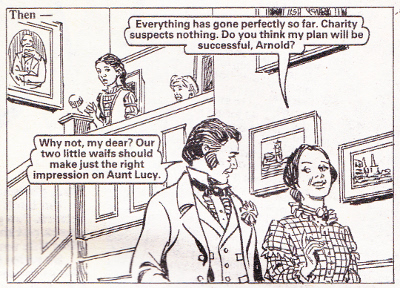
Charity is upset by her heartlessness, and she and Billy runaway. She is determined to get Billy to the seaside but to never trust in people’s kindness again. On their journey they meet people who seem to want to help but through misunderstandings, Charity believes they are only using them and are deceitful. In one instance a couple take her and Billy in, but then Charity overhears the couple talking about a plan and that her and Billy should make  a good impression on Aunt Lucy. She believes they are being used to get a rich older relative’s money. In actuality the Langtons were hoping Aunt Lucy would like the two children and take them to her home by the sea and that they would be good company for the lonely woman.

cold as charity_02cold as charity_06

Usually Charity leaves before these misunderstandings are cleared up. This not only ruins her chances but also at times lets the people who tried to help her in bad situations. Such as a blind man losing his cherished dog. Charity has to accept help from a young school mistress when she hurts her ankle. She believes that Miss Ellen is only concerned with herself and is ready to move on again when she comes across a student, Sam, beaten up. She confronts Miss Ellen about this, thinking she made Sam go against his father’s wishes just so she had her best student at an inspection. But she is soon put right by Hannah (Miss Ellen’s older helper). Sam was going to be put to work as a chimney sweep and Miss Ellen has arranged an education grant for him through the inspector.  Charity realises her mistake and is upset as she begins to think there have been other people she misjudged and acted coldly towards.

Miss Ellen’s kindness continues as she rents a cottage for them at the seaside for a month. The first day is wonderful for Billy and Charity thinks the sea air has done him well as there is colour in his cheeks. Only Hannah recognises it as a flush of fever. That night Billy dies he is later buried by the seaside. Charity has learned a lot from Miss Ellen and she goes on to become a nurse in a children’s hospital.

cold as charity_04

Thoughts

The phrase as cold as charity isn’t something I come across regularly nowadays, but it is fitting with the Victorian setting. I don’t know the exact origin of the saying  but I would guess its around the time, Cringe Or Starve was a nickname for Charity Organisation Society. The title/saying is referenced a lot throughout the story, mostly by people referencing Charity Barton in a bad light. But even in the end when she’s changed it is referenced with Charity being the opposite of cold. These stories liked emphasising the titles a lot (especially if the character’s name was fitting with a clever pun/phrase).

Tragic stories another popular plot for these comics. Of course the best setting for these tragedies was often the Victorian era, with children having to stay out of workhouses, poverty or deal with poor working conditions and cruel employers. Charity comes across many situations that in other stories she would have been right to assume the worse; underhand people using children to get money out of a rich older relative or using a sick child to get sympathy when selling things etc. Other than Mrs. Drabble, they do come across some troublesome people. In one instance, Charity upsets some boys, who get their revenge by messing up their chance of a boat passage. Of course Charity wrongly assumes that the fault is of the woman who promised to put in a word with the captain, and this again reinforces her idea not to rely anyone’s supposed kindness. Why people keep helping her even with her coldness is because they can see goodness in her as well, particularly as she is so protective and caring for her brother.

It is tragic that Charity and Billy suffer many needless hardships because Charity has lost her trust in people. But it also hard on the people who helped her and she betrayed. For example a bunch of runaways get carried off to a workhouse, as she believes the leader is running a scam and gives them up to the police to save herself. The gang sell matchboxes on the street and the leader Tom gets majority of the money.  He is actually keeping money aside so he can buy everyone shoes, though one kid tries to run a scam selling half full boxes. Charity believes Tom is responsible for the half boxes and is keeping money for himself.

cold as charity_05

The “happy” ending is Charity becomes a compassionate nurse and Billy got his one day at the seaside. It is still harsh that they have a cottage booked for a month and Billy only gets one day there, even if it is the best day ever. There’s some great art throughout, Charity and Billy meet a lot of people on their journey and they each have a distinctive look, the crowded busy town streets are vibrant and the seaside is peaceful in comparison. There’s great detail put in to capture the era. It’s a good story, it can be frustrating that Charity keeps making the same mistakes, but she has a reason to be cautious and distrustful after being betrayed. While the situations could have become repetitive, each character and situation are distinct enough to keep interest.

cold as charity_03

The Locked Room

  • The Locked Room – Judy: #1153 (13 February 1982) – #1162 (17 April 1982)
  • Reprinted – Judy: #1459 (26 December 1987) – #1466 (13 February 1988)
  • Reprinted (as Judy Classic ) – M&J:  #188 (17 December 1994) – #195 (04 February 1995)
  • Reprinted and translated into Dutch (as “De afgesloten kamer”) – Debbie #48 (1985).
  • Art: Paddy Brennan

Plot

Susan Brown lives with her parents, her older brother Phil and younger sister Linda. They are a close family, helping each other out and sharing everything. That is until one night something strange happens. First Susan hears and accident on the road, she runs out to investigate and finds a puppy on the road and a car driving away. She settles the puppy in the shed, as he seems to be terrified of the house. The next morning she gets up and can’t find any of her family. She finds one of the rooms locked and her family reappear acting peculiar.

lockedroom_01

Her father tells her he has new scientific equipment in the room that can’t be meddled with and that is why it is locked. The family continue to act strangely, they don’t joke or talk naturally. Instead they seem cold and their speech is stilted.  Her mother finds it interesting that Susan thinks they talk strangely, and after this conversation Susan sees them watching a TV programme about learning English.  When she raises concerns with a family friend, already the speech patterns are loosening up. Susan feels very alone and tries to find the secret of the locked room herself.

lockedroom_02

She gets an opportunity to search the house when the family leave looking for samples, for an experiment. She finds a furnace with a very high temperature gauge in her father’s office and she also finds a false eyelash in her parent’s room. Later when her father and Phil are using the furnace she burns her hand on the office doorknob and passes out.  She wakes up locked in her room (with bandaged hand) and gets another chance to investigate as the family are missing again.

Finally she gets into the locked room through a trapdoor in the attic. What she finds in there are her parents, Phil and Linda lying unconscious in the room.  Fearing they are dead Susan cries, and her tears un-paralyses her real family. The fake family were actually copies made by miniature aliens that crashed outside their house. They have collected all the metal they needed to repair their ship and fly away. The copies of themselves just melt away.

lockedroom_06

Thoughts

This is one of my favourite stories, I mean who couldn’t love a story where the explanation for a family acting strangely is because they are copies being controlled by miniature aliens! It is a good sci-fi story, the mystery of what has happened to the family is interesting. Also what the secret of the locked room is, is quite intriguing, I would have guessed some alien technology or something similar at first. In my first reading I assumed the family were being mind controlled rather than copies (which has been the case in other stories like “The Face in the Crystal”). Also nice change to to see there aren’t sinister motivations, the aliens are just trying to get home and have no interest in taking over Earth.

lockedroom_05

So it is a nice pay-off to see what is in the locked room and I do love the image of the little spaceship flying away afterwards. Though one flaw is the ending seems to be full of expository dialogue. First the explanation of why Susan’s tears free the family, then the father’s theory of what has been going on from the aliens crashing and why they locked them up.  Also conveniently the clones melt away clearing up any last bit of evidence. Still other than that it is a solid story.

lockedroom_07

There is a lot great imagery in the story and also the contrast of the family and alien family is handled well. It could have been interesting to see the aliens in their actual form, but I think it works well with just having them fly away, and not interact with the family after they are free. It was good to see them try to fit in, and adjust to human life while they are working on their repairs. The real Mrs. Brown was relaxed and a bit scatty, whereas alien Mrs. Brown tries to follow advice from housekeeping magazines, to try and be the best mother. As Susan was out of the house when they took it over, they were not expecting a fifth member of the family. Although they are cold and wooden to Susan and don’t want to her to interfere with their plans, they don’t actively set out to hurt her.  Fake Mr. Brown bandages up her hand when she is hurt and Mrs. Brown tries to follow housekeeping’s advice in being a mother to Susan. Good characters, intriguing mystery and some nice sci-fi explanations.

The Four Marys

  • The Four Marys – Bunty: #01 (18 January 1958) –  #2249 (17 February 2001)*
  • The Four Marys in the Footpath Fued (text story) -#25(5 July 1958) – #30 (9 August 1958)
  • Writers: Maureen Hartley (2 Stories: “Creefy’s Rival” and “The Mystery Virus”), Rhoda Miller, Judy Maslin [and other unknowns]
  • Artists:
    • Bill Holroyd (#01-#15),
    • Either James ‘Peem’ Walker or Jim Lorimer worked on the story after Holroyd. (1958-1981)
    • Manuel Cuyàs (#434 – #436)
    • Selby Donnison (1980s)
    • Jim Eldridge (Late 1980s – 2000s)
  • *Note: The Four Marys did appear in most issues including first and last issue, but there were times when it had a break or reprinted older stories.
  • List of Appearances 

Plot

Four girls all named Mary attend a reputable boarding school, St. Elmos. They become firm friends and usually go by their nicknames Raddy, Simpy, Fieldy and Cotty. Throughout their time they have many adventures and solve some mysteries.

Thoughts

This is one of the most well remembered stories, and that has to be partially due to its longevity. A 40 year run is quite impressive. The strip appeared in the majority of the issues but wasn’t a continuous run from first to last issue. There was a couple of breaks particularly in the 80s, though they never went away for too long. There were some reprints over the years particularly towards the end of Bunty.

1950s/1960s

The first 15  issues were drawn by Bill Holroyd, and each girl had their own distinctive look.  The early years had an Enid Blyton tone to the stories, they had the usual boarding school routines,  as well as chase up some mysterious going-ons.

fourmarys_02

While all the girls had their own personality and talents, Mary Simpson was probably one of the most inspirational to young girls. A smart working class girl, that had earned her place in a good school, yet had to contend with being looked down on by some snobs. Bunty in the late 50s was aimed at a more working class background and at the time it was quite a novelty to put a scholarship girl as a main character.  Overall it seems the big appeal of the story was the relationships and friendship of the girls. (Mel Gibson discusses such things in her essay: What Bunty did next….)

While it’s true that the friendships were very important, probably most people had their favourite Mary. Personally I always had a soft spot for Mary Cotter, the talented but often shy and clumsy Mary. Mary Radleigh was the daughter of an Earl but also hated anyone putting on airs and graces, she was loyal and down to earth. Mary Field was the active sports mad girl, that could be a little too pushy at times. Of course 2 other regular characters were the snobs; Mabel and Veronica, who disliked Simpy for her lower class upbringing and the Marys in general for being popular and goody two shoes!

The boarding school itself was full of traditions. Dr. Gull was the head mistress, sometimes known as the Squawker (and the first years were called the Newts). While the girls were allowed to go to the local town, Elmbury, they were expected to behave appropriately, wear their full uniform and there were certain shops they weren’t allowed visit. Miss Creef was the third form mistress, who held up the various traditions but was also described as firm but fair.

Story arcs from this decade included; a mystery surrounding  a hermit teacher Miss Johnson who turns out to be a former student; Lady Josephine Bramily. She has amnesia after a boating accident. Luckily, Mary Simpson and head girl, Ann Fairlie, help her  recover her memories so she can go reclaim her inheritance. Another mysterious teacher Miss Mandy seems to have hidden past with a young cockney that involves thieving. The girls help a young girl Hilda secure a job as maid in the school, only to discover someone’s out to get her fired.  Mary Cotter damages her eye in a lab accident and  nearly does worse damage when she mixes up eye ointment with a bottle of bleach, luckily Simpy catches her in time, and eventually Cotty’s eyes recover (although by the end of the series, her eyesight declines and she ends up having to get glasses!).  A group of girls dub themselves ‘the avengers’ and punish any girl that has done any wrong doing. Simpy discover that it is Raddy and Fieldy doing such things after they let her join them in dunking a cheating prefect Avril in a bath.

fourmarys_01

Early on the stories usually consisted of 2 pages, though later this got expanded to 3 pages. The girls interestingly didn’t refer to each other by nicknames, for the first few years they continued to just call each other Mary. I’m not sure when exactly the change happened but it made sense to start giving them each a distinctive name to be referred as.

1970s

There was a lot of reprinted stories in the 70s.  It was quite common to reprint shorter serials in these comics and with a long running strip like the Four Marys it may have been hard to keep the weekly turnover of new stories. Presumably it was also thought that readers of the first printing would have outgrown the comic by then.

Some of the new stories included; the school being threatened by a flood. A cycle trip with the cycle club led by Miss Creef, Mabel and Veronica mess with Simpy’s old bike in the hopes of getting back to the school earlier. Simpy manages to borrow an old 3 wheeler bike and enter in a race. She doesn’t win but the winner gives her the prize of a new bike for being so entertaining. Cotty believes she is under a gypsy curse and those close to her are getting harmed, it turns out to be a combination of  Mabel and Veronica playing some tricks and a scheme to take over the school. Raddy has trouble looking out for her cousin Sonia.  A feud between Mr Crowe, a local farmer, and the school starts over the school using the right of way to walk through his land.

4marys_04

1980s

Like I mentioned before the 80s saw the Four Marys on some breaks. On one of these breaks the regular ongoing story had some similar themes, involved 3 friends in a ballet boarding school called The Three Imps. Perhaps they were testing out permanent replacements or maybe they just needed a break, but the Marys did return again and with a new artist. At the end of the 80s a new format seemed to settle with the Marys. With them being the first story in the issue, and the more modern School’s Out (which was replaced with The Comp by 1989) as the last story of the issue. Dr Gull had been replaced by the more forward thinking Miss Mitchell, and the girls even got to interact with boys from St. Bartophs boarding school.  The end of 1989 was also when Bunty got a new colour update. While some stories were still in black and white, The Four Marys were now fully coloured.

4marys_05

Some stories in the 1980s include the girls rallying a strike to stop Miss Creef being dismissed after a fall out with Dr Gull. A group of unruly circus girls joining the school temporarily. A new American pupil Lana  gets elected captain of the Bee’s House and wants to hold up all St. Elmos traditions including challenging the village boys to a football match, running barefoot down to the town and raising the house flag on the clock tower. A mystery involving the school’s founder Margaret Carews actual death. A temporary Home Economics teacher who has been secretly keeping her toddler daughter at the school. A competition sees the Marys all split up into different teams, this causes problems but in the end they all come together. St Elmo’s comes under threat of closure when they start to lose students, of course the school is saved with the help of the Marys.

1990s/ 2000s

So the 90s started with the Four Marys in colour and now expanded to 4 pages. The Four Marys was trying to change with the times, with the more up to date Miss Mitchell, continuing to modernise the school, and even Cotty stopped wearing her hair in 2 plaits. The girls were now frequently seen out of uniform as they were able to wear their regular clothes down town and like I mentioned before they were even mixing with boys. Still even with this more modern tone, the girls still has familiar adventures; dealing with new teachers with hidden agendas, threats to the school and tests of their friendships. By the end of the 90s earlier stories were reprinted a lot.

4marys_06

Stories in the 90s included; Mary Field having trouble when her cousin becomes her teacher, causing the other girls to think she’s a teacher’s pet. The girls go on a trip to America with Miss Creef and help foil a jewel thief. The girls try to help a girl they believe is being held captive. It turns out the wheelchair bound, Ailsa, who just has an overprotective aunt, but agrees to let her join St. Elmos. When a famous fashion designer comes to St. Elmos to unveil her new collection, it seems someone is out to sabotage her.  A story set in the past shows the Marys first term in St. Elmos. Raddy gets held captive by robbers who coerce Miss Mitchell into letting them hide out the school. The other Marys soon get suspicious of the new “gardener” and Miss Mitchell’s story that Raddy was sent home sick.

4marys_10

In the final story for The Four Marys, it looks like they will be split up when Cotty fails her exams and will have to leave St. Elmos. Luckily she passes her resit test, Raddy gets elected as form captain and Simpy ends the strip on line “The Four Marys forever”

bunty_2249_4maryslastissue

Final Thoughts

The Four Marys certainly had lasting power, although by the 80s/90s I think they were considered somewhat old fashioned, and so there was changes made to modernise them. At the same time the Marys were permanently stuck in the 3rd form, similar story-lines were repeated and in some ways they felt quite worn out. Still they appealed to a lot of readers. Personally growing up I did enjoy the Four Marys but I  was definitely more interested with The Comp. Funnily reading back the older issues even though it was before my time I actually find the 60s stuff appealing to me more, the art was more simplistic and it had a nice charm with the setting and stories. I think sometimes the Marys could come off a little too good and helpful at times, but still they weren’t without their flaws and their solid friendship it seems is one of the things that interested people.

The art changed a lot over the years and while the artists all did well, my personal favourites are  James Walker (60s) and Selby Donnison (80s).  There was a lot of adventure, mystery, fun and characters that you could get invested in.

Quick Links:

The Four Marys – Characters                                List of Appearances 

Judy 1962

As I’ve already done a post on the last Judy annual published, I thought it was time to look at the first Judy annual. Of course being 30 years from this annual to the last annual there are definite differences.  Some of the focus of the stories is different, there are less teen romance stories here, than in the last annual. This early annual also had more text stories, and even the picture stories tend to use more text boxes, rather than speech bubbles. The presentation is also different to later annuals for example this is from a time that annuals had dust covers.

Inside the annual, there are 8 picture stories, 6 prose stories and 18 features.  While there isn’t a lot of picture stories, they are quite long on average taking up 8 pages. As usual a lot of stories involve the long running characters from the weekly issues including; Heather, Tricky Trixie and Val of the Valley. The features are varied from puzzles, to interesting trivia and articles on women’s achievements. (For just a list of contents click here)

Picture Stories

Sandra and the Sleeping Beauty   (Pages: 6-13)

Art: Paddy Brennan

I really like the art work in this; the ballet postures, the colours of the Lilac Fairy’s costume. I know Paddy Brennan drew Sandra and the Secret Ballet, I’m not too sure if this early work is his too, it does looks similar in parts. The story itself involves Sandra falling asleep and dreaming that she plays the Lilac Fairy in a ballet of Sleeping Beauty. Other than a panel where the Wicked Fairy curse the princess and a thought balloon on the last panel there is no dialogue just text boxes explaining the story. The story isn’t anything new but it is prettily drawn and the ballet interpretation is refreshing.


Colleen and the Last Witch   (Pages: 26-31)

Artist: George Ramsbottom

This was a regular story in Judy, it is set in Ireland, in a fictional town named Ballyvale near Cork. This is a new town and it is located right next to the cave where Bumble the last witch of Ireland lives. She is upset by this new town disturbing her peace and regularly casts spells to try and drive the people away. She is always defeated by a young girl Colleen, who as a 7th daughter of a 7th daughter is immune to the witche’s spells.

In this story Bumble tries to ruin the new Girl Guides camping trip. She sends a troop of ants into their camp-site, then summons great winds when they move to another site. Colleen gets the idea to set up camp in Bumble’s cave as she cannot cast spells on her own home. This was a light-hearted fun story. Bumble as a character seemed to have more in common with antagonists of “boy” comics of the time. As an antagonist she was funny, never getting the upper hand and never really a threat.

Tricky Trixie   (Pages: 33-38)

Trixie the girl with a thousand faces, can change her voice and appearance through her talents of acting and make-up appliance. Here Trixie helps out a girl, Lucy, who’s overprotective mother is a big problem. First Trixie disguises herself as Lucy’s teacher and convinces her mother Lucy needs to be allowed socialise more. Mrs. Green relents somewhat but she still doesn’t let her do anything she considers strenuous.  While watching her friends ice skate, one of the girls Jill falls through thin ice. Lucy being the smallest is able to get the closest to Jill and pull her out.

Lucy asks Trixie not to let her mother find out about the incident, afraid she’ll become even more over protective. When a reporter comes to cover the story for the local paper, Trixie sees this as an opportunity to help out. She dresses up as Lucy and gets the story and “Lucy’s” photo in the paper. Mr. Green  is very impressed with his daughter’s deeds and decides they have been too over protective of Lucy. Mrs. Green doesn’t seem as convinced but goes along with her husband, so it all works out for Lucy.

Joan All-Alone   (Pages: 49-56)

This story is set in Arizona around the 1700s.  Frank Carr has the job of delivering post across “Indian” country, his wife Martha is crippled and he is dissappointed that all he has to look after her is his daughter, Joan. He wishes he had a son instead and has no problem in letting Joan know this.

Joan is determined to prove that she can do anything a boy can do. When her father leaves on a job, she takes a cloak she made out of leaves to hide herself and tracks her father. Frank meanwhile gets shot in the back. Joan brings him home, but he is badly injured and delirious.  Joan sees this as her chance to prove herself. She takes the letter to deliver to Fort Brush and braves the Indians alone. She proves to be a capable person, when she hears she is being followed she quickly sets up a trap to take Red Eagle out.

As Joan continues on her way other Indians find the unconcious Red Eagle and start to track her down. When Joan sees them coming close she heads for a forest, knowing she can’t outrun them but she may be able to hide from them.  When the Indians find her abandoned horse and have no luck finding her they set up camp for the night and discuss their plans to attack the fort. Joan overhearing this manages to sneak away when they fall asleep and warn the Colonel.  Her father learning of all this is prouder of her than of any son.

The story has the stereotypes of “Cowboys and Indians”, as was common in the 60s and often depicted in films.  There isn’t a lot of dialogue throughout the strip as Joan spends most of her time on her own. Instead of thought bubbles; text boxes were the most popular method of moving the plot along. The art and inking is impressive and colourful. The thing I most like about this story is Joan as a smart, strong and brave character, able to be feminine yet stand up to gender roles.

Backstage Betty   (Pages: 69-76)

Art: Don Walker

Betty is a young girl that helps out backstage with a concert troupe, doing whatever odd jobs are needed of her and extra things just to make sure everthing works out ok.  She is a cheerful girl and happy when things work out.  (The girl working in the background, solving all sorts of problems was quite common story; Miss Fix-It of TV,  Girl With the Golden Smile were similar types in different settings.)

Here Betty helps a homesick dancing couple to feel more at home so they can perform better. The couple Carmen and Rodriguez,  won’t make it as international stars if they expect everyplace to be like Spain! Firstly they are unhappy because England is so much colder than Spain.  Which is a fair point as temperature adjustment takes time, but they are also just miserable being in England. The first rehersal is a disaster because of this. So Betty paints bullfighting scene on background and learns Spanish phrases to help them feel at home. She also plays Spanish music for them (which makes me wonder what they were trying to dance to before!) Borrowing a fan and Brazier she is able to heat up the stage and the rehearsal goes great.

There is another obstacle when Rodriguez is confined to bed after bad English food. Betty finds a Spanish chef to cook for him. Rodriguez automatically feels better so it doesn’t seem like it was food sickness he is just a fussy eater! Luckily after all this the show is a great success


Dixie at Dude Ranch   (Pages: 90-94)

Dixie Dalton helps her father out at his Texan Ranch. She has a talent for playing guitar. Not just ordinary talent, but by playing certain cords she can command the horses of the ranch.  When Miss Weston a tennis player arrives at the ranch, Dixie does not take kindly to Weston’s rudeness and boasting about her skill. She uses the opportunity of a poor local Indian girl to beat Miss Weston and put her in her place.

Runaway Princess in Paris  (Page: 97-104)

The Princess in the title may be misleading, Princess is a dog not any kind of royalty. Coincidentally the girl of this story Babette’s dog is named Prince. Her and her parents live in Paris, but not for long as her Dad is getting transferred to London, but Prince will not be able to come. Naturally Babette is upset by this news but is distracted from her problems when she witnesses a minor car crash and a poodle escaping. With the help of Prince she tracks down Princess. Prince rescues Princess from a lake and they get her back to her owner Charmaine, a famous actress. Charmaine is delighted and Babette tells her of her predicament. Charmaine solves the problem by offering her a job, so both her and Prince can stay in Paris.

Heather in Italy   (Pages: 113-120)

Art: Giorgio Letteri

Heather was an amusing “wee” Scottish girl. She was often of the habit of breaking the 4th wall, looking straight out at the readers. Here she on a tour with some snobby artists in Italy she soon gets the best of them after them playing tricks on her. The art is good solid, the story is amusing.

The Third Wish

  • The Third Wish – Mandy PSL: #178
  • Artist: Paddy Brennan

Plot/Thoughts


This is another time when the cover art is different from the inside. I like the simplicity and the painted look of the cover. Not something I note often but I also like the font style of the title, it just seems to fit well. The inside art is good too, Brennan’s art I primarily recognise  from the Judy strip “The Honourable S.J.” Though I do like the art I admit whenever  I see it I keep thinking S.J. will pop up.

The story involves a girl Becky, who is on a pony trekking holiday. On one of their treks her and her friend, Zoe,  accidently stumble across a pool. Playing around, Becky throws in silver leaves and makes three wishes. She doesn’t wish for fame or fortune, but makes simple requests. She would like trifle for tea, there is a particular horse she’d like a chance to ride before the end of the summer and she wishes that annoying know-it-all Nella gets what she deserves. That day she gets to ride her dream horse and they have trifle for tea. After a bit of research she discovers the legend of a magical wishing pool that will  only appear to those not intentionally seeking it out.

Becky starts to worry about her third wish so she begins looking out for Nella as it seems disaster could fall on her at any point. She nearly falls over twice, then nearly gets hit by a van. Becky feels responsible. As Nella is always telling people how to do things properly and being bossy, Zoe tells Becky no-one will hang around Becky if she starts hanging out with Nella.

After saving Nella from an old collapsing building Nella begins to show a nicer side. She explains how she was raised by her bossy gran who always sends her on courses during the holidays, so she knows a lot about stuff. She agrees with Becka to try and be a less of  a know it all.  During a treasure hunt Becky is trying to make sure Nella doesn’t get into trouble and ends up falling over quarry herself. Luckily Nella stays calm and withe her emergency supplies she saves Becka

Becky is happy to see Nella get what she deserves, a medal for bravery.

So a nice play on words. The story works fine, although Becky’s wishes could have been more elaborate I like how the vagueness leads to events following could be taken as coincidence. Nella actually becomes a more sympathetic character despite her bossiness. There’s a nice conflict for Becky where she wants to make sure Nella is okay but wants to stay popular with her friends at the same time. Overall the story isn’t breaking any new ground but for what it is, it is fine.


Judy 1993

This was the last Judy annual published. By this time the Judy comic had merged with Mandy to become M&J. The Mandy annuals continued until 2007 and I think the character of Judy did appear in some of the later Mandy annuals, but this was the last of  a solo Judy title.

While Bunty and Mandy annuals declined in quality in their last years I think this Judy annual finished up on a good note. There are 21 picture stories, 3 prose stories and 6 features. There are favourite characters like Bobby Dazzler and Wee Slavey along with complete new stories. (For just a list of contents click here)


Picture Stories

Home for Christmas   (Pages: 4-11)

Art: “B Jackson”

The first story as you can guess from the title is Christmas themed. When I was younger I quite liked having some Christmas themed stories in these annuals.  As traditionally I used to get these annuals as a Christmas present, having these type of stories was nice to keep in the festive mood. Some annuals seemed to avoid being tied to Christmas, if you look at the Judy 1984 annual, none of the stories are set at Christmas and even the cover looks more Summer like than Winter like.

So this story is a nice family Christmas story. Wendy is the youngest sibling in the family, her older brother Kevin and her sister Gilly have both moved out into the working world. Wendy and her parents are looking forward to having the family all back together for Christmas, so they are disappointed when they get a letter from Kevin saying he won’t make it home as he is shipping off to Canada.

The mum reminisces about how she always knew the three of them would make something of themselves, they used to make their own way home from school letting themselves in with the key hidden under the garden gnome. Obviously this memory is significant to the story later on, with short stories like this subtlety wasn’t always an option.  There is more bad news, when Gilly phones to say she has to do a photo shoot and won’t make it for Christmas either.

Wendy tries to make the best of things by decorating the house, but when she goes to get the decorations out of the attic she is knocked of the ladder and ends up in hospital.  She is told she will have to stay in hospital over Christmas.  The Dad decides he’ll take the Mum out for dinner Christmas Eve to cheer her up. Wendy is delighted when she is released from hospital early. She gets a lift home forgetting her parents won’t be there. Luckily the hidden key is still under the gnome and she enters only to find that Kevin has made it home for Christmas after all.

The parents are on their way home when they hear on the radio that Gilly has been in a car accident and wandered off. They are delighted to find Wendy and Kevin at home but are worried about Gilly. She manages to find her way home as well. Turns out her shoot was cancelled. The father wonders how they all got in with the key because they usually bolt the door from the inside these days. Turns out the mother unbolted the door just in the hope that the children would come home.

I really like the art and the inking. The colouring is quite muted when things look bad and then changes to nice and bright without being too overwhelming when things turn out well. Its just a nice family Christmas story to read.

Junior Nanny (Pages: 14-16)

Art: Oliver Passingham

Junior Nanny never seemed like the most interesting concept, a young nanny solving the problems of children no older than 5, but somehow I always liked the strip. The kids were genuinely cute and often sympathetic and Chris Johnson was kind but also practical and resourceful.

Here she tries to help new arrival Jonathan who is shy and cries during snowball fights. When another kid Alan tease him for this Chris explains that he gets upset easily because his parents are in hospital. Alan being a good kid at heart takes it on himself to look after Jonathan. But this means he ends up missing out on stuff he likes to do because Jonathan doesn’t like it.  To solve this Chris enlists Jonathan to make a special present for Alan.  Its a fort for his toy soldiers. After helping make this Jonathan is keen for everyone to play together with Alan’s new fort.

Pepper the Pony  (Pages: 17/111)

Pepper the pony is a humour strip that ran in Judy. The first strip in this annual, involves Lucinda calling Pepper lazy, so he decides to run off. Remembering the tale of Dick Whittington and his cat making a fortune in London, he goes to look for puss. After spending all night looking for him he ends up needing a rest. Lucinda berates him in the morning again for being lazy while Puss is already up and washing himself.

The second strip has Pepper being scared by stories of witches and ghosts. He gets particularly scared when he sees the shadow of a witch in the stables. It turns out to be Lucinda dressed up for a costume party.

Wedding Belle   (Pages: 18-22)

Artist: Ana Rodriguez

Belle is a girl who hires out her services as a flower girl/bridesmaid at weddings. It is quite a successful endeavor, although I could never understand why people would want a stranger as part of their wedding!  I can imagine looking at the photos would be like; there’s the bride, groom, best man and some girl we hired!

Belle’s neighbour Liza isn’t having a lot of luck in the romance department. Belle observes this is because Liza is a bit over eager and ends up scaring guys off. Belle meanwhile is bridesmaid at a wedding of someone she knows. Valerie runs a dating agency, but her and her husband are moving away after the wedding so the agency will have to close down as she couldn’t find anyone to take it over. Belle thinks Liza would be perfect for the job. Apparently she is very good because just a few weeks into the job already one couple she introduced are engaged.

People seem to move fast in this town! The job also helps Liza out because she has been so busy she hasn’t had time to chase guys around. Dan from the downstairs office, finds this busy Liza, that hasn’t time to talk to him attractive, so he asks her out..in a somewhat abrupt manner.

But Liza seems charmed enough so happy ending for her.

The Honourable S.J.   (Pages: 26-32)

Artist: Paddy Brennan

Nasty blackmailer Sarah Jane is up to her usual tricks. When Ann tries to stop her stealing from caravans they are both sent to  an under-privileged children’s home for a bit of community service. Soon S.J. has all the children and staff charmed. Ann keeps her eye on S.J. and discovers her plot to steal a silver rose bowl heirloom. She manages to stop her and also records the encounter.  At a disco for the children Ann plays the recording, exposing S.J. Ann volunteers to stay on for the rest of the Summer even though her name is cleared and S.J. gets sent away.

“You’re Just Jealous!”   (Pages: 33-38)

Artist: Edmond Ripol

This is a story of friendship versus boyfriend.  When Lucy falls sick her best friend Amy is pretty bored until she meets Chris.  So when Lucy gets better, she isn’t too happy to find out that Amy has a boyfriend now. She is especially upset to find out Amy and Chris went to a film that they were planning to see together.

She is feeling pretty blue about it… I don’t know where that colouring in that panel came out of but I still think the art looks good throughout the story. So Lucy see Chris hanging around with another girl and tells Amy straight away. Amy presumes she is just being jealous, so they fall out. Amy does try to make things up but Lucy won’t hear of it.  Lucy later gets to prove her point when she sees the girl Chris was hanging around with.  Only to discover that the girl, Laura, is his sister. Amy realises Lucy made a genuine mistake and they end up going on a double date with one of Chris’s friends.

I like the friendship angle of this story, Lucy feeling threatened by her friend’s new boyfriend is a reasonable reaction and she does try to be happy for her at first too. I also like that Amy doesn’t hold a grudge against Lucy, she puts their friendship as a high priority even with new relationship. It seems like a pretty solid message.

The Boys From Beyond   (Pages 39-46)

Artist: Guy Peeters

This is a Skeleton Corner story, a regular feature in Judy.  They  were basically  spooky stories introduced by a skeleton. Here two sisters, Tanya and Fay, are getting ready to attend a Halloween party at their father’s hotel. Before the party, Tanya is disappointed when her favourite metal band Darkest Night, skip their appearance on a TV show. They attend the party but it is a further disappointment, as it all old people attending. They then meet a boy, Luke,  their own age who is dressed up in old fashioned clothes. They go for a walk together and come across a farmhouse, that is supposed to be empty, has lights on. Tanya is delighted to find inside is Darkest Night rehearsing. Luke apparently is not a metal fan and runs away from the noise. Fay follows him and Tanya is left to talk with the band.

They explain that they picked this place to play because their next album Boy from Beyond is about a young  ghost from the area.  Tanya figures Luke is a ghost and that now he’s alone with her sister. The lead singer reassures her that even if Luke is a ghost he won’t hurt her ghosts just appear and vanish again. Tanya finds Luke and Fay and discovers he is pale and sensitive to noise because he recently had an accident but he is not a ghost. She re-enters the farmhouse only to find the band doing a montage of their cover art.

I really liked this story. I am a fan of skeleton corner and spooky, twist stories in general. I also really liked that Tanya’s favourite band was a heavy metal band. It was really refreshing to see a girl not into the usual boybands, or pop charts stuff for a change.  It was closer to my taste in music, so I found her a more relatable character.

Bobby Dazzler   (Pages: 50-58)

Art: Giorgio Letteri

Bobby Dazzler, the only girl at a boys boarding school, has trouble getting on the football team. The boys think they will be laughed at if they have a girl in the team for their next match.  She appeals to the coach who decides letting her be their sub will please her, but he has no plans of playing her. On the day of the match the other team’s star player, Barry, is just a sub for a day, so Bobby ends up flirting with him. Mike and Don are a bit distracted by Barry chatting up Bobby. When it comes to half time they blame each other for how badly the match is going. Don pushes Mike injuring him so the coach benches Don and has to replace Mike in goal with Bobby.

Bobby is less impressed with Barry when he comes onto play and takes advantage of their earlier talk aiming for her weak spot. Luckily Bobby manages to save it. Then Mike feeling better comes back to play goalie, and Bobby goes back on the field. She manages to score the equaliser and win man of the match. I liked that Bobby can show her feminine side by flirting but still be as good as the boys in whatever situation she is in.

Where is Melanie Forbes?

Plot

After an accident on board a train, orphan Sandie Walsh came to and found she was being used to take the place of another girl called Melanie Forbes in the house of Melanie’s wealthy and adoring grandfather, who was convinced she was his granddaughter.

Notes

  • Writer: Marion Turner (under pen-name: Fiona Turner)
  • Artist: Paddy Brennan

Appeared

  • Where is Melanie Forbes? – Judy: #1167 (22 May 1982) – #1177 (31 July 1982)
  • Reprinted – Judy: #1536 (17 June 1989) – #1546 (26 August 1989)

Sarah Below Stairs

Plot

While Daisy the kitchen skivvy from the Moncrief household, in Victorian London, secretly went home to nurse her sick mother, Miss Sarah Moncrief had offered to take her place.

Notes

  • Artist: Paddy Brennan

Appeared

  • Sarah Below Stairs – Judy: #1547 (2 September 1989) – #1558 (18 November 1989)
  • Reprinted (as Judy Classic) – M&J: #273  (3 August 1996) – #287 (9 November 1996)