Plot
Julie Dawson, helps an old woman and in return is given a magic ring. This ring allows her to talk to animals.

Notes
- Artist: Charles Grigg
Appeared
- The Ring That Winks – Judy: #01 (16 January 1960) – #32 (20 August 1960)
Julie Dawson, helps an old woman and in return is given a magic ring. This ring allows her to talk to animals.
When Kathie’s mother has to go to hospital, she tells Kathie to go with her two younger brothers to her home village Brangwen,and that she will be looked after there. Unfortunately the village is cursed with ghostly apparitions of smugglers haunting the streets each night. After seeing these ghosts go by Kathie finds her brothers missing. She asks around the village for help looking for her brothers, but everyone denies their existence telling her she arrived alone. That night she sees her brothers with the ghosts.

When the villagers find out who her mother is they are more open with her as she is one of them. They bring her to her grandmother who lives in a big house up on the cliffs. Her grandmother, Manfraya, explains that centuries ago, villagers of Brangwen, lured ships onto the rocks and plundered the goods. One night Jamie Trevellyan (an ancestor of theirs) joined the smugglers and got shot by Excisemen, his companions left him to die. His grieving mother, Roberta Trevellyan, in turn cursed the whole village. The smugglers soon died and were condemned to walk the streets for eternity. Along with them some of the living villagers are chosen to walk with them at night, continuing the smuggling trade. Those who are not chosen to walk with them cannot see where the ghosts reside or they will be taken. This happened a boy by the name of Young Willie years ago and he was never seen again. Later Kathie meets Young Willie but he warns her away from the path she is taking. That night Some of the villagers decide to take Kathie to the dead as they believe that she is making the dead uneasy since she arrived. Although Kathie argues that even if they got rid of her they will still be cursed.

Kathie is saved by the appearance of the ghost of Roberta, who for some reason doesn’t want the Dead to get Kathie. Soon after that a stranger turns up in the village, he turns out to be Kathie’s uncle, Roger. Manfraya faked his death as a baby and sent him away as she was afraid the dead would have taken him. Helped by Young Willie’s mother Beth Hewitt, Kathie and Roger try to find the place of the dead. Roger hurts his leg, but Kathie carries on and she finds the cave but an evil apparition tells her she will never leave. Roberta comes to rescue her rescue again. Later some village men decide to defy the dead, and not walk with them. As long as they stay at the Trevellyan house, with Kathie they will be safe. But Kathie is tricked into seeing her brothers and runs to them leaving the men unprotected.

Beth tells her she is the only one able to break the curse, as she is under Roberta’s protection. She has to go to the Dead’s secret place while they are still roaming the streets. Kathie finds her brothers, who are no worse for wear after their adventures. Manfraya, Beth and Roger round up the villagers to get them to defy the dead. Kathie encouraged by the help of the villagers, manages to convince Roberta to let go of the past, the dead disappear and the curse is lifted.
Oliver Passingham is one of my favourite artists, he could portray a variety of stuff from comedy/slapstick to horror. He did seem to draw a lot of supernatural stories, such as Skeleton Corner stories and was very good at creating shadowy and creepy atmospheres. Throughout this story the ghosts are very eerie, as is the cave where they reside. There is some great detailed scene shots that make the environment look threatening and creepy. I like the panel where the villagers bring Kathie to her grandmother’s house. Even though its during the day, so a bit less creepy, there is a sense of isolation about the house, and potential danger of the cliffs.

The flashback to the original curse is also great, first the image of the wrecked ships and the people left to drown. Then when Roberta finds her son and curses the village, you never see her face, its always in shadow. Apparently a grieving mother’s curse is one of the most powerful things in the world. Although I would argue that Jamie, hardly deserves such wrath. The smugglers were despicable people, wrecking ships off the cliff and of course they left Jamie to die, but Jamie chose to go with them, so that doesn’t say much for his character.

The curse itself seems needlessly complicated and doesn’t make sense in a lot of ways.
Also it seems odd that Emily would send her children to Brangwen, sure their only living relative is there, but there had to be some better option then sending them to a cursed village. Also its unclear why Roberta decides to save and listen to Kathie, maybe its because she is the only ancestor that actually tried to do something about the curse.

Despite these logical flaws and unnecessary complications, I do like the story. This is in most part because of the amazing art, but there is a lot to like in the story as well. I like that the villagers are nearly as antagonistic as the ghosts themselves. They get rid of all evidence of the boys so Kathie has no way to prove to the police that her brothers are missing. The villagers are motivated by fear, but there is a sense of community with them and they look after their own. They do try to comfort Kathie when she discovers her brothers with the Dead.
I like Beth Hewitt’s character, she is a wise woman, but also quite broken hearted about her son. She is the one who really riles the villagers up to make a stand, telling them Willie was better off with the Dead then been raised with a bunch of cowards. Manfraya has some parallels to Beth, she lost her son as well, but through choice she sent him away in attempt to save him, but similarly she has been quite heartbroken about it. Kathie is our typical hero, strong, right-minded and determined, but she can be rash at times. After promising to stay with the village men she nearly dooms them by running after what she thinks are her brothers. Overall it is a nice creepy story with some good characters.
Follow-My-Leader Lil – Judy: #905 (14 May 1977) – #914 (16 July 1977)
Lil Lavender lives in an industrial area of town. The closest thing they have to a playground is a waste ground nearby named the Forstal. Lil is confined to a wheelchair and she likes to sit under an old tree and watch the nature around her. But Marsdon a local councillor and developer wants to build on the land. Lil takes the lead in a campaign to try and stop this. First her and the local kids try and track down a deed to prove that the space is common land, but Marsdon is one step ahead of them and has taken all the records out on loan. The kids try to track down any other copies of the deed. They manage to find an old copy but its in Latin. They get it translated and discover the land can be used to host a fair or festival indefinitely on St. Peters Day, as long as it is done with no more of a 75 years elapse.

At the same time of this discovery, Marsdon’s men are ready to cut down the old tree and start development. Some of the boys climb up the tree to delay them while Lil and the others got to the council offices to present their discoveries. They manage to put a hold on the work. They only have 2 weeks to find out if there was a fair held in the last 75 years. They manage to find proof but it seems the last fair was held just within the 75 years, so they have only bought them selves an extra 18 days then the deed will lapse. But Lil isn’t one to give up so she says they will just have to organise a festival themselves.

Marsdon tries to put a stop to the festival, by ruining all their attractions. They arrange a gymnastic display, dancers and a local marching to appear, but these acts rely on council grants and buildings to get by. So Marsdon makes sure they won’t risk helping out the festival. Similarly the choir backs out, as most of them are Marsdon’s employees and fear they’d lose their jobs. Lil’s still not going to give up though and decides to turn it into a youth festival. To counter this, Marsdon sets up a free seaside trip for the same day. When it looks like the festival will fail, Lil wonders if she can get the old tree marked for preservation. They go to the local newspaper to ask about preservation, the staff can’t help with that but they do think the festival and campaign make a good story. So they help with the festival, getting a popular band to come play and writing an article about it. The day is a success, keeping the area safe for another 75 years and Marsdon resigns from the council.

It is good to see a story with lead character who is disabled but not have that define the plot. Stories with disabled characters usually fell into a few categories. The plots would involve; trying to find a cure or trying to overcome the disability, using their disability (or faking one) to exploit people or exact revenge, or being exploited themselves. In this story Lil’s disability is not really key to the plot, she could have still been the leader of the campaign and been able to walk. She is not being discriminated against because of her disability, she is in the same position as the other local kids fighting to keep the one green area they have.
That’s not to say her disability is totally inconsequential. They use it to their advantage when needed; such as delaying people so the boys can sneak into a site to find the deed , or gaining sympathy so she can get to see an old woman outside of visiting hours. Even the newspaper reporters make a point of saying a photo of her in her chair (along with the campaign) would be good at pulling at people’s heart strings.

There have there have been several stories of campaigning girls saving their park/youth clubs from evil developers previous to this. So Lil’s disability may be seen as a a gimmick to differentiate it from these similar stories. Also the word “cripple” is still in use throughout the story. Still overall it’s quite progressive that it is Lil’s leadership qualities that define her character not the wheelchair. The story itself does have a sense of urgency, with them only having weeks to save the Forstal. Marsdon is your typical antagonist a big business man that steps on the little people and uses underhand methods to get what he wants. The other kids don’t stand out as much, mostly they are there just to follow Lil’s plans. There are two that seem the closest to Lil (one being her brother) acting like second-in-commands, but the rest of the kids are quite interchangeable.

Throughout the story the Forstal is described as a wasteland, so I find it good that they save the land and they don’t go further by making it into some great playground for the kids. Its just an open space for them to play in. There are some issues raised that without this space the kids are more likely to stray into delinquent activities. Of course it would be great if they had extra facilities but more realistic that they are lucky just have some green area.
In Victorian times Charity Barton and her young brother Billy are taken in by one of their neighbours, Mrs. Drabble, after they are orphaned. Although she works them hard Charity believes she must be kind as she has given them a home. Charity intends to sell her mother’s wedding ring so she can carry out Billy’s wish of visiting the seaside. Mrs. Drabble offers to sell the ring for her and send Billy to a seaside home for the Summer. Charity is grateful for Mrs Drabble’s help until she later overhears her plans to send Billy to a workhouse and keep Charity on as a cheap servant. Mrs. Drabble is already enjoying the money she got from the pawned ring at this stage as well.

Charity is upset by her heartlessness, and she and Billy runaway. She is determined to get Billy to the seaside but to never trust in people’s kindness again. On their journey they meet people who seem to want to help but through misunderstandings, Charity believes they are only using them and are deceitful. In one instance a couple take her and Billy in, but then Charity overhears the couple talking about a plan and that her and Billy should make a good impression on Aunt Lucy. She believes they are being used to get a rich older relative’s money. In actuality the Langtons were hoping Aunt Lucy would like the two children and take them to her home by the sea and that they would be good company for the lonely woman.
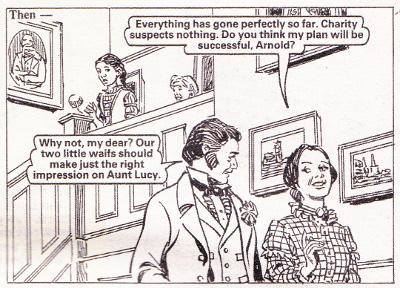

Usually Charity leaves before these misunderstandings are cleared up. This not only ruins her chances but also at times lets the people who tried to help her in bad situations. Such as a blind man losing his cherished dog. Charity has to accept help from a young school mistress when she hurts her ankle. She believes that Miss Ellen is only concerned with herself and is ready to move on again when she comes across a student, Sam, beaten up. She confronts Miss Ellen about this, thinking she made Sam go against his father’s wishes just so she had her best student at an inspection. But she is soon put right by Hannah (Miss Ellen’s older helper). Sam was going to be put to work as a chimney sweep and Miss Ellen has arranged an education grant for him through the inspector. Charity realises her mistake and is upset as she begins to think there have been other people she misjudged and acted coldly towards.
Miss Ellen’s kindness continues as she rents a cottage for them at the seaside for a month. The first day is wonderful for Billy and Charity thinks the sea air has done him well as there is colour in his cheeks. Only Hannah recognises it as a flush of fever. That night Billy dies he is later buried by the seaside. Charity has learned a lot from Miss Ellen and she goes on to become a nurse in a children’s hospital.

The phrase as cold as charity isn’t something I come across regularly nowadays, but it is fitting with the Victorian setting. I don’t know the exact origin of the saying but I would guess its around the time, Cringe Or Starve was a nickname for Charity Organisation Society. The title/saying is referenced a lot throughout the story, mostly by people referencing Charity Barton in a bad light. But even in the end when she’s changed it is referenced with Charity being the opposite of cold. These stories liked emphasising the titles a lot (especially if the character’s name was fitting with a clever pun/phrase).
Tragic stories another popular plot for these comics. Of course the best setting for these tragedies was often the Victorian era, with children having to stay out of workhouses, poverty or deal with poor working conditions and cruel employers. Charity comes across many situations that in other stories she would have been right to assume the worse; underhand people using children to get money out of a rich older relative or using a sick child to get sympathy when selling things etc. Other than Mrs. Drabble, they do come across some troublesome people. In one instance, Charity upsets some boys, who get their revenge by messing up their chance of a boat passage. Of course Charity wrongly assumes that the fault is of the woman who promised to put in a word with the captain, and this again reinforces her idea not to rely anyone’s supposed kindness. Why people keep helping her even with her coldness is because they can see goodness in her as well, particularly as she is so protective and caring for her brother.
It is tragic that Charity and Billy suffer many needless hardships because Charity has lost her trust in people. But it also hard on the people who helped her and she betrayed. For example a bunch of runaways get carried off to a workhouse, as she believes the leader is running a scam and gives them up to the police to save herself. The gang sell matchboxes on the street and the leader Tom gets majority of the money. He is actually keeping money aside so he can buy everyone shoes, though one kid tries to run a scam selling half full boxes. Charity believes Tom is responsible for the half boxes and is keeping money for himself.

The “happy” ending is Charity becomes a compassionate nurse and Billy got his one day at the seaside. It is still harsh that they have a cottage booked for a month and Billy only gets one day there, even if it is the best day ever. There’s some great art throughout, Charity and Billy meet a lot of people on their journey and they each have a distinctive look, the crowded busy town streets are vibrant and the seaside is peaceful in comparison. There’s great detail put in to capture the era. It’s a good story, it can be frustrating that Charity keeps making the same mistakes, but she has a reason to be cautious and distrustful after being betrayed. While the situations could have become repetitive, each character and situation are distinct enough to keep interest.

Girls comics were full of bullying, blackmail and nasty girls. As evidenced in this interesting article: http://www.booksmonthly.co.uk/bully.html. So I thought I’d take a look at some of these, starting with two similar stories:
Hateful Harriet
Plot
Peg Roberts has to keep Harriet Marlowe out of trouble in school, or else her widowed mother will be fired by middle manager, Mr. Carrick. Harriet has been expelled from many schools, and is sent to live with the Roberts as well. At the same time as this, Peg is competing for a drama scholarship, which also relies on her getting a good character reference from her teachers. Of course Harriet causes Peg all sorts of trouble, and has the teachers fooled that she is a sweet girl. Mrs. Roberts can’t do anything to help as she is also at the beck and call of Harriet. Finally Harriet gets caught out and expelled and Mr. Carrick fires Mrs. Roberts. Luckily for her she gets a job in a travel agents. Harriet is to be sent to school in Switzerland, though she doesn’t seem happy about it. On the day of Peg’s big interview for her scholarship, Harriet is in an accident with a bridge collapse. After Peg misses her interview to save her life, Harriet turns over new leaf and helps Peg get a second chance with the scholarship. She in turn is given a second chance with the school and is allowed to come back.

“Be Nice to Nancy!”
Plot
Yvonne Baxter has to be nice to Nancy Norden (Nikki in the reprint), or she fears her father will lose his job. Nancy is openly nasty and a bully and is not popular at school. This of course causes many troubles for Yvonne as she keeps covering for her. She loses friends and gets in trouble in school. When she tries to explain how nasty Nancy is to her parents, they don’t listen. Only her best friend Maggie knows what’s going on. Eventually Mr. Norden catches Nancy out and he apologises to Yvonne. He was hoping that she would be a good influence on Nancy. He is going to send her to a special school instead and of course Mr. Baxter isn’t going to be fired.

Thoughts
A girl forced to be friends with a nasty girl for fear of a parent’s job is a common theme. There were ,any variations of this theme such as the family’s reputation, rather than a job, being in jeopardy. The link at the start of this post discusses a lot of the different types of bullying that went on in these stories.
Both Hateful Harriet and Be Nice to Nancy have an overall similar storyline. Even their looks correspond with the long blonde hair for the antagonist and the shorter dark hair of the protagonist. Both Harriet and Nancy get up to similar trouble and share a lot of the same personality traits. At the same time Peg and Yvonne both feel helpless and dislike having to cover for the other girls. There are differences though, in how the stories develop and conclude. In the case of Hateful Harriet, Mrs. Brown knows what Harriet is like but not only can she not help Peg she also has to give into Harriet’s demands. (Incidentally this story would not work today, as Mrs. Roberts boss could be charged with wrongful dismissal, at first he wants to fire her because of her age and only keeps her on as long as she keeps his boss’s daughter out of trouble).

Yvonne on the other hand tries to tell her parents what Nancy is like but they don’t listen. Her father in particular keeps the pressure on her to be friendly with Nancy. While Nancy does use this to her advantage, Yvonne seems to feel the most pressure from her father and Mr. Norden rather than Nancy herself. Harriet likes to constantly remind the Roberts that they have to keep her happy.

Harriet does get redeemed in the end but Nancy hasn’t learned her lesson. This contrast could be to do with the way their fathers deal with their daughters. While Nancy’s father is actively trying to help her out (though he may be going about it the wrong way!). Harriet’s father doesn’t appear at all, instead his orders are passed through lower manager Mr. Carrick. Clearly Harriet is not used to people being kind to her for no reason, she seems to be following her father’s behaviour of using power and threats to get what she wants. She is used to being shipped around and her behaviour becomes more understandable when it seems she hasn’t had a very caring home life. When Peg shows her friendship, even after Mrs. Roberts gets a new job and then saves her life, Harriet turns her life around and starts to appreciate her friendship.

Nancy is a less sympathetic character. Mr. Norden does try to help his daughter but he goes about it the wrong way. He puts the pressure on Yvonne to be friends with her thinking that if she is not with a bad crowd then she will be a better person and stay out of trouble. He dosen’t realise that she needs more help than that and that it is unfair to expect Yvonne to be responsible for keeping his daughter on the right path. At least Nancy does get the chance to go to a school that will help her, but she doesn’t have the excuses of Harriet for her bad behaviour.

Hateful Harriet is a bit more dated, and Peg is such a good person that she goes to support Harriet in a play that she should have been lead in (this is after Mrs. Roberts gets her new job). It’s a bit unbelievable that a girl could be this nice! Harriet’s change of heart may be a bit sudden but after a near death experience not unlikely. Be Nice to Nancy is a story that is remembered pretty well so it must have stuck in people’s mind. It is more realistic in it’s portrayal of characters and everything isn’t all wrapped up neatly in the end. Still most importantly the protagonist gets a happy ending, free of Nancy!
It’s interesting to see how a similar theme can develop differently, and of course very telling is the different time periods as they were first published nearly 2 decades apart.
Plot
Susan Brown lives with her parents, her older brother Phil and younger sister Linda. They are a close family, helping each other out and sharing everything. That is until one night something strange happens. First Susan hears and accident on the road, she runs out to investigate and finds a puppy on the road and a car driving away. She settles the puppy in the shed, as he seems to be terrified of the house. The next morning she gets up and can’t find any of her family. She finds one of the rooms locked and her family reappear acting peculiar.

Her father tells her he has new scientific equipment in the room that can’t be meddled with and that is why it is locked. The family continue to act strangely, they don’t joke or talk naturally. Instead they seem cold and their speech is stilted. Her mother finds it interesting that Susan thinks they talk strangely, and after this conversation Susan sees them watching a TV programme about learning English. When she raises concerns with a family friend, already the speech patterns are loosening up. Susan feels very alone and tries to find the secret of the locked room herself.

She gets an opportunity to search the house when the family leave looking for samples, for an experiment. She finds a furnace with a very high temperature gauge in her father’s office and she also finds a false eyelash in her parent’s room. Later when her father and Phil are using the furnace she burns her hand on the office doorknob and passes out. She wakes up locked in her room (with bandaged hand) and gets another chance to investigate as the family are missing again.
Finally she gets into the locked room through a trapdoor in the attic. What she finds in there are her parents, Phil and Linda lying unconscious in the room. Fearing they are dead Susan cries, and her tears un-paralyses her real family. The fake family were actually copies made by miniature aliens that crashed outside their house. They have collected all the metal they needed to repair their ship and fly away. The copies of themselves just melt away.

Thoughts
This is one of my favourite stories, I mean who couldn’t love a story where the explanation for a family acting strangely is because they are copies being controlled by miniature aliens! It is a good sci-fi story, the mystery of what has happened to the family is interesting. Also what the secret of the locked room is, is quite intriguing, I would have guessed some alien technology or something similar at first. In my first reading I assumed the family were being mind controlled rather than copies (which has been the case in other stories like “The Face in the Crystal”). Also nice change to to see there aren’t sinister motivations, the aliens are just trying to get home and have no interest in taking over Earth.

So it is a nice pay-off to see what is in the locked room and I do love the image of the little spaceship flying away afterwards. Though one flaw is the ending seems to be full of expository dialogue. First the explanation of why Susan’s tears free the family, then the father’s theory of what has been going on from the aliens crashing and why they locked them up. Also conveniently the clones melt away clearing up any last bit of evidence. Still other than that it is a solid story.

There is a lot great imagery in the story and also the contrast of the family and alien family is handled well. It could have been interesting to see the aliens in their actual form, but I think it works well with just having them fly away, and not interact with the family after they are free. It was good to see them try to fit in, and adjust to human life while they are working on their repairs. The real Mrs. Brown was relaxed and a bit scatty, whereas alien Mrs. Brown tries to follow advice from housekeeping magazines, to try and be the best mother. As Susan was out of the house when they took it over, they were not expecting a fifth member of the family. Although they are cold and wooden to Susan and don’t want to her to interfere with their plans, they don’t actively set out to hurt her. Fake Mr. Brown bandages up her hand when she is hurt and Mrs. Brown tries to follow housekeeping’s advice in being a mother to Susan. Good characters, intriguing mystery and some nice sci-fi explanations.
 Time-Witch – Judy PSL: #322 (1989)
Plot
Becky and her friend go to a fair, where they decide to get their palms read for fun. Becky is surprised when the palm reader tells her she has the same markings as her daughter Tania, who is a Time-Witch. She explains that Time-Witches have the rare ability to travel through time, Tania used mirrors to travel through time but she was inexperienced and got lost somewhere in time. Becky feels sorry for the woman but doesn’t believe her story, when she looks through mirrors all she can see is her reflection.
It turns out Becky has a different way of travelling when she finds her self being pulled into her TV. She meets Tania, but Tania is being chased by an evil witch Enzida. Enzida does not have the same power as Becky and Tania, she has to use stolen spells to travel. Enzida catches up with the girls and uses a spell to separate them and send them to another time. Becky finds herself in an ancient Arabian Bazaar, there she helps the daughter of a Sultan escape the Black League. She catches up to Tania again but again they get sent away to England around the 13th century. There Becky is captured by the Baron’s soldiers for trespassing, Tania is rescued by a boy just before her capture. Luckily for Becky before she is thrown in the dungeons she is recognised by the steward’s daughter, Giselle, and saved. Giselle has a carpet that her father brought back from the crusades, it depicts Becky saving the Sultanate.

Together they track down a wise woman and also meet up with Tania, again. They defeat Enzida and together the 2 girls have enough power to get home.

Thoughts
Another time travel story, but with a bit of a difference. I like the idea that Becky herself is a time traveller. Often girls would just stumble on to a doorway/ painting / mirror etc. and wind up in the past. The idea that time-witches are rare and they travel in different ways is interesting as well. A fun set up in the first page, has Becky complaining about the TV not showing the scheduled programme, not knowing that she’s actually seeing a portal to the past.
Throughout the book the art is good at depicting the different eras. I also particularly like Enzida as the villian she looks ordinary yet creepy at the same time. Another highlight is the transition in travelling between times and when Becky is first transported into the TV.

A lot of the time Becky ends up looking for Tania, so they can get home, though it doesn’t come across as just being self serving. It seems she really wants to help this girl and that they become close very quickly. This seems to stem from the beginning, when Tania’s mother talks about her daughter and shows her a picture, Becky sympathise with the woman missing her daughter (even if she doesn’t believe the time travel stuff). So when she meets Tania there is already a good connection built between them. Tania seems to be constantly getting caught by Enzida so it is nice to see her be the one to steal her scroll away in the end.

Becky gets to have adventures outside of trying to get home, showing her compassionate nature and quick thinking when she helps the sultanate and her friend hide in a carpet. The friend’s father is a carpet maker and its quite coincidental that Becky’s adventure in Arabia, helps her later in the book but I actually quite like the tie in.

There is a build up when the wise woman (good witch) battles off Enzida’s spells, Becky faces fierce winds in trying to get to the woman and Tania, and inside the cabin they face fires and ice coldness. Despite this in the end it seems Enzida is defeated quite easily while the wise woman fights and distracts her Tania just runs up grabs the scroll. Still its a small complaint, as it is an accomplishment to set Becky up as a time witch, travel to three different time periods. and have a fight with the evil witch in such a small book and it does well.
While I talked about the differences of the first Judy annual to later annuals a little bit before, I thought I’d do an additional post to expand on it.
There was 32 Judy annuals in total from 1962 to 1993. Which isn’t as long a run as Bunty or Mandy but still pretty good. Obviously it went through some changes over the years, both in its physical format as well as focus of the stories. Firstly like a lot of annuals of its time the 1962 annual had a glossy dust jacket, over the hard cover. There was also a different picture inside the dust jacket; it was of the Judy character. It is black and white picture so while not as eye catching as the colourful dust jacket, I think it does look quite appealing and classic.

By the time the 1993 annual was published it was just a glossy hard cover, no dust jacket. Interestingly Judy annuals rarely had the Judy character on the annuals covers (unlike say Bunty which had Bunty on the cover up until 1988, then it was switched to cover girls for the remaining run.). Unusually, there was a variety of covers for Judy, there didn’t seem to be one long running theme. It used cover girls early on (ballerinas were popular choice for a few annuals) , but it also still used hand drawn pictures that were unrelated to any Judy characters, or anything inside the annual. The blonde Judy appeared on the cover of the 1964 and 1965 annual. While the brunette Judy appeared on the 1988 annual and the last two annuals.


Paper quality also improved over time, particularly use of photos were more clearer and brighter in later annuals. The last Judy annual actually used less photos than the first annual. There had been some photo stories in previous annuals but there was none in the last annual, its only photo use was for the ‘Halloween Treats’ feature. Also the first annual used more colour than the last annual. In general the colours in the 1993 annual seem to be  more subtle and there is less use of the bright bold colours used in the 1962 annual. The 1993 annual used a lot of the two tone colours, which was common at the time (i.e blue/black/white etc.). I presume this method was used to cut down on inking cost, but this wasn’t a bad thing as often it looked just as pretty and more detailed than full colour strips.
As for the contents itself, there was a lot more picture stories in the 1993 annual (21 versus the 8 in the 1962 annual). The picture stories in the 1962 annual also seemed more wordy with a tendency to describe what’s happening. The 1993 stories had more focus on romance with at least 9 of the main plots revolving around a boy. The 1962 annual had the more action like character; in Joan All Alone, but other than those two points the essence of the stories didn’t change too drastically. There is still a good mix of funny stories and drama stories. Marta’s Market Stall, has a similar character to Backstage Betty, Junior Nanny is quite like Big Sister. Despite more of a focus on romance, the morals and strong characters were still present in 1993.
The other big differences were there were more text stories in 1962 and also a lot more features. Though right through the 80s, Judy still was very feature heavy. There was a lot of make and do and factual articles. The last annual on the other hand is quite sparse. The features it does have focus on Make and Do projects, humour and a Best Friends Quiz. The 1962 annual while having some humour and quizzes it seems its focus was on informing the readers of a variety of subjects from the stars to local birds, its a pity this focus on interesting facts and role models wasn’t present in the later annuals.
Mostly I’ve covered these points in the posts about the two annuals but I will reiterate that Judy had a good run, it was probably lucky it finished when it did before its quality declined too much. The 1962 annual feels more fresher, with a wide variety of things to read, the 1993 annual suffered a bit from having a lot of similar themed picture stories. Still the 1993 stories were still decent and like I said the 1962 stories actually still hold up well with solid characters. Both annuals are still interesting reads.
 As I’ve already done a post on the last Judy annual published, I thought it was time to look at the first Judy annual. Of course being 30 years from this annual to the last annual there are definite differences. Some of the focus of the stories is different, there are less teen romance stories here, than in the last annual. This early annual also had more text stories, and even the picture stories tend to use more text boxes, rather than speech bubbles. The presentation is also different to later annuals for example this is from a time that annuals had dust covers.
Inside the annual, there are 8 picture stories, 6 prose stories and 18 features. While there isn’t a lot of picture stories, they are quite long on average taking up 8 pages. As usual a lot of stories involve the long running characters from the weekly issues including; Heather, Tricky Trixie and Val of the Valley. The features are varied from puzzles, to interesting trivia and articles on women’s achievements. (For just a list of contents click here)
Sandra and the Sleeping Beauty (Pages: 6-13)
Art: Paddy Brennan
I really like the art work in this; the ballet postures, the colours of the Lilac Fairy’s costume. I know Paddy Brennan drew Sandra and the Secret Ballet, I’m not too sure if this early work is his too, it does looks similar in parts. The story itself involves Sandra falling asleep and dreaming that she plays the Lilac Fairy in a ballet of Sleeping Beauty. Other than a panel where the Wicked Fairy curse the princess and a thought balloon on the last panel there is no dialogue just text boxes explaining the story. The story isn’t anything new but it is prettily drawn and the ballet interpretation is refreshing.

Colleen and the Last Witch (Pages: 26-31)
Artist: George Ramsbottom
This was a regular story in Judy, it is set in Ireland, in a fictional town named Ballyvale near Cork. This is a new town and it is located right next to the cave where Bumble the last witch of Ireland lives. She is upset by this new town disturbing her peace and regularly casts spells to try and drive the people away. She is always defeated by a young girl Colleen, who as a 7th daughter of a 7th daughter is immune to the witche’s spells.
In this story Bumble tries to ruin the new Girl Guides camping trip. She sends a troop of ants into their camp-site, then summons great winds when they move to another site. Colleen gets the idea to set up camp in Bumble’s cave as she cannot cast spells on her own home. This was a light-hearted fun story. Bumble as a character seemed to have more in common with antagonists of “boy” comics of the time. As an antagonist she was funny, never getting the upper hand and never really a threat.
Tricky Trixie (Pages: 33-38)
Trixie the girl with a thousand faces, can change her voice and appearance through her talents of acting and make-up appliance. Here Trixie helps out a girl, Lucy, who’s overprotective mother is a big problem. First Trixie disguises herself as Lucy’s teacher and convinces her mother Lucy needs to be allowed socialise more. Mrs. Green relents somewhat but she still doesn’t let her do anything she considers strenuous. While watching her friends ice skate, one of the girls Jill falls through thin ice. Lucy being the smallest is able to get the closest to Jill and pull her out.
Lucy asks Trixie not to let her mother find out about the incident, afraid she’ll become even more over protective. When a reporter comes to cover the story for the local paper, Trixie sees this as an opportunity to help out. She dresses up as Lucy and gets the story and “Lucy’s” photo in the paper. Mr. Green is very impressed with his daughter’s deeds and decides they have been too over protective of Lucy. Mrs. Green doesn’t seem as convinced but goes along with her husband, so it all works out for Lucy.

Joan All-Alone (Pages: 49-56)
This story is set in Arizona around the 1700s. Frank Carr has the job of delivering post across “Indian” country, his wife Martha is crippled and he is dissappointed that all he has to look after her is his daughter, Joan. He wishes he had a son instead and has no problem in letting Joan know this.

Joan is determined to prove that she can do anything a boy can do. When her father leaves on a job, she takes a cloak she made out of leaves to hide herself and tracks her father. Frank meanwhile gets shot in the back. Joan brings him home, but he is badly injured and delirious. Joan sees this as her chance to prove herself. She takes the letter to deliver to Fort Brush and braves the Indians alone. She proves to be a capable person, when she hears she is being followed she quickly sets up a trap to take Red Eagle out.

As Joan continues on her way other Indians find the unconcious Red Eagle and start to track her down. When Joan sees them coming close she heads for a forest, knowing she can’t outrun them but she may be able to hide from them. When the Indians find her abandoned horse and have no luck finding her they set up camp for the night and discuss their plans to attack the fort. Joan overhearing this manages to sneak away when they fall asleep and warn the Colonel. Her father learning of all this is prouder of her than of any son.
The story has the stereotypes of “Cowboys and Indians”, as was common in the 60s and often depicted in films. There isn’t a lot of dialogue throughout the strip as Joan spends most of her time on her own. Instead of thought bubbles; text boxes were the most popular method of moving the plot along. The art and inking is impressive and colourful. The thing I most like about this story is Joan as a smart, strong and brave character, able to be feminine yet stand up to gender roles.
Backstage Betty (Pages: 69-76)
Art: Don Walker
Betty is a young girl that helps out backstage with a concert troupe, doing whatever odd jobs are needed of her and extra things just to make sure everthing works out ok. She is a cheerful girl and happy when things work out. (The girl working in the background, solving all sorts of problems was quite common story; Miss Fix-It of TV, Girl With the Golden Smile were similar types in different settings.)
Here Betty helps a homesick dancing couple to feel more at home so they can perform better. The couple Carmen and Rodriguez, won’t make it as international stars if they expect everyplace to be like Spain! Firstly they are unhappy because England is so much colder than Spain. Which is a fair point as temperature adjustment takes time, but they are also just miserable being in England. The first rehersal is a disaster because of this. So Betty paints bullfighting scene on background and learns Spanish phrases to help them feel at home. She also plays Spanish music for them (which makes me wonder what they were trying to dance to before!) Borrowing a fan and Brazier she is able to heat up the stage and the rehearsal goes great.
There is another obstacle when Rodriguez is confined to bed after bad English food. Betty finds a Spanish chef to cook for him. Rodriguez automatically feels better so it doesn’t seem like it was food sickness he is just a fussy eater! Luckily after all this the show is a great success

Dixie at Dude Ranch (Pages: 90-94)
Dixie Dalton helps her father out at his Texan Ranch. She has a talent for playing guitar. Not just ordinary talent, but by playing certain cords she can command the horses of the ranch. When Miss Weston a tennis player arrives at the ranch, Dixie does not take kindly to Weston’s rudeness and boasting about her skill. She uses the opportunity of a poor local Indian girl to beat Miss Weston and put her in her place.
Runaway Princess in Paris (Page: 97-104)
The Princess in the title may be misleading, Princess is a dog not any kind of royalty. Coincidentally the girl of this story Babette’s dog is named Prince. Her and her parents live in Paris, but not for long as her Dad is getting transferred to London, but Prince will not be able to come. Naturally Babette is upset by this news but is distracted from her problems when she witnesses a minor car crash and a poodle escaping. With the help of Prince she tracks down Princess. Prince rescues Princess from a lake and they get her back to her owner Charmaine, a famous actress. Charmaine is delighted and Babette tells her of her predicament. Charmaine solves the problem by offering her a job, so both her and Prince can stay in Paris.
Heather in Italy (Pages: 113-120)
Art: Giorgio Letteri
Heather was an amusing “wee” Scottish girl. She was often of the habit of breaking the 4th wall, looking straight out at the readers. Here she on a tour with some snobby artists in Italy she soon gets the best of them after them playing tricks on her. The art is good solid, the story is amusing.

Judy’s title character went through some changes in the 30 year run of comic. Unlike Bunty and Mandy the title character Judy didn’t have as strong a presence throughout the book’s publication. The first issue from 16/01/1960 had the character as a young girl with platinum blonde hair tied up in a ponytail, she wore blue dungarees and a red shirt with white dots. This outfit was her most regular look. She was also accompanied by 3 cats; a white cat with black patches, a black cat with white paws and a tiger striped cat.

While Bunty and Mandy were on the cover for a long time Judy lasted only until #293 (which is quite respectable number but nowhere near the 1000+ covers the others had). Judy didn’t have any text along with the cover either. When she was removed from the cover, she did appear for a time as small three panel wordless strip called Judy and the Kits, usually with the kits getting into to trouble, This usually appeared at the end of the Letters or the Club Page. She also introduced the club page for a time.


Instead of Judy as the cover girl she was replaced by different picture strips, including “Topsy and the Scientist Secrets” and “Marina and the Monster”. In issue #432 (20 April 1968) popular character Bobby Dazzler first appeared as the comic strip on the cover. Bobby Dazzler had a long run as the cover strip in the 1970s, until being replaced by covers that represented a story inside the comic. As for the Judy character she had disappeared from the book, returning later with a complete makeover in the 1980s.
I believe Judy’s first reappearance on the cover was to celebrate 21 years of the comic with issue #1097. She was very changed, looking older and also she had changed to a brunette with long curly hair. Previous to this Judy had also been joined by the comic Emma, in issue #1029. Emma’s presence was most noticed in the addition of Emma’s Mag in the middle of the comic. During this time other than the 21st birthday issue, the cover continued to represent inside stories.
It wasn’t until another comic joined with Judy that the characters started appearing on the cover again. Tracy joined with Judy in issue #1306 and both the characters of Judy and Tracy started to appear on the cover. Tracy was blonde bobbed hair girl who in her own comic appeared with her pet budgie, Elton. As said previously Judy now appeared to be brown curly haired girl but there is an indication that it was the same Judy as there was a reappearance of her 3 cats looking the same as early issues.

Judy and Tracy had a long run before the Tracy name was dropped from the title and it reverted back to being just called Judy. But the character of Tracy didn’t disappear and for the first time Judy had a comic strip called Judy & Co. to go along with the covers. This started with issue #1449 and the “Co.” part of the title referred to Judy’s 2 friends Tracy and the return of Emma.

The cover still had a one page shot of Judy and her friends with no dialogue, that would set up the strip of Judy&Co. usually on the next page though sometimes on the back. The stories involved Judy getting into misadventures, dealing with school, boys and life.


(Judy & Co. – Art by Norman Lee)
The story lines weren’t anything new they were similar in tone to Life with Bunty, but they were still fun and it was good to see the character of Judy actually get a comic strip!

(Judy & Co. – Art by Sean Phillips)
Of course when Mandy and Judy joined together they made a completely new magazine starting from issue 1. The last of issue of Judy had her moving away and ending up next door to Mandy. So they became best friends, and Emma and Tracy disappeared once again. The new strip concerned the 2 girls but there were other regular friends that popped up like Pauline and Dishy Dave! Later this was turned into a text story as a diary form.
It is interesting that the Judy character had no presence for such a long time and when she did return she was unrecognisable as her earlier counterpart. I did like that Judy & Co. incorporated Tracy and Emma into the strips, often when comics merged the characters were usually swallowed up by the main title so that was a nice nod to them.
Other Appearances: