Category Archives: Bunty

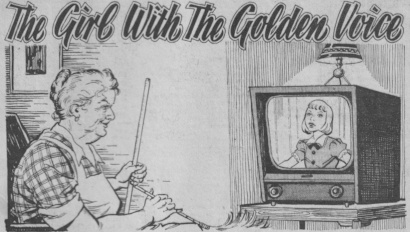
The Girl with the Golden Voice / The Sunshine of her Songs

Plot

Carole Chatton found joy in singing but her stepmother Kaye, hated Carole and was always cruel to her, while her father was away. Kaye finds ways to try and stop Carole suceeding like when she gets invited to sing at concert, Kaye burns the letter, but Carole finds out about it, but has no dress to wear to the concert. With help from her neighbour Flossie, an ex-entertainer, she wins money in a talent contest but Kaye finds out and takes the money so again she’s left with nothing to buy a dress.

Notes

  • Text story
  • First appeared in Bunty, reprinted in Mandy with new new name and new spot art.
  • The Sunshine of her Songs  – Spot Art: Claude Berridge

Appeared

  • The Girl with the Golden Voice (text) – Bunty: #22 (14 June 1958) – #37 (27 September 1958)
  • Reprinted as The Sunshine of her Songs  (text) – Mandy: #01 (21 January 1967) – (?)

My Brilliant Friend (1990)

Published: Bunty Picture Story Library #324

Artist: Unknown

Writer: Unknown

Special thanks to Lorrsadmin for helping me find a copy.

Plot

Josie Manton is a brilliant girl who excels at everything. By contrast, Josie’s best friend Debrah King seems to be a born loser and never shines at anything. Debrah keeps hearing the remarks from other girls. Some say Josie must be jolly decent to hang about with such a loser, while others say she could do better than Debrah and hanging around with such a loser is holding her back. Even Debrah wonders why Josie bothers with a loser like her for a friend instead of girls more like herself.

Athletic Mary invites Josie to her athletic club and artistic Lisa to her art class, to sharpen her edge with more fitting competitors. Josie declines both times, saying she wants to stay with Debrah. Debrah assumes they’re just trying to split her and Josie up, but she still thinks these remarks must be so disparaging for Josie.

Debrah speaks to her gran, who recently came to live with the family, about it. Gran prompts Debrah to try harder, and instead of putting herself down and compare herself unfavourably with Josie, encourage herself with a positive attitude. So Debrah tells Josie that she has decided to make something of herself and be a friend Josie would be proud to have. Gran encourages Debrah in every way and helps her with her defeatist attitude. But not surprisingly, Debrah still has problems with confidence and breaking away from comparing herself to her brilliant friend.

Both Debrah and Josie go for an art contest, but Debrah throws her effort in the bin, thinking it’s not good enough compared to Josie’s. Unbeknown to her, gran rescues it and enters it in the contest.

The school craft fair comes up. Instead of helping Josie with her stall as she did before, Debrah decides to run one of her own. Gran helps Debrah makes lucky mascots out of pom poms to sell, but just as things are about to start, the mascots go missing. Debrah eventually finds them in a rubbish sack and accuses Lisa, the girl in charge of the sack and was always harshly comparing her artwork to Josie’s, of taking them. Lisa is upset at the accusation, but Debrah is impressed at how Josie smooths things over. She’s such a good friend. Then, at the fair, Debrah’s cash box is stolen and people think she stole the money for herself. Debrah finds herself an outcast, with only Josie sticking by her and more comments from the other girls at how Josie could be so loyal to a girl like Debrah, who doesn’t deserve it.

The maths teacher sets a homework test paper on decimals, but while Josie is a breeze on it, Debrah struggles with it, thinking she’s a duffer on the subject. At home, when gran explains decimals to Debrah, she suddenly finds it easy and gets the test done in no time flat. But at school, Debrah’s maths book with the test in it goes mysteriously missing after she hands it in. She is forced to do the paper again, but her new confidence falls to pieces and she struggles with the decimals once more.

School Sports Day is coming up, and there are more remarks from Mary about how Josie could do much better at the sports club instead of training beside a loser like Debrah. Josie sticks up for Debrah, saying she’s her friend. Gran determines that Debrah’s athletic skills lie in jumping, not running, so Debrah enters those events. However, on the day, she hears Josie calling for help from the gardener’s shed. When she goes there to help, someone locks her in. This causes her to miss her events and her explanations are not believed. Debrah surmises someone must have been mimicking Josie’s voice to play a dirty trick on her, but Mary has an alibi. Josie, however, does not. In fact, she went missing for a while after competing in her own event…

The following day, Debrah receives a letter that she made it to the final of the art show, and finds out what gran did for her. Josie made it too, but Debrah doesn’t tell her she is also in the final because she wants it to be a surprise. At the final, Debrah wins the landscape section. The judges say they liked the spontaneous impressionism of Debrah’s work over Josie’s “chocolate box” effort. Debrah is concerned at how Josie must be feeling about this, but Josie’s reaction is both a shock and surprise: she claims the picture is a preliminary sketch she did and Debrah stole it from her! As the girls were together when they painted the pictures, Josie must know that can’t be true, but when Debrah confronts her about it, her only response is “Just leave me alone.” The prize-giving is put on hold while Josie’s claim is investigated.

Appalled at Josie’s conduct, Debrah decides to go over to her house and speak to her about it, but she gets no answer. After determining Josie is out, Debrah hides in the shed to catch her by surprise when she returns. In the shed, she finds her missing money box and maths book. At this, she realises her so-called best friend was wrecking her attempts at success the whole time.

When Josie returns, Debrah confronts her over it and demands an explanation. Josie replies that she wanted her to stay the way she was, not be good at things. But if it’s no longer the case, she’s through with Debrah.

So, the brilliant Josie hung around loser Debrah because she was a loser? And now she isn’t, she’s dumping her? What gives?

When gran hears about this, she surmises that Josie can’t face competition or anyone going one better than her. She declined the invitations to the art class and athletics club because she was afraid of the competition. The real reason she hung around Debrah, a girl who never shone at anything, was to make herself look better by comparison. It’s probably due to a confidence problem (gran’s theory) or a jealous streak (my theory).

Gran also informs Debrah that the judges have cleared her of Josie’s accusation. She is free to collect her prize, which she does in the final panel. Success for Debrah at last!

Thoughts

Stories about girls who try to prove themselves because they are ridiculed for not being good at anything, only to be constantly sabotaged by a spiteful person to keep them in the shadows have been a long-standing staple in girls’ comics. “Shani Must Shine”, “Sheena So Shy” and “Make Headlines, Hannah!” from Tammy are some examples. In stories like these, the story shows who the saboteur is and the tricks they are pulling, so we know what’s going on. In many cases, but not all, the protagonist realises it too, so what she has to do is finally get one step ahead of her spiteful saboteur.

The story takes a different take on the formula. In this case the identity of the saboteur is unknown, creating a mystery to be unravelled. And girls just love mystery. Equally mysterious is the motive for it all. It is indeed a puzzler, as there seems to be no reason why anyone would want to sabotage Debrah. The two suspects, Lisa and Mary, don’t seem to have any real motives for doing it. In fact, they would rather Debrah succeeded more against Josie, to give her more worthwhile competition. As far as we can tell, Debrah has no real enemies or bullies picking on her, nor has she upset anyone. Did she put someone’s nose out of joint? Is there some spiteful minx at work, doing it all for kicks? Or is it linked to some past grudge?

Josie is crafty in how she manages to keep herself well-hidden when she pulls her tricks. Her false show of loyalty and friendship and sticking up for Debrah further serve to pull the wool over our eyes as well as Debrah’s. However, Josie’s false accusation at the art show because there is no other way to sabotage Debrah is her undoing. Little did Debrah know what she had done in not telling Josie she was in the final: she caught the dirty trickster on the hop, with no time in advance to pull another sneaky trick to stop her winning.

There is more psychology and realism to Josie and her motives in wrecking Debrah’s efforts at glory than most, who don’t seem to do it for much more than pure spite. The story does a fine job of developing Josie’s motives, and it’s believable. It stems from some form of insecurity or jealousy in being unable to handle competition and challenges, so Josie avoids it where possible.

In a way, it’s sad for Josie. If she carries on with avoiding serious competition she will never achieve her full potential, as competition to improve herself is precisely what she needs to achieve it. The girls are right in saying Josie holds herself back. We won’t be seeing Josie at the Olympics in pursuit of medals or making her name in the art world because she is too afraid of being outdone.

Josie’s friendships won’t reach their full potential either. Choosing friends who won’t be competition rather than people she really likes severely limits her friendships. She will never be true a true friend to anyone, and her despicable treatment of her best friend, without any remorse or apology, is the ultimate proof of that. She was never a real friend for Debrah, and Debrah is well rid of her.

Debrah is a classic example in girls’ comics of how poor esteem and not believing in yourself can hold you back, especially when you are being compared to a more achieving person. Josie using Debrah to make herself look good serves the additional purpose of holding Debrah back because it makes Debrah feel she’s a failure and a loser in comparison. It’s a very crafty move. But along comes gran, who encourages Debrah to take an entirely different attitude. Even without Josie’s sabotage there will still be bumps in the road for Debrah as she strives to find her feet and what her strengths are (jumping events, impressionism, crafts, mastering maths, and more just waiting to be discovered). She discovers she had these talents all along, but it took a supportive relative, a more positive attitude and confidence, and achieving something at long last to bring them all out. We are far more likely to see Debrah making her name than the brilliant all-rounder Josie who keeps holding herself back because she can’t face competition. Debrah won’t be afraid to try the athletics club or the art class now she believes she has talent to offer there.

Bunty for Girls 1990

I was going to do a Christmas post while I had time off from work, unfortunately after Christmas day, I was unwell, but I have recovered now (just in time to go back to work of course!), so better late than never, I have managed to get time to look at an old Bunty annual.

The Bunty annuals up to 1988 all depicted a drawing of the Bunty character on the cover, in 1989 this changed instead to a photo of a girl and the 1990 annual does the same, a trend that would continue until the end of the annuals. What I do notice about this earlier photo covers is they are more minimalist, with just plain background, girl, and title. Later annuals would have more text added to the cover advertising what to expect inside. For regular weekly readers they would know what to look forward to, a lot of familiar characters are present with some fun one-off stories as well. (For just a list of contents go to the next page)


Picture Stories

Sister Susie (Pages: 6-15)

Artist: Matias Alonso

Petra Mayne’s uncle raised a chimp named Susie like a human child. While he was away, Susie comes to stay with Petra’s family. Susie can be quite difficult to manage at times. To try and keep her entertained they go to visit a Stately home with a fun fair (oddly enough they leave Petra’s young twin siblings with a neighbour, which seems unfair that they miss out!). The plan is to stay at the outside grounds, but Susie slips away into the Hall. She causes mischief until  a group of children visiting from children’s home are able to lead her outside. They have more success at the fair as Susie helps a boy down the helter skelter and stays with the children for the rest of the day. She does manage to get up to one more piece of mischief before leaving slipping hall to steal the wax fruit display, which the Mayne’s don’t notice until driving home!

Bonnie and Claude (Pages: 17-24)

Artist: Andy Tew

Ballroom dancers Bonnie and Claude Plank along with young Laura Balmain go to Rio de Janeiro on holiday, before they are to compete in the World Latin American Dance Campionship. Unbeknownst to them a competing pair of dancers, Pedro and Carmen Maneto, have decided in order to win, they must make sure the Planks can not participate.

They follow the Planks around on holiday but their tricks always backfire, until Pedro takes drastic measures and gets bandits to kidnap the trio. The bandits put them to work for them, but it has disastrous consequences, Laura puts too much chilli in the food, the Planks flatten his gold watch and burn his long johns with an iron. Laura then comes up with a plan to escape, Bonnie and Claude distract the bandits with dancing lessons and she throws bullets on fire, making them think they are being attacked. Bonnie, Claude and Laura manage to make it to championship just in time and of course win it. Still not knowing Maneto’s involvement she is confused when the Bandit seem to blame the Manetos for things her and the Planks did!

The Wilde Bunch (Pages: 26-32)

Art: Russ Nicholson

Carol Wilde found kids for the model agency she worked at. The company used real ordinary kids off the street rather than pretty posed professional models. Carol was good at finding the perfect kid, but it could also cause a lot of trouble.

While running late for work, she runs into a boy on roller skates, although he says he will jump over her, she ducks out of way landing in water, he tells her she could have saved herself a soaking if she listened to him. When she finally gets to works she has a note from colleague Miss Potts, but she can barely read the hand-writing, “Mega TV need a boy – skater trained – for a special stunt commercial” . Miss Potts is out looking at potential candidate but rings to say she has had no luck, Carol says she has an idea that she ran into a great skater earlier, she hangs up before hearing Miss Potts protest.

The boy, Lennie, sees Carol coming and thinks she is mad about earlier and runs off. Borrowing some skates Carol goes after him. Lennie gives is skates to is twin brother Teddy and disappears, Carol catches Teddy not knowing he is a twin. Without listening to him trying to explain she rushes him over to studio wondering why he has got so clumsy all of sudden, learning the truth, she thinks she is in big trouble but the TV people are delighted with Teddy. Miss Potts arrives she had been trying to tell Carol earlier the note said ‘scatter-brained’ not ‘skater-trained’, the commercial is for a relaxing hot drink where a kid is to wreck the house. So coincidentally for Carol, everything worked out as it should!

Three stories in and a lot of humour, hijinks and misunderstandings in this annual! There’s a change of pace for the next story.

The Necklace (Pages: 33-44)

Artist: David Matysiak

As in a lot of these annuals (mostly in Diana, Man in Black stories)  a spooky tale by David Matysiak, seems tradition. In this story Sally Regan borrows a special necklace from a friend and promises to return it first thing in the morning. She puts in a secret cubby hole for safe keeping but oversleeps in the morning and forget to bring it. Jean is anxious to get the necklace back, so Sally rushes home to get it after school but doesn’t pay attention when crossing the road getting hit by truck.

Sally makes it home but is feeling strange, there is a truck moving furniture and girls in her bedroom which confuses her. Then she puts her hand through a clock and she realises she is a ghost. Her memories are not fully in tact, she remembers getting hit and she was rushing to do something important but can’t remember what it was. Getting used to her ghost state, she eavesdrops on the new owners conversations to find out her parents moved. She then seeks out her grave and sees her friends including Jean visit. Jean is sorry that she was cross about the necklace the last time she saw Sally. Now knowing what she needs to do Sally goes back to the house, and after a workman discovers her secret cubby  hole she scares him and takes the necklace placing it in Jean’s desk. This is not the end of it though, as Sally discovers so much time has passed that her old class have moved to third year. The boy who now has Jean’s desk finds the necklace and gives it to his girlfriend. Sally manages to sneak it back from her during gym class and slip it into Jean’s blazer pocket. Jean is surprised to find it, and even more surprisingly Sally wakes up in a hospital bed with her parents beside her. She has been unconscious since the accident, she thinks it was all a strange dream she had, until Jean visits wearing her necklace, saying she found it in her blazer pocket!

School’s Out! (Pages: 49-58)

Artist: Terry Aspin

Before The Comp came over from Nikki, Bunty’s equivalent long running soap story, School’s Out, followed the pupils at Wansdale School. In this story Patti asks her friends to come along to the Christmas Eve disco with her, but they all have plans – Dawn is decorating at an Old people’s home, Sandra is going to a fancy dress party, Carol is baking a Christmas cake, Ellie is going with her brother Kevin to get a Christmas tree and Gladys is being Santa at a kid’s party. Their Christmas plans end up being a disaster, after lots of complaints about her decorating Dawn discovers someone else has decorated the party room at the old peoples home, Sandra’s Eddie the Eagle costume cause her trouble as she can’t get in taxi or crowded bus with her skis, Kevin and Dawn tries to cut down a tree but after a misadventure buy one instead, and the kids are not convinced by Gladys Father Christmas voice and rip her beard off. Patti is surprised to see them all turn up at the disco, but they all have a good time in the end.

Life in Bunty (Pages: 59-61)

Not to be confused with Life with Bunty that follows the Bunty character, this strip follows Kirstie a worker in a ficionalised Bunty office, that seems to employ a number of women with a male boss they call “Sir”. In this story Kirstie recall some previous years Christmas mishaps, like Sir trying dance on table at restauraunt and slipping onto holly or when they all had the same idea to give Sir a photo of themselves as a present. This year Kirstie brings the whole office down as she slips on a filofax after decorating the office.

Toots (Page: 64)

Artist: Bill Ritchie

Toots bemoans the youth watching TV instead of doing constructive hobbies like bygone years  such as knitting, painting, playing the piano… that is until she hears the theme tune of “Neighbours” on the TV and so has to pause to watch that first.

Bike Rider (Pages: 65-69)

Artist: Andy Tew

Sandy Clark with her computerised super bike go on the hunt for a pickpocket, after mistaking a man running for the bus as the thief trying to get away, they have better luck at the circus and they find a trained monkey responsible. After the events, the ringmaster is sorry that the Bike Rider has disappeared he wanted to offer him a job as a stunt rider. Sandy overhearing thinks “he” won’t be taking up the offer.

The Four Marys (Pages: 71-80)

Artist: Jim Eldridge

After the four Marys find out that Miss Creef’s been teaching at St Elmos for 25 years, they talk to Miss Mitchell about celebrating the occasion. They decide to write to old pupils to get together for the celebration. Everyone replies except sisters Ruth and Rhoda Dale. As the last address they have for them is close to Raddy’s home, over half-term they decide to pay a visit. They are shocked when Rhoda has so much hate for Creefy, she tells them of her time in school. Her mother was a famous actress that they rarely got to see when she was in London for only one day, they wanted to go visit, but Dr Gull was unable to let them go as there was no teacher free to chaperone the. Rhoda and her sister snuck off to London anyway, surprised to meet Creefy at the train station. Despite the hotel being close by, Creefy just took them back to school, and they never got a chance to see their mother again as she died in an accident a few months later.

The Marys are disappointed that Miss Creef could do something like that, but remind themselves people can make mistakes. On the day of the celebration allthe old pupils tell stories of how Miss Creef helped them. The Marys think everything will be ruined when Ruth and Rhoda show up, but of course the story Rhoda told was not the whole truth. What she did not know was that he mother did not want to be seen with the girls in case having grown up daughters damaged her career. Miss Creef had gone to see her to try and get her to change her mind, Ruth found this out later and only after learning that Rhoda still had resentment for Miss Creef she told her the whole story. So the firm but fair Creefy’s reputatation is restored and everyone is able to happily join in the celebrations.

Haggis (Pages: 93)

Haggis is tired of having to follow orders, but he doesn’t refuse the order to come for dinner.

Life With Bunty (Pages: 94-95)

Artist: Doris Kinnear

Bunty is enjoying skating with her friends. When a boy comes along that she likes, she pretends not to be a good skater so he will offer to help her.

No Time for Terri (Pages: 97-104)

Artist: Douglas Perry

Terri Dempster’s parents run a children’s home, Heartvale House. Sometimes Terri feels her parents don’t have as much time for her as the other children, so she is excited when she sees they have booked a holiday to Paris. She icannot hide her disappointment when they tell her it is a getaway just for her mom and dad and they’ve got a temporary matron in for the week. Terri is so upset so won’t stay at the home and asks to stay with an aunt instead. She ends up quite bored, meanwhile the children aren’t getting along with the new matron and decide totrack down Terri. Terri comes back to the home and helps the matron, with all the little tricks she’s learned from her parents (like putting a sprinkle of cheese on the mash so the children eat it).

Hearing the whole story when they return, her parents are proud of her when they come back. They want to treat her to a weekend away to London just the three of them. Terri is excited but when one of the young girls, Mandy, is upset that Terri will miss her birthday, Terri feels so bad that they end up staying for the party instead. Terri tells her parents she is getting as daft about the place as they are.

Bringing Up the Barkers! (Pages: 106-112)

Artist: Andy Tew

Walter the dalmatian of Janner Hall, despaired at his new owners, the rough and common Barkers who had inherited the Hall. When Princess Idra comes to stay, he thinks she must also be appalled by the Barkers behaviour. When he invites some of his dog friends to look at the Princesses room, he get in trouble as Karl attacks a big teddy bear and the room gets wrecked. Walter is  ashamed but redeems himself when he raises the alarm to kidnappers who are spying on the place. Him and the Barkers stop them and Princess Idra is grateful, she also thinks the Barkers are fun and is enjoying her stay. Walter admits one can’t be highbrow all the time!

Dream Pony (Pages: 113-120)

Artist: Edmond Ripoll

Mandy Mason gets to ride her neighbours cart pony Missy, but dreams of owning her own exciting competitive pony. When her father comes into money her dream comes true when she is able to buy an arab pony, Flame. But she soon finds out he is not as perfect as he seems, he tires her out from straining on the reigns, is traffic shy,  he bolts from her and doesn’t watch out for people when jumping over a drop. Mandy#s friends mention having such a thoughtful pony as Missy who would never do such things has spoiled. Mandy had never seen things that way but begins to realise how lucky she was to have Missy. She gives Flame back and when her old neighbour wants to give up her cart, Mandy is delighted she can buy Missy her perfect pony for herself.

Photo Stories

Ever Had That Shrinking Feeling? (Pages: 81-92)

Helen agrees to take on her friend Rosemary’s newspaper round for a day as a favor. The shopkeeper mentions Rosemary was shakey after returning from her round the previous day. Helen wonders what could have caused trouble, as everything runs smoothly, her nerves start to ease, but when she gets to house 13 suddenly everything starts looking bigger. The house belongs to a witch who has cursed her for insulting her the previous day, not realising she’s a different paper girl. Helen has to escape the wilds of the garden before getting into the house and finally getting attention of the witch. Finding out her mistake the witch un-shrinks Helen but also makes her forget what happened. So the next day when Rosemary asks what happened thinking there is no trouble she says she doesn’t want to give up the money will take back the paper round.

There is some dodgy cut and paste sometimes with making Helen small and interacting with things, but it was a different type of photo story than we usually see so it makes it more memorable.

Features

  • Top Popstrels  (Pages: 16, 48, 70, 121)
    • Posters of popstars: Kylie Minogue,Whitney Houston, Tiffany and Sinitta
  • Pop the Question (Page: 25)
    • A pop music quiz.
  • Alton Towers (Pages: 45-47)
    • A feature on the lesure park
  • “As We Were Saying…!” (Pages: 62-63)
    • Animal photos with joke speech bubbles
  • A Right Royal Crossword (Pages: 96)
    • A crossword based on the royal family.
  • Lets All Go to Sandy City! (Page: 105)
    • Feature on sculptor Kent Trollen sand city built on Seal beach, California.
  • A Photo Story is Born… (Pages: 122-123)
    • An interesting insight into the making of a photo story. The story in question is “Nothing to be Afraid of” appeared in the Bunty 1989 Summer Special.  According to this feature firstly the writer Judy Maslen, passes on the story to sub-editor Jeanette Taylor which then gets passed to photographers Norman and Benita Brown. The photographers gather the cast and after shooting the scenes, the film is developed and passed back to the Bunty office. The type is set, read and corrected and stuck up by balloonist Elaine Bolton.
  • Design a Fashion (Pages: 124-125)
    • Eight fashion designs submitted by readers, redrawn by a Bunty artist.


Final Thoughts

This was the earliest Bunty annual I owned when I was younger (well… technically it belonged to my sister first). I always preferred the Mandy and Judy annuals, but Bunty had its merits too and I have good memories of this. There is a lot of humourous stories in this, I enjoyed The Wilde Bunch, the misunderstandings and Carol’s chase of Lennie is quite dynamic. The soap story School’s Out could be played for drama in the weekly issues at times, but this story instead goes for a humourous Christmas inspired tale. I especially appreciate Sandra’s costume of an eagle with skis to represent Eddie the Eagle. Another favourite of mine is The Necklace the long spooky story, left you wondering how much was a dream and is a story that stuck out in memory with of course David Matysiak’s distinctive art.  The Four Marys is always a classic, and I do have a soft spot for stories that show flashbacks to St Elmos in the past, of course there was a misunderstandings with Miss Creef, us readers could hardly believe she could be so cruel and story shows of course that’s not the case.  It’s the only story that shows us some past events as well, as all the stories are set in contemporary times, no tragic Victorian orphans stories present here.

Surprisingly we get no text stories, although maybe its not a big surprise as Bunty annuals didn’t have a lot of text stories other than the very early years, and none appeared in annuals from 1988 to 1992. We do get one photo story, Ever Had That Shrinking Feeling? is more memorable than other photo stories which usually stuck to general life stories with their restricted format. Another bonus of this book is the behind the scenes of how the photo stories were made, with names of people who worked on the story. Photos taken of photographer taking photos for a photo story, all very layered! There were some other other fun features, I liked the Design a Fashion page where reader’s designs would be drawn by a Bunty artist, and the sand sculptures in the Lets all Go to Sandy City.
 

Oh, Boy! (1993)


Plot

Charlotte Wilson, a tomboy who is always called Charlie, moves to a new town and stumbles upon an open air audition for a new television series. Because of her boyish looks, she is mistaken for a boy and gets a male part in the show, and continues pretending to be a boy in order not to lose the role. Inevitably she is discovered, but she has become too popular to be fired. So the director writes her true gender into the show as a twin sister.

Appeared

  • Oh, Boy! – Bunty #1845 (May 22, 1993) – #1854 (July 24, 1993).

Notes

  • Art: Ron Lumsden.
  • Translated into Dutch as “Zeg maar Nico!” (Call me Nico!) in Tina #7/1994-16/1994, reprinted #18, 2002.
  • Image from Dutch translation.

They’re No Match for Mo! (1977-78)


Plot

Mo Miles, the daughter of a rag-and-bone man, is an ace tennis player. She is invited to join a posh tennis club after finding a valuable ring lost by a club member. Nonetheless, she and her father meet constant discrimination from the snobby club members, even when she starts winning tournaments for them. However, Mo can prove she is a match for all opposition, both on and off the tennis court.

Notes

  • Artist: Colin Merrett
  • Translated into Dutch as “Geen Partij voor Patty” (No Match for Patty), Debbie Parade Album #27.
  • Reprinted as “Nellie Never-Give-In”, Lucky Charm #12.

Appeared

  • They’re No Match for Mo! – Bunty: #1031 (15 October 1977) – #1050 (25 February 25 1978)

The Summer Fête [1996]

  • The Summer Fête – Bunty Picture Story Library : #427 [1996]
  • Art: Jesús Redondo

Plot

Westfield Community Centre run a Summer Fête each year, but the Women’s Circle who usually organise it, feel that it’s only fair some other group take charge this year as all the groups benefit from the money raised for the facilities. While most people are reluctant, Anne from the youth group, spiritedly volunteers herself and her two friends (much to their dismay!). After Anne talks her friends, Sally and Julie, around they set off confidentially making a list of things to do and actually getting excited about the project, but things don’t go quite as smoothly as they would have liked!

First they contact Farmer Buckley for use of his field and he tells them they can use last years stall that are stored in the barn… though they may need a lick of paint. The girls find the stalls in poor condition needing more work then a paint job. When they can’t find anyone to help repair the stalls, they set about doing it themselves. This does not go well, but then Farmer Buckley’s son, Billy, comes across them and offers his woodwork skills. With the first problem sorted they go about trying to find someone to open the fete. Seeing a poster of pop star, Chris Rich, the girls think it would be great to get him to do the opening, even if it is most unlikely to get such a star. Being optimistic, even though it’s a slim chance they figure no harm in asking, and after getting no response from his agent, they go and try and see him at a show to ask in person. They get mistaken as contest winners and introduced to Chris, before they get a chance to ask him about the fête, the real contest winners burst in to expose them as frauds. Luckily when the girls explain why they are there, Chris takes it all in good humour, he even says if he is not too busy he’ll open the fête and his agent will be in contact.

Unfortunately after a few days they hear nothing from Chris’s agent, so are back to square one. They tell Mrs Lucas about this problem when she asks how preparations are going, she says she can get Bob Benning the local radio DJ to come. The girls accept, though privately Sally says she isn’t pleased to have an old  boring guy with terrible jokes as their special guest, but they don’t have other options. More bad news for the girls when they go to barn and find the prizes have been stolen. With Billy’s help they find them dumped close by, some of the prize are broken, but they manage to salvage most of it . Their luck seems to turn for the good  when Chris Rich shows up saying he can do the show, apparently his agent has been fired for mismanagement. The girls are so delighted until they realise now the have two openers! Then Bob Benning shows up! He tells the girls he appreciates being asked to open but he’d prefer to dress up walking around the fete entertaining people. The girls graciously accept, relieved the problem sorted itself.  On the way out Bob makes a comment that he’s sure they could find some one else to open, like maybe the latest heart-throb, Chris Rich. The girls then realise he overheard their earlier conversation with Chris, they think he is great for doing that and they would never refer to him as boring again.


So just as things seem to be coming together, of course another obstacle presents itself. When they go to the field to start setting up everything, they find caravans there instead. Farmer Buckley tells the girls he didn’t realise they would need to set up so soon, he can’t ask the caravans to move, and that they will have to use the smaller  field instead. Trying to make the best of things Sally decides to start moving things to field but slips and hits her head while moving a slide. She wakes up in a caravan, the owner Mary is a nurse and lucky Sally isn’t badly injured. Mary asks her what she was trying to do when she had the accident, and after hearing her story, Mary tells her she would be happy to get all the caravans to move to smaller field. Of course noting can ever go smoothly and soon after Mary notices her diamond ring missing and she blames Sally as she was in her caravan. The police are called, but it turns out two young boys had found it and took it not knowing it was valuable. Everyone is very apologetic to the girls after that, for the accusations.

Again things are finally running smoothly they’ve even come up with a contingency plan if it rains. Of course there is one final obstacle to overcome, when Mrs Lucas enquires about the food for VIPs like the opener and Mayor, the girls had not thought of that or even to invite the mayor. Luckily a quick phone call and persuading Mrs Lucas that the Mayor asked for her food specifically solves that. The day of the fete arrives and it is a sunny day, everything goes well, even Mrs Lucas says it may be the best one yet. Anne tells Mrs Lucas was thinking about the Christmas fair but Sally and Julie quickly shut that idea down!

Thoughts

A Summer story for Summer! A campaign/project can be a fun setting for a story. While often these type of stories have a saboteur working against the protagonist (like in Follow-My- Leader-Lil or “Hands Off Our Club!”), sometimes its just a a series of events to make an ordinary task more exciting.   Organising a fete is no easy project on its own, and the girls of course get even more drama thrown their way with trying to track down a pop-star, having prizes stolen and even being accused of thievery themselves! The story keeps things interesting by giving the girls all these obstacles to overcome, while never letting things get too frustrating for them.

It also has some good humour, especially with Sally and Julie being the long suffering friends of Anne’s ideas. Although they soon come around to helping out and are proud of achievements at the end of the day, they are not ready to take on such another project again, unlike Anne! The girls are quick thinking, pretending to Mayor that his invitation got lost and taking the opportunity to meet Chris Rich in a case of lucky mistaken identity. They do get some help along the way, Mrs Lucas despite not wanting to run things does check up on the girls reminding them of things and even getting convinced to provide food, Billy Buckley and his friends despite the girls initial misgivings about the boys do offer a helping hand when needed and are the only ones to stand by them when they are accused of theft. Even both celebrities Chris Rich and Bob Benning come to the girls rescue in different ways.

It’s also another good example of Jesus Redondo art, whose style seems to suit the restrictions of the smaller picture story library format. As always with these PSLs it can be a challenge to present an interesting story with satisfying conclusion in a short format, but this works well, ending on success of fete and Anne getting grand ideas on the next fair.

The Comp: Bunty PSL #348 (1992)

Published: Bunty PSL #348

Artist: Peter Wilkes

Writer: Anthea Skiffington

Special thanks to Goof for scans

Plot

Grim Gertie is hospitalised, bringing in a substitute teacher, Mrs Whitely. Laura Brady isn’t off to a good start with Whitely when she rushes to registration, which causes her to collide with Whitely and tread on her toes. “Trust me – I just crashed into Gertie’s stand-in!” But the real bad start comes when Whitely discovers Laura’s name during registration. All of a sudden she is looking daggers at Laura, seems to have a sudden thing about Laura being a problem pupil or something, and says, “I shall remember you, Laura Brady.”

From then on, it’s bully teacher time for Laura. Whitely constantly singles Laura out for unwarranted and unfair punishment, even for things that are totally untrue, and detentions are a particular punishment. It starts with her giving Laura detention for homework with four wrong answers, sloppiness and scribbles. Now that’s bizarre to say the least. Okay, so Laura did the homework while being engrossed with a Tom Cruise movie on television, but it looks like everyone else did too. Her mother, who checked her homework, can vouch it was tidy and scribble-free, so what’s Whitely talking about? Later, Laura finds out others did even worse than her on the homework assignment and didn’t get detention – so why did she get it?

At any rate, as Laura is soon to discover, it makes no difference to Whitely as to whether her schoolwork is the best or not.

At first Laura’s classmates think she is just imagining things about Whitely, but they change their minds as it grows more obvious. On one occasion Whitely pounces on Laura for trying to ping a paper pellet at Hodge; Hodge says it was his fault for pinging it first, but Mrs Whitely refuses to listen and punishes Laura with a stinging 500 lines. On another, she punishes Laura for talking in class; her friends admit they talking too, but Whitely doesn’t listen to them.

Whitely also refuses to hear Laura’s pleas that these constant detentions are causing her to miss out on vital hockey practice and matches, which incurs the displeasure of Miss Bliss (“The Blizzard”) against her. As a result, Laura eventually loses her place in the hockey team.

The class reckon it must be Whitely’s trodden toes. Their only advice to Laura is to ignore it, but that’s easier said than done. As Gertie will not be fit to return for a while yet, Laura fears her bully teacher ordeal looks set for the long haul. She has not spoken to her parents about it, not even when Mum asks at one point why she’s crying.

Meanwhile, the class visit Gertie in hospital and discover the maternity wing badly needs funds or face closure. They decide to pitch in, and settle on a Fun Day to raise funds. They need approval from their form teacher before approaching the Head. But when Laura suggests it to Whitely, she won’t listen: “Don’t bother me with your ridiculous notions, Laura Brady!” Then Laura discovers that a few minutes earlier, Whitely thought it was a great idea when Hayley and Roz suggested it, and told them to go straight to the Head for permission. This makes her even more convinced Whitely hates her.

The Head agrees to the Fun Day, sets the date for the last day of half term, and he must approve of the events being held. This could be problematic, as Hodge has scripted a parody of Redvale, “Riotvale Comp”, with parodies of the school staff. Laura is in the role of the Grim Gertie parody, “Miss Gruesome”.

Although Hodge tries to keep this school parody hidden from the Head, he inevitably finds out. Surprisingly, Hodge comes back with the news that the Head gave his approval to stage Riotvale, with “one or two tiny conditions”, such as a couple of small changes to the script. Hmm, is there a hint of something else here? Anyway, rehearsals for Riotvale continue. For Laura they are a welcome relief from her growing miseries with Whitely, and despite them, she is coming along well in the role.

But then Whitely goes too far. She forces Laura to do a homework assignment twice, saying the first was sloppy while Laura had taken care she would have no cause for complaint, plus having to do those 500 lines as well. Then she springs a surprise test on the class over the material. Laura is determined to score well, and ought to after running through the material twice. But when she does, Whitely hauls her before the Head with claims she saw Laura cheating in the test, but as there is no way these accusations can be true, Whitely can only be lying. The Head sends a letter to Laura’s parents, and there’s more detention for her. It’s getting too much for Laura, and she decides to drop out of Riotvale.

When the letter arrives, Laura reaches breaking point and finally tells her parents her teacher hates her. But they don’t believe it: “Now, that’s silly, dear. Why should she?” At this, Laura runs out of the house, still yelling that Whitely hates her and shouting at her parents for not listening to her. She then decides to run away, unable to take any more of Whitely. By now she has realised there has to be far more to this than trodden toes but can’t think what.

In class, Whitely notices Laura’s absence, but only says “perhaps we’ll have some peace and quiet for a change”, which further convinces the class that Whitely is gunning for her. She isn’t even asking questions about Laura’s absence.

Laura left the house in such a state that she forgot her schoolbag, which brings Mum up to the school. From there, she discovers discovers Laura is missing and reports it to the Head, who calls the police.

Mum asks to speak with Whitely. When she sees her, she now believes Laura, for she has recognised Whitely as Susan Stigmore, a nasty piece of work who used to be an old enemy of Laura’s aunt at school. When Mum confronts Whitely about this, her malice spills over and she expresses venomous comments about Laura and her aunt. She then realises her mistake in doing this right in front of the Head, but it’s too late – she’s been caught out. He sacks her and writes a report that will make sure she never finds another teaching job.

Laura is soon picked up, and everything is sorted out. When the other teachers hear about Whitely’s conduct, the Blizzard reinstates Laura on the hockey team. And Laura is back in Riotvale.

Two weeks later, it’s Fun Day, and Gertie is back. Riotvale is a thundering success. But then Hodge tells the gang what he had not told them before (aha!). The Head had granted permission to stage Riotvale on the condition that the school staff have their own sling-a-sponge event afterwards – with the Riotvale cast as targets. And boy, are the staff loving it! Revenge at last for all those things they put up with in class.

However, the Riotvale cast get revenge on Hodge with another fundraising idea: 10p to help throw him into the school fountain. And so he is, much to his chagrin. Ah well, it’s all in good fun and fundraising for Fun Day.

Thoughts

This is a PSL to be read over and over. There’s so much in it for readers to enjoy, and it is a well-constructed story that interweaves two contrasting elements with each other: the bully teacher and the Fun Day. Fun Day delivers the ever-popular charity cause theme, a brazen school parody that’s a welcome change from tired old fund-raising events, and heaps of fun on the big day that will finish half term with a bang. Providing contrast is the ever-popular bully teacher theme, with the drama, emotion, misery, and bullying that grows worse and worse until it becomes too unbearable. Added to it is the mystery element – what is Whitely’s problem with Laura?

There isn’t a DCT regular strip (The Four Marys, Penny’s Place, etc) that hasn’t had a bully teacher at some point, but it’s never a regular member of staff – it’s a new/substitute teacher. Whitely belongs to this long-standing tradition, as she does to the long-standing tradition of new/substitute teachers frequently spelling trouble of some sort in girls’ comics.

Bullying a pupil because of a long-standing grudge against a family member is a common theme. “Teacher’s Pet” (Judy) is another example of this. It also has the added tension of mystery to the story – why does the teacher hate the girl? And girls just love mystery in comics. And because the pupil doesn’t understand the teacher’s motives in bullying her, she may start wondering if she’s the one at fault.

The story was ingenious in throwing in the little mishap Laura had with Whitely right at the start, as misdirection for why Whitely hated Laura. If Laura (or reader) had looked more carefully at Whitely’s initial reactions to her, she might have realised it was something about her name that set Whitely off. Whitely changing her name through marriage was also a clever means in keeping her motives concealed and making them harder to figure out. If she’d come to the school as Miss Stigmore, it might have set off a few alarm bells with Laura’s family or laid some clues for Laura to pursue.

It’s no surprise to hear Whitely was a bully in her youth. It’s not clear if she was a bully teacher before Redvale or if Laura just brought out the worst in her because she was related to her old enemy. But, as it is obvious Whitely never learned her lesson about bullying, she was set to be a bully in adulthood. A teaching career would put her on course as a bully teacher who could bully other pupils, and ones who reminded her of Laura’s aunt would be particularly vulnerable. So we can all say thank goodness she was out of the teaching profession in the end. Her bully streak made her totally unfit for it.

But it’s not all depressing bully teacher time. The Fun Day thread is a total delight and a welcome light relief and contrast to the bully teacher situation. It’s all in a good cause, and Riotvale puts it above a whole new level. Without it, the Fun Day plot line would not have been nearly so much rollickin’ good fun for the reader. When the Head added the condition to performing it, we can just imagine his reasoning for it: “If you’re having your piece of fun with us, it’s only fair we have ours with you, eh?” Well, yes, he’s right – it’s fair exchange, and we have to laugh at the added twist it gives. Setting Fun Day at the end of the half term finishes off the half term in grand style, and the added punishment of Hodge gives Fun Day an even higher and more satisfactory note to end the story on.

They All Hate Hetty! (1975)

Published: Bunty PSL #146

Artists: Cover – Jack Martin; story – Mario Capaldi

Writer: Unknown

Special thanks to Goof for making the entry possible with scans.

Plot

Hester “Hetty” Mellish and her parents have only just moved to the isolated village of Widdivale when Dad is hospitalised in a road accident and Mum has to go to lodgings to be near him. Hetty is left in charge of a neighbour, Mrs Jones.

Hetty is curious to track down her great-grandmother, a Mrs Turvy who lived in Cubby’s Cottage in Widdivale. When Hetty finds Cubby’s Cottage, it is a rundown, neglected place, and then a couple of children suddenly run away in terror when they see her there. Tracking them down to sort things out, Hetty finds their mother, Mrs Preston, acting equally hostile and scared at her poking around Cubby’s Cottage. Mrs Preston warns Hetty to stay away from there and then slams the door in her face.

Next stop is the churchyard, where Hetty hopes to find her great-grandmother’s grave. She eventually finds it behind an overgrown bush, and the headstone bears the name Hester Turvy, the same first name as hers. But Hetty is astonished that the headstone is so neglected and kept behind the overgrown bush while every other headstone is kept immaculate – as if someone wanted it out of sight and mind. She tries to clean up the grave.

While she does, Sam Wiles, the man in charge of the graves, turns up. When he hears Hester Turvy was her great-grandmother, shares the same first name, and even looks like her, he suddenly goes scared and crazy and goes off spreading wild tales that Hetty is descended from Hester Turvy the village witch, come back to plague the village. Witch beliefs still persist in the village, and great-grandmother Turvy was believed to be a witch. From what Hetty and Mrs Jones can gather, it was all rumour mongering that arose because she lived alone, looked rather formidable, and, as the story later reveals, had a recipe book, which must have sparked tales of “a spell book”.

The whole village turns against Hetty, now believed to be a witch like her great-grandmother. When Hetty comes, people flee in terror, jeer and throw stones, or slam their doors shut. Wiles is spearheading the campaign to drive her out. He takes to the soapbox on a tree stump in the village square rabble-rousing the villagers, fanning the flames against Hetty, and urging people to burn down Cubby’s Cottage, saying it must be the source of her power. He even pays off Freddy and his friend Tom to spy on Hetty for any “witch” activity.

Mrs Jones remains Hetty’s only friend and staunchly stands up for her against Wiles, the persecution, and the crazy stories that get going. She knows how those villagers are so easily infected by gossip as they don’t have much else to occupy their minds with.

As is usual with these types of stories, strange things seem to happen and attract themselves to Hetty. The villagers start to imagine things that started when Hetty arrived. Good deeds Hetty tries to do to prove she’s all right just go wrong and look like more witchcraft. All of them inflame hatred against Hetty. There are rational explanations, and Mrs Jones helps Hetty to scotch a number of them, but it can’t really stop the persecution or Sam Wiles and his hate mongering.

Among them, Hetty tries to clean up the cottage and makes a makeshift broom for the job, but when the villagers see the broom, it sparks rumours it’s a witch’s broomstick. She acquires a cat, Tinker, who got left behind when his previous owner moved. Although the villagers know Tinker, they scream he’s the witch’s cat as he’s black, and throw stones at him. The frightened cat takes refuge in Cubby’s Cottage. While looking for Tinker in the cottage, Hetty finds great-grandmother’s old recipe book and tries a recipe for cowslip tea. She does not realise Wiles and his spies are watching her, and Wiles orders them to watch Hetty and that “spell book” very closely. The boys steal the cowslip tea, and Tom dares Freddy to drink it. Soon after, Freddy grows ill and his mother accuses Hetty of poisoning him with her witch’s brew. However, when Mrs Jones and Hetty investigate, they find Freddy is merely sick from eating too many sweets, which he admits were bought with the money Wiles gave him for information received.

The village fete comes up, and Mrs Jones is sure it will distract the villagers from Hetty. Hetty decides to contribute a doll in the hopes it will help the villagers to see she’s okay. No such luck.

When Hetty tries to be friendly and smiling to the villagers, crazy old Wiles starts the rumour that the “witch-girl” will harm Mrs Jones, the way Hester Turvy used to harm “innocent folk”. Oh, no, we can guess what happens next…

Sure enough, Mrs Jones soon has an accident and is sent to hospital. Hetty is blamed when the villagers see the doll – the doll’s dress is made from the same material as Mrs Jones’ and a needle is stuck where Mrs Jones got injured. It looks like Wiles’ “prediction” that Hetty would harm Mrs Jones by witchcraft has come true. At any rate, Hetty has lost her only friend and now faces the villagers’ hostility alone. She decides to stick things out so as not to worry her parents.

When Hetty donates the doll to the fete, the villagers refuse to touch it. Then a violent storm strikes, and the villagers blame Hetty although the weather forecast had warned about sudden storms. Wiles renews the call to burn down Cubby’s Cottage. Back home, there’s a note on the gate: “Get Out, Witch!”

Next day, Hetty decides to do just that. She packs a suitcase and strikes out for her mother’s lodgings, to tell her what’s been going on. But then, something tells her to go back to Cubby’s Cottage.

At Cubby’s Cottage, Hetty finds Freddy and Tom have been at it again. They tried to burn down Cubby’s Cottage for a lark, but it backfired on them when the fire got out of control. The cottage is going up like a torch, and Freddy is trapped in there. Hetty braves the flames to rescue him, but is soon in danger of becoming trapped herself. Then great-grandmother’s ghost appears and helps them both to safety.

After this, the villagers decide the great-grandmother wasn’t a witch after all and stop their persecution of Hetty. Weeks later, after Dad has recovered, the villagers want to make it up to Hetty, and they start by cleaning up great-grandmother’s grave. As Hetty and her mother inspect their work, great-grandmother’s ghost is doing the same and smiling.

Thoughts

Lingering witch beliefs in British villages have inspired numerous girls’ serials with the “descended from the village witch” formula. Other stories to use it include “Bad-Luck Barbara” (Mandy) and “Witch!” (Bunty). The formula is used to make a statement about the stupidities of witch beliefs, superstition and mass hysteria, and that 20th century people ought to be living in the 20th century, not the 16th century. And of course, illustrate how idiotic gossip and rumour-mongering can get as rapidly and dangerously out of control as the fire in the story.

The story is a little different from the formula its counterparts usually take, which makes it more interesting and novel. Usually there is an ambivalence about the things that happen, leaving readers to wonder if there really is something weird going on and the girl really is developing strange powers, or if it’s all coincidence, rational explanations, law of attraction or whatever. Here, the strange things all have rational explanations. In the end, it turns out there really is a supernatural force after all (something these types of stories usually hint at but keep ambiguous) – great-grandmother’s ghost, but it turns out to be benign and had nothing to do with the goings on the villagers blamed on Hetty. Also, instead of being a pervasive influence throughout the story, which is the more usual pattern, it only appears at the climax. It doesn’t even manifest during Hetty’s earlier visits to Cubby’s Cottage.

The story is also different in having males as the main persecutors. More often, they are female and don’t seem to be in it for much more than bullying, though personal gain can be linked to it. But it is logical to have ringleader as an older man, perhaps old enough to remember great-grandmother when she was alive, and his occupation (sexton) ties in well with how the whole thing starts. Being a man, and a respected one as the village sexton, would give him a whole lot more authority and power as a rabble-rouser against Hetty. Having the two boys as the main antagonists in the persecution and Wiles’ flunkies also makes sense. By nature they are scamps, and it’s obvious they get into all sorts of mischief. Persecuting a “witch” is the perfect excuse to cause mischief and worse with impunity, plus there’s money in it. After nearly getting themselves killed by their own mischief, maybe they will think twice about pranks and dares in future.

There is always a single person in these types of stories who serves as the girl’s only friend and sticks up for her against the persecutors (the girl’s parents are always useless for one reason or other). Usually it’s another girl who’s new to the village and therefore does not think the way the superstitious village idiots do. But this case, the story takes the unusual step of making her an adult who’s lived there for a long time, knows those gossiping, small-minded villagers all too well, and has friends among them. An adult is much more effective as an ally than a mere girl. An adult, and certainly one like Mrs Jones, is much more capable of standing up to those village idiots and trying to talk sense into them, or at least try to make them shut up.

As is common with similar stories DCT has produced, the protagonist eventually loses her only supporter, making her position even more precarious. And no matter how she tries to ride the storm, the situation inevitably reaches crisis point. If not for the supernatural intervention, Hetty and her parents would have been forced to leave the village altogether, which happened in “Witch!”

The ending – the persecution ending with the girl proving her goodness by saving lives and being accepted as a heroine – has been seen before in these types of stories. It usually comes off as pat and unrealistic because in real life, once witch believers think someone’s a witch, the label sticks and cannot be unstuck. But here we have a supernatural element taking a hand, and when there is one, we know things will be all right, which makes the ending more acceptable. And, unlike similar stories, we get to see the original “witch” finally happy and able to rest in peace after being persecuted in both life and death, which makes it even more satisfying.

“I Won’t Share with Shirley!”

Plot

Orphan Shirley Turner was given a comfortable home with her cousin Joan’s parents. While acting friendly, secretly, Joan hated having Shirley in the house and set out to make trouble for her in the hopes of her being sent away. After Shirley gets injured while saving Joan, Joan has a change of heart and confesses everything.

Notes

  • Art: Oliver Passingham (1982)
  • Later adapted into a picture story for Bunty Picture Story Library
    • Cover Art: Norman Lee, Inside Art: John McNamara

Appeared

  • “I Won’t Share with Shirley!” – Judy: #1179 (14 August 1982) – #1185 (25 September 1982)
  • Reprinted as PSL Book  “I Won’t Share with Shirley!” – Bunty Picture Story Library#279 (1986 or 1987)
  • PSL Book Reprinted as “I Won’t Share!” – Bunty Picture Story Library #422