Category Archives: Bunty

Penny’s Puppets (1966)

Plot

Orphan Penny Fairchild lives with her stern, cold grandmother Agnes Fairchild at the Fairchilds’ ancestral home, Middleton Manor. She feels out of place at school because of the clothes grandmother makes her wear and grandmother not allowing her friends over, but finds solace in her teacher Miss Jackson. Penny finds further solace in the puppets she finds in the attic and starts playing with, but this is going against grandmother, who has forbidden her to go to the attic.

Then Miss Jackson tells Penny that the trouble is about a family feud. The feud has something to do with the puppets, which are linked to Roland, the world’s greatest puppeteer and ventriloquist, and a singer called Rose Rossay. They start to investigate the mystery together.

Notes

Appeared

  • Penny’s Puppets – Bunty: #435 (14 May 1966) – #440 (25 June 1966)

School of Shadows (1995)

School of Shadows cover

Bunty Picture Library: #393

Published: 1995

Artist: Carlos Freixas

Plot

The pupils of Ratcliffe Park Boarding School are temporarily relocated to Ratcliffe Manor when their school needs repairs because of structural damage from flooding. There are whispers from a couple of pupils, Emma and Mags, that the manor is haunted. Sarah and Sally, the protagonists of the story, don’t take the rumours seriously. But they are disturbed when they see the portrait of the stern-looking Lavinia Wykes, whose family were the first owners of the manor, and marvel at what a contrast it is to Lavinia as a child in another portrait.

School of Shadows 1

Then the headmistress, Mrs Jonson, starts acting very strangely. Normally she is a kindly headmistress, but suddenly there are strange fluctuations in her behaviour. She starts turning into a Jekyll and Hyde character. At times she acts quite normally, but at other times she turns into a dragon, treating everyone in a manner that is not only extremely harsh but also Victorian in its thinking. She gives orders for the pupils to be served plain breakfasts consisting of dry bread and porridge. New rules are installed, and the girls are shocked and surprised at how severe they are: uniform to be worn at all times; no talking after lights out; no food in the dorms; no wandering around inside the house; and other rules listed that are not described. The caretaker doesn’t fare much better. When the school first arrives, Mrs Jonson tells him not to worry about cleaning the difficult-to-clean Victorian style windows. But then she does a very angry U turn, demanding they be cleaned “my good man!”

School of Shadows 2

Sally and Sarah put her behaviour down to the stress of the move, and Mrs Jonson is indeed taken ill. But when the deputy head, Miss Greg, takes over, she starts acting the same way. When Mrs Jonson returns, she seems to be herself again and even gives the girls pop posters for their dormitory. But soon the same thing starts again.

Things get weirder and weirder. When sent to the upstairs room for detention, Sally and Sarah rapidly discover there is something strange about it. It is inexplicably hot, and soon there are strange lights and voices crying “No! No! No!” in the room. In the school grounds they encounter a strange apparition and catch the words “…and I will not tolerate it!” in a voice they don’t recognise.

Sally and Sarah now think it is time to look up the history of the manor. They search newspapers in town, which yields information that the Wykes family built the manor as a private house. Thirty-five years later it was converted into a girls’ boarding school, with Miss Wykes as headmistress. Two years after that, a fire broke out in a dormitory, killing Miss Wykes and several pupils.

Now Sally and Sarah believe the manor really is haunted after all, and the ghost of Miss Wykes has possessed Mrs Jonson (and Miss Gregg during her brief stint as headmistress). When they tackle Mags for information on what she said about the manor, she says she was just embroidering rumours she had heard from her gran.

The abnormal change in Mrs Jonson gets worse and worse. She even starts looking like Miss Wykes, calls herself Miss Wykes, and redecorates her office in a Victorian style and switches to kerosene lamps because electric light hurts her eyes. She also gets flummoxed when she encounters computer technology, but then seems to recover herself and tackle it comfortably. She had given the girls posters to decorate the dorm with, but then tears them down when she turns into the dragon that seems to model itself on Miss Wykes.

School of Shadows 5

By now the headmistress’s behaviour has spread confusion and fear through the pupils. Because of it, they hate being at the manor and are desperate to go back to their own school. Sarah and Sally don’t want to start a panic by telling them what they think is happening, but they do take a third girl, Jane, into their confidence.

During another Wykes possession, Mrs Johnson scolds the girls for reading by candlelight in the dorm again – when there are no candles at all. At this, Jane, Sally and Sarah suspect that candles in the dorm started the fire.

They discover that records from the Wykes school are stored in the upstairs room – where the inexplicable heat, noises and lights are centred. That evening, they investigate the records, while the heat and noises start up again. They suspect this is because the original dormitory was located in the upstairs room, and where the fire started. A blueprint of the original school confirms their suspicions.

School of Shadows 3

They then come across a teacher’s journal, which lists the same set of rules that Mrs Jonson set up. The journal reveals that the fire was indeed started by pupils reading by candlelight in the dorm, which they often did because Miss Wykes frequently punished them by sending them to bed much too early. It goes on to say that the manor had been a sinister place since the fire and would have been better off burning right to the ground.

Then the girls discover that the day is an anniversary of the fire, which can only mean that something terrible is going to happen. Right on cue, the voices start up again and a notebook starts floating. They realise that another school on the premises must have been what sparked it all off. They head off to the headmistress’s office, hoping to convince her that they are in danger. As they do so, they feel they are being followed.

School of Shadows 6

They find no headmistress – but her office is on fire! They sound the fire alarm and the school evacuates. They hear another “No! No! No!” coming from the upstairs room, this time in Mrs Jonson’s voice. They find her in a very strange state, and she drops her lamp, which starts more fire that is not affected by fire extinguishers. The girls feel that these are not ordinary flames, and the fire brigade does not fare any better against them. This time the manor does burn to the ground, and the girls realise that the journal was right to say that it should – it is the only way to purge the ghosts. Mrs Jonson returns to normal and everyone is safe. The protagonists don’t dwell on wondering exactly what happened at the School of Shadows – they are just glad to see the end of it and return to their own school.

Thoughts

The harshness of old-style school discipline, particularly among principals who take it too far, or even let it turn into downright child abuse, has been a frequent one in girls’ comics. It often makes grim reading and a salutary lesson in not what to do in education. But when it is combined with the supernatural, as it is here, it makes for the most disturbing but compelling reading.

The haunting at the School of Shadows is all the more frightening and effective because the ghosts are kept obscure and it is never made clear just what the haunting is about. There are no supernatural beings actually appearing to frighten everyone, apart from the one in the grounds. No apparitions appear to speak to anyone, whether it is to make demands, threats, requests, or offer explanations and help. The ghost of Miss Wykes does not appear in person; you just get the impressions of both the ghost and the tyrannical headmistress it was in life, through its possession of Mrs Jonson. But this makes the haunting even scarier.

School of Shadows 4

The ghost in the grounds is the only apparition to actually appear in the story, but just what it is – it does not even look like Miss Wykes or the pupils who died in the fire – what it wants, or what it means by “And I will not tolerate it!” are not clear. It does not even bother to actually scare the girls; it just drifts by them as if they don’t exist. Its purpose in the story is difficult to understand and it does not square with who is supposed to be haunting the manor. One gets the impression that Bunty was gilding the lily a bit there.

However, there are few nice touches about the haunting of Miss Wykes. The first is the glimpse of her as a cute-looking child in one portrait that is such a contrast to the formidable, unsmiling headmistress she has become in the portrait that unnerves the girls. So often do these stern, hard teachers that we see in so many serials forget that they were once children themselves, just like the kids they rule with a fist of iron. And the reader also gets a reminder that a horrible headmistress was a child once – something you don’t see every day in girls’ comics.

There are also dashes of faint humour that the tyrannical ghost of Lavinia Wykes is getting a bit of 20th century culture shock while she possesses the body of Miss Jonson. One occurs in the computer room where she is completely thrown by all the computer technology, and we get the impression she had to retreat there and let Miss Jonson return. Another occurs in her office where she can’t bear modern electric lighting and insists on the old-fashioned lamps.

The girls don’t dwell on pondering exactly what went on at the manor, but we will take a moment to do so. First, there cannot be much doubt that the combination of the upcoming anniversary of the fire and the presence of another school on the premises was enough to stir up the ghosts. Plus, it must have been a miserable school with the harsh, intolerant Lavinia Wykes as headmistress (mind you, we have seen worse in girls’ comics).

It certainly looks like Lavinia Wykes was reliving her time as headmistress through her possession of Miss Jonson – but for what purpose? Was the past just replaying itself through the guest school because of the upcoming anniversary of the fire? Or did the ghost(s) have an ulterior motive? For example, did Lavinia Wykes want to relive her time as headmistress all over again? Or did she react badly to the sight of the modern, progressive school and its easy-going headmistress and set out to impose her ideas of discipline on the school? Clashes between strict old-fashioned schools and progressive modern schools have occurred before in girls’ comics, such as “The Girls of Liberty Lodge” in Tammy and “Dracula’s Daughter” in Jinty. If Lavinia Wykes had been alive, there would certainly have been feuds between her and Miss Jonson over the way a school should be run.

School of Shadows 7

Or were the ghosts out to exorcise themselves by recreating the past and then the fire? It is strange, the way the fire that destroys the manor does not seem to be an ordinary fire, and resists all attempts to extinguish it. But the ghosts don’t seem to be out to kill anyone with the fire, as there is no there is no attempt to stop them escaping with their lives.

There is no way to know for certain because there is not enough information given about the ghosts and their motives. Like the girls, we only know for certain that the ghost of Lavinia Wykes is no more by the end of the story, and are so glad.


“I Want to Go Home!”

  • “I Want to Go Home!” – Bunty: #1689 (26 May 1990) -#1696 (14 July 1990)
  • Art: Edmond Ripoll

Plot

When Kate and Kim Parker’s parents divorced, Kate decided to stay with their Mom, while Kim chose to stay with their Dad.  For the first time in 6 months, Kim was to come stay with her mom and sister for the holidays. It is quite a change for her, as since their Dad got a promotion Kim has been used to living in style in a large country house. While she does seem to be happy to see Mom and Kate she quickly complains about the smaller terraced house, bikes instead of cars and even wonders how Kate can be happy with no new clothes and so little money. Even though mom and Kate make an effort to make things nice and fun, she  wants to go home.

i want to go home 1

Kim gets her wish when their mom falls sick and they have to go to their fathers while she recovers. Now its Kate’s who is feeling uncomfortable, while Kim shows her around pointing out all the nice things they have, Kate feels she would prefer her dad to be home to greet them like their mom would. When he does come home, she also isn’t happy that the first thing he suggests is giving her money to buy new clothes before going out again. She tries to make an effort by convincing Kim to cook dinner together, so they can have a nice family meal. She isn’t happy when dad rings to cancel 2 hours later as he ran into a friend, even though Kim still defends him.

i want to go home 2

The next day Dad gives them the money he promised them so they can go on a shopping spree. Kate is not used to spending so much money feels uncomfortable but that then turns to anger when they run into Kim’s friends and she finds out Kim’s been telling lies about them. She has been saying their mother is a personal secretary for a TV producer and that they live in a bigger house. Kate soon puts the record straight saying she’s not ashamed of their mom. Kim apologizes and they make up. They then go to meet their Dad at restaurant, he also brings his friend Alicia. Kate is nervous at being at fancy restaurant and messes up which cutlery to use and knocks over some water. Her Dad reprimands her and the cracks began to show as even Kim thinks her dad shouldn’t have told her off.

i want to go home 3

The next day Mrs Harvey the maid is sick and while the others are out Kate decides to do some housework as she likes to be busy and is not used to having everything done for her. Again Dad criticizes her for this. Later Kate talks to Kim how she doesn’t feel like she fits in and would prefer to be back home with mom and their bikes. Dad overhears and obviously feels bad. The next day bikes arrive for the girls with an apology note from him. When he arrives home things are looking up and they all arrange to go on cycle trip. So Kate feels let down when once again he cancels on them for business.

i want to go home 4

Again he does something nice by taking them out for show, but then acts thoughtless when he says he’ll be home by 10 and the girls worry when he doesn’t arrive.  It turns out he has gone to a club with Alicia and he berates the girls for contacting police.

Kate is delighted that mom is better and happy to have her back and Kim if she’s willing to for the rest of the summer. Dad meantime is feeling bad about the club incident and decides to make it up to them by going on a cruise for a month with Alicia. Kate is unsure but when she tells her mom, her mom understands that it’s a good opportunity. The girls go riding their bikes but Kim has an accident and breaks her leg.  Her father says he’ll hire a nurse for her while the rest go on the cruise. Kate is not having any of it and says she’s not leaving Kim on her own and will stay too. Dad is not happy is still going with Alicia as he’s already paid (funny he didn’t mind throwing money around earlier!). This is a big blow for Kim and as the seeds of doubts were already there she has come around to Kate’s way of thinking money isn’t everything. She decides she wants to live with her mom and Kate and just visit dad during the holidays.

i want to go home 8

Thoughts

This is a short story only 8 episodes, there is a nice twist at start. The set up makes the reader think the whole story will be about Kim wanting to go home, it actually turns things around by switching locations. It is good in that establishes both homes and its differences.

While there is affection between Kate and her Dad, it’s clear that Kim feels very close her to dad. This is highlighted in their greetings when they first return to their father’s house.

i want to go home 5

That’s why it must sting Kim so much when he chooses to go on cruise, and leave her with a nurse. She has spent much time defending his thoughtlessness but with Kate pointing things out and comparing him to her mom it becomes harder not to notice and the broken leg was the icing on the cake. We don’t see the dad’s reaction to Kim’s decision. I might have thought it would have shocked him into looking at his behaviour but going from his previous actions, it probably wouldn’t have made a difference.

It appears that Dad is moving on with his life, his promotion having changed him. Kate mentions that he and mom used to have fun decorating their old house but now he thinks such things are beneath him and his family.  He cares for his children but when he messes up he thinks buying them things will make it all better. Another change in his life is Alicia, who clearly becoming an important part of it. Strangely she is never addressed as his girlfriend just a “friend”. It seems more serious than a casual thing, he’s close enough to bring her to dinner with his family and on a cruise. We don’t get much input from Alicia though so we don’t know how she feels, maybe she does want it to be casual and has no interest in being a parent.

While the story is mostly told from Kate’s point of view, it’s Kim that grows and changes over the course of the story. While she had picked up some of her father’s snobbery, she learns she shouldn’t be ashamed of her mom’s job and that a parent that will spend time looking after you is more important than one that buys you things.

i want to go home 7


Eve All Alone (1996)

Eve All Alone cover

Published: Bunty Picture Library #425

Artist: Unknown

Year: 1996

Plot

Gemma Halliday comes home from school one day to good news – her father’s company wants him and mum to spend the summer in Hong Kong. But the bad news is that Gemma can’t come as well. The company isn’t paying for her and the parents can’t afford it. Instead, Gemma will be spending the summer with Great Aunt Lyn in the country. Gemma is very disappointed to hear she won’t be going with her parents and is bracing herself for a summer holiday of boredom in the countryside with a great aunt she hardly knows.

Aunt Lyn is very nice, but Gemma still wishes to be with her parents, and her boredom increases when bad weather sets in. Aunt Lyn suggests she go up to the attic for something to read. Gemma is not hopeful that there will be anything decent to read, but is pleasantly surprised to come across an old diary. It starts in September 1939, when a twelve-and-a-half girl called Eve writes that she has just decided to start it.

Eve All Alone 1

Eve and her parents live in London. World War II has broken out, and there are tearful goodbyes to Dad as he departs to go into the army. Eve promises her father that she will look after Mum while he is away.

At school the teacher distributes letters for parents about children being evacuated to the countryside in case Germany bombs London. Mum declines the offer because she and Eve want to stay together. But then their home is destroyed in the Blitz. At this, Mum changes her mind and tells Eve that she is joining the next round of evacuees. Eve is horrified, but Mum is adamant. So Eve resolves to be brave and not cry over leaving her and going to an unknown fate.

Eve All Alone 2

Lunch interrupts Gemma’s reading. But now she is feeling less upset because her own separation from her parents is nowhere near as bad as Eve’s.

Upon the resumption, Gemma reads that at their destination, the evacuees were all taken in except Eve – Mrs McDonald, who was meant for her, has been taken ill. Evacuee organiser Mrs Barford hastily sets Eve up with Mrs Pettigrew, a reclusive-sounding woman living alone in a big house with a housekeeper.

Right from the start, Mrs Pettigrew’s is not the place Eve wants to be; the house looks “gloomy and scary”. Mrs Pettigrew herself “looks like a witch” and doesn’t behave much better. She has never welcomed lodgers – Mrs Barford virtually blackmails her into taking Eve by threatening to get her house commandeered for army barracks or hospital services if she refuses an evacuee.

But Mrs Pettigrew immediately goes to spiteful lengths to show Eve how unwelcome she is. She gives Eve the attic bedroom (tiny and cold) when the more kindly housekeeper offered her the more plush spare room. When the housekeeper offers Eve porridge for breakfast, Mrs Pettigrew directs her to make Eve’s porridge with water because she wants all the creamy milk. Then she forces Eve to do the washing up although Eve protests that it will make her late for school, and she suspects that was precisely Mrs Pettigrew’s intention.

Eve All Alone 3

Soon Mrs Pettigrew is making Eve work like a slave. All the while she allows Eve so little food that Eve cannot sleep for hunger, even though she is worn out because of the work. Added to that, Eve starts hearing strange noises (a door banging for no reason, mysterious footsteps) and Mrs Pettigrew starts winding her up about the house being haunted.

Meanwhile, an enemy plane is shot down and one of the pilots escapes. Now there is a manhunt for him and everyone is on the lookout, but so far the airman is evading capture.

In between reads, Gemma learns not to turn up her nose at food she doesn’t like (better than going to bed hungry like Eve), and introduces Aunt Lyn to bowling. She is delighted to see Aunt Lyn enjoying it and thinks her childhood must have been really boring. But Gemma can’t wait to get back to the diary; it is a riveting read now.

Now food goes missing. Mrs Pettigrew blames Eve and punishes her by allowing her no breakfast for a week, and the work gets harder. More food goes missing, but the kindly housekeeper agrees not to mention it to Mrs Pettigrew; she reckons Mrs Pettigrew is taking it herself. Where possible, the housekeeper shows Eve kindness.

Then Eve finds a man’s footprints on the kitchen floor she just cleaned, and they go straight to the larder. Eve realises there is a man creeping about in the house, which explains the strange noises and missing food. Assuming that Mrs Pettigrew is hiding the missing German airman, Eve goes to the police. But it is not the airman (who gets captured later) but Mrs Pettigrew’s son Peter. She had been hiding Peter in the cellar to keep him away from the fighting, but now he is arrested for “shirking”. Following this, Mrs Barford takes Eve away from Mrs Pettigrew, saying something else has turned up for her anyway.

Eve All Alone 4

And in the next village, Eve is surprised to be reunited with Mum! Mum didn’t like being on her own, so she got herself a job as a cook at a big house in the countryside in order to be with Eve again. They are going to stay there until the war ends – and there ends the diary. Gemma wishes she could know if Eve’s Dad ever came home.

But next day Gemma discovers that Eve is Aunt Lyn (Eve and Lyn are short for Evelyn). Aunt Lyn does not mind Gemma reading the diary one bit. Yes, Dad did come home, and there was “quite a to-do” when she exposed Mrs Pettigrew and Peter. Recalling her earlier assumptions about Aunt Lyn having a boring childhood, Gemma realises how wrong you can be about people.

Thoughts

This story is certainly a lesson in expectations and not making assumptions about anyone or anything until you know more about them. Gemma came in with expectations of a boring, miserable summer with no parents, and she came away with a whole new appreciation for the things she has, her aunt, and also family history. And Gemma reciprocated her aunt as well, such as introducing her to bowling for the first time in her life. So grownups can learn from kids as well.

Eve All Alone 5

It is also a story about two girls undergoing the pain of separation but being united through the diary. As Gemma reads, her own pain of separation lessens as she learns that there are others who are worse off than herself, including the girl she is reading about. Eve has no idea when – or even if – her father will return from the fighting. Then she loses her home in the Blitz and the forced separation from her mother to an uncertain fate as an evacuee. Things go from bad to worse when Eve endures starvation, drudgery and misery under the spiteful Mrs Pettigrew. Mrs Pettigrew’s motives for abusing Eve are more rounded than most adults who treat their charges badly in similar stories. She was clearly selfish and mean by nature, but she was also a reclusive woman who understandably resented having Eve forced upon her, and she was no doubt worried about her secret being discovered. But of course that is no excuse for her treatment of Eve or helping Peter with “shirking”. After the punishment of the Pettigrews, it’s a happy ending for Eve when her mother moves to the country to be with her. The diary is the stuff of fairy tales.

Eve All Alone 6

Eve All Alone is an engaging story and one you could read again and again. World War II is always a theme that can guarantee engrossing stories about emotion, separation, hardship, courage, adventure and warfare, and this one is no exception. It also reminds us that the war didn’t bring out the best in everyone, especially if they were not the best of people to begin with. Eve’s story as an evacuee still resonates even generations later in her family, and the lessons it teaches come across in a heart-warming manner that is not preachy.

Curiously, the son Peter has exactly the same name as a Harry Potter villain – Peter Pettigrew. Yet Eve came out three years before Harry Potter and the Prisoner of Azkaban. An anticipatory moment or a popular choice of name?


The Cat on the Trail of the German Flying Bomb (1976)

wj9v9y

Bunty Picture Library: #161

Artist: Mike White

Published: 1976

 Plot:

In Nazi-occupied France during World War II, Marie Bonnet is despised for appearing to be over-friendly with the Germans, particularly the Commandant. Josee and Burnetta are two bullies who are always picking on Marie over it. Nobody suspects that the apparent collaboration is all part of Marie’s cover for her secret life as a costumed resister known as “The Cat”!

The story opens with The Cat robbing the Commandant’s safe. The silly old boy thought hiding the key in the flower vase (clichéd!) would make the money “as safe as it would be in the bank in Berlin”. Plus, he never thinks to make his window more secure though he knows how The Cat can climb.

The Cat gives the loot to the town bank manager to redistribute among the poor. The Commandant is furious of course, but his retributive measures against The Cat (searches everywhere and new “wanted” posters that double the reward money) are futile.

Cat 1

Then fellow resister Henri puts out the signal for The Cat to call. When The Cat arrives, Henri says there has been a message from London to investigate happenings at the Chateau Villai. The chateau is heavily guarded, but The Cat infiltrates it (swimming the moat and then climbing the bell tower). She discovers a huge laboratory and fuel stores.

London orders a second infiltration, this time with a special camera they have sent, because they want photographs. The Cat gets the photographs (the laboratory, documents, scientists and the stores), but then a guard spots her and gives the alarm. She gets away on the top of a truck and slips into the woods. However, the Germans have now been alerted, which makes a third infiltration too risky.

Cat 3

When the photographs are developed, they reveal that the scientists are developing V.1 rockets. The resisters believe that these rockets are to be used on London and send the photographs there immediately. When Marie tries to pump information out of the Commandant later with her ‘friendliness’, she gets confirmation of what they suspect, but little else.

In London, the military realise they need time to build defences against the V.1, but bombing the weapons sites are ineffectual because they are too well protected. So they decide to enlist the aid of The Cat once more, to sabotage the rocket and cause the Nazis a setback that would buy them time to build their defences. They also dispatch one of their own men and explosives to help The Cat.

The man arrives safely, but then the Germans detect the plane. It is forced to take off with the explosives still on board. So The Cat raids the Germans’ stores for some replacement explosives.

Cat 5

However, at the chateau the Germans have built the launching site underground, which poses a problem in how to plant the explosives. Then the air-raid siren sounds and there is a bomb strike on the site. The bombing is accurate, but cannot destroy the launching site because it is underground. It is up to the resisters to do the rest, and the air raid gives The Cat an idea – trigger the air-raid siren to draw the Germans out.

So next night, they rig the siren to go off. The Germans are drawn out and into the air-raid shelter, and the resisters barricade them in there. They proceed to plant the explosives. But the Germans rumble the trick and manage to force their way out. They catch the resisters just as they are about to detonate the explosives. The explosives are set off, but there are still enough Germans ready to fire on the resisters. The Cat resorts to launching the V.1 that was meant for London – they have destroyed its guidance system, which turns it into a runaway rocket. It ends up landing on the chateau, where it ignites the fuel stores and creates a huge explosion that is a definite setback for the Germans and helps the resisters to escape.

Two months later the V.1s are launched against London, but the British now have defences against them. The military are pleased that more than half of the V.1s are failing to hit their targets, and are so grateful to Henri and The Cat for the time they bought them to prepare their defences. They wish they could give The Cat a medal. But until the war ends, it’s daily bullying for Marie as part of her secret war against the Nazis as The Cat.

Thoughts

This is the only Bunty Picture Library that was inspired by the Bunty classic serial “Catch the Cat”. It is a pity Bunty didn’t produce more Picture Libraries on The Cat, because they would have been extremely popular. The Cat is one of Bunty’s best-remembered characters and one of the most proactive heroines ever produced. She doesn’t hesitate to rob the Commandant in a Robin Hood style, commit acts of sabotage, help blow things up, or commit other acts of defiance that thumb her nose right at the Nazis, including leaving her trademark Cat signature. The costumed identity also adds to the appeal, as does the fact that there are no super-powers or gimmicky weapons. In fact, she isn’t armed at all. The only weapons she has are her suction pads, her incredible acrobatic abilities, and her amazing wits that can get her out of any scrape.

Cat 4

The Cat’s Clark Kent identity also arouses readers’ sympathies for her, because of the daily bullying she has to endure as part of pretending to be a collaborator in order to infiltrate the Germans. She always tells herself “One day they will know the truth”, “If only they knew” or other words of comfort, but she always looks sad and never holds her head very high against the jeers and ostracism from her fellow classmates. Living a secret life as The Cat does not do much for her schoolwork either, and we have to wonder at how much sleep she gets.

We also wonder why everyone, on both sides of the war, always thinks The Cat is a “he”. Why can’t anyone see that The Cat is a female? Not even Henri realises, and he is the one who is in the closest proximity to The Cat. Is it chauvinistic attitudes, or is there something about Marie that enables her to pass a male when it’s not so obvious that she’s a female? Whatever the reason, it must help Marie to keep her secret.

Cat 2

The picture library Cat story certainly is a strong, racy one. We see acts of war against the Nazis that are truly spectacular and go beyond sabotaging vehicles, sending Nazi commemorative statues to a watery fate, helping the Allies to bomb factories and such. Rather, we see The Cat helping to blow up rockets! How many heroines get to have such fun as that? And even before she starts on the rockets, she’s committing a heist on the Commandant. And it’s a heist that could have gotten her killed, because she has to haul a huge, heavy bag of loot across rooftops. We can just see that bag is so heavy that it could easily fall and send The Cat plunging to the ground with it. And how can The Cat lug anything so heavy across a rooftop? But she pulls it off, much to the gratitude of the townsfolk and the fury of the Commandant (next time, use safe combinations, Herr Commandant!).

And in her Cat identity, Marie even gets a bit of her own back on Josee and Burnetta in this story! They unwittingly get in her way during her second raid on the chateau, and she shoves them into a stream to get rid of them. They end up having to face very angry parents about their messed-up clothes. The sneaky girls twist it around to Marie later and brag that they helped The Cat. Little do they know!

But nobody must know until the war ends, which is what The Cat thinks to herself as she goes back on the prowl against the Nazis yet again in the last panel. How wonderful it would have been to see more of her prowling in the Picture Libraries.

Cat 6

First & Last: Bunty Annuals

There were 50 years of Bunty Annuals, the first one dated 1960 and the last 2009. From 1960 up to 1973, the Bunty covers had a distinguished look, the Bunty logo, with a banner underneath it declaring itself “the book for girls” . From 1965 on this banner also included the year. There was a white border and  in the central picture Bunty was doing some activity, Haggis (the dog) would often appear. The 1974 and 1975 annuals were quite similar but they dropped the banner and had a blue and a pink border respectively. After this borders are done away with completely. In 1989 there is a switch from pictures of the blonde namesake to photos of cover girls. From 1994 on wards there are banners to advertise some of the contents. The 2008 and the 2009 annual are more explicit in their advertising and also includes some celebrity faces on the cover.

bunty_ann_1960bunty_ann_1976bunty_ann_1985Bunty_Ann_1995bunty 2009

The big difference between the first and the last annuals is the number of pages, 128 pages was the standard up until 2007, in 2008 that dropped to 96 pages and then to 80 pages in 2009. That’s a 48 page difference, so of course there is a lot more in the 1960 annual. They both have a contents page, which I think is nice to have, they are presented quite differently though. The 1960 annual is quite simplistic with an illustration around the border, while the 2009 one, is a bit more busy with lots of photos and different coloured writing. Throughout the 2009 book, there is a clear colour scheme and layout that is meant to grab the reader, there is a lot more pink bubbly titles and  the lettering is bigger and bolder.  Of course there are more photos used throughout the 2009 annual, while the whole of the 1960 annual is illustrated. The 2009 does make an effort to credit some people (text story writers and some illustrators) which is nice to see.

b60_contents           B09_contents

Including funny strips there are 21 picture stories in the first annual compared to the 4 in the last. Actually I think the 2009 annual could have found room for a short funny strip like Bugsy, Girls Talking or better yet the comics namesake, a Bunty strip. Both annuals have only 1 Christmas themed story. The other story themes covered in the 1960 annual are; adventure, animals, ballet, career girls, family life, friendship, historical, hobby/talent, horses, school, war. That’s  quite a variety; in comparison the 2009 annual themes are; animals, friendship, romance, school, spooky, sport (which isn’t a bad mixture considering there’s only 8 stories). The 1960 book, nearly all the stories feature regular characters from the weekly issues. By the time the 2009 annual appeared there was no weekly issues but 2 long time favorites, The Four Marys and The Comp appear. The Four Marys appeared in every annual, the story may have changed somewhat over the years, but it is still very recognisable.

The features in the books also show the difference in focus for the years. The 1960 book focuses on more informative factual articles about animals, women during the war, it also looks at poems and ballet.  The 2009 book has some articles about animals too, but focuses on facts about actors/actresses as well. Both annuals have a crafty feature. The 2009 annual does have a lot more features so it also includes; quizzes, puzzles, posters and pieces on readers.

It is hard to compare the two books as the 2009 book is at a clear disadvantage being so much shorter than the 1960 book. Artistically the 1960 book is better, even in it’s layout, it very prettily put together. The 2009 book has some highlights and I appreciate the more puzzle and quiz based features. While I would have liked more stories in the 2009 book (which is why I enjoyed the The Best of books better), I am not the target market, and it must have been harder to entice readers in especially when there was no weekly issues, so readers wouldn’t be so eager to see their favourite characters.  Although I still  think more stories would have given it more value to the reader, 8 stories is what you used to get in a weekly issue not an annual! Still, 50 Bunty Annuals is an impressive run and I think someone would be able to find something to enjoy in any one of those annuals

 Annual 1960 2009
Dust jacket  Yes  No
Cover Illustration  Cover Girl
Page Count  128  80
No. Full Colour Pages  62  80
 No. Picture Stories  12  4
 No. Funny Strips  9  0
 No. Text Stories  8 2
 No. Photo Stories  0  2
 No. Features  10  22
 No. Christmas Stories  1  1


Bunty 2009

bunty 2009This is the last Bunty annual, not including any ‘best of Bunty’ books that came out after it.  At a mere 80 pages including covers already it’s at a disadvantage for being 48 pages less than the older annuals. The cover shows a clear change in how they market the book. A cover girl appears but is mostly overwhelmed by flashy banners advertising whats inside and celebrity pictures.  Of course when this annual came out, the weekly issues had stopped for many years, so it may be understandable they are trying different methods to entice readers in with. Inside the annual, there is a table of contents, there are only 8 stories altogether; 4 picture stories, 2 text stories and 2 photo stories, the book is more feature heavy with 22 features. Some of the features  are factual articles, quizzes, posters and puzzle pages. The whole annual is full colour. (For just a list of contents click here)

Picture Stories

The Comp       (Pages: 19-25)

Art: Peter Wilkes

There are a lot of reprints in this annual, but this story I can’t confirm is a reprint,  it has some more up to date (for the time) references, like mention of the  X-Factor tv show, but it may have just updated the dialogue. At Redvale Comp there is going to be a concert for an end of term fund raiser. Laura, Roz,  Hayley and Becca are trying to think of an act for the concert and decide they will perform as  a tribute band – the Spice Girls, as they were when they started. They need a fifth person, they ask Nikki but she says her and Claire are more comfortable handling backstage stuff. Freddy volunteers to be Scary Spice. Stancee, Roz’s stepsister directs the group. They plan to mime and dance, but then the auditions take place and don’t allow any props. They try their best and luckily their routine and explanation means they barely make it, despite the bad singing. On the night of the concert in their costumes they are the hit of the concert, even if Jayne the Payne and Margaret aren’t impressed. The story is fine, nice to see the Comp gang again, although it may seem familiar to me because I think it was quite common for The Comp annual stories to revolve around some sort of concert!

Bunty_2009_comp

Strictly Dancing!      (Pages: 33-38)

Art: Andy Tew

This was first printed in the 1995 annual under a different name – The Perfect Partner. The story has also had a colour update. now in full-colour rather than the orange/black/white it was before. There are some other changes-  like the lettering is different, there are some alterations to the dialogue (mainly to reiterate the title strictly dancing) and the main characters names are changed. Danielle has her name shortened to Danni and Mark  becomes Nat.

The story itself has Nat and Danni as friends and dance partners. It isn’t until someone points out that they would make a great couple that Danni realises her feelings for Nat aren’t platonic. Unfortunately at the same time Nat gets a girlfriend, Zoe. When Zoe comes to watch their dance practices, Danni can’t concentrate and decides to dance solo for a while. Nat misses Danni though and he realizes he also has feelings for her so the resume their partnership and start dating. The colour update is fine, it doesn’t overwhelm the original drawing, so it works well. The forced extra dialogue can be a bit much though “We’re strictly dancing partners”  “It’s strictly dancing to him. Nothing more”.  Still the story holds up well enough and clearly isn’t outdated that it still works 14 years later.

Bunty_2009_strictly

perfectpartners_B95

The Four Marys      (Pages: 45-49)

Art: Jim Eldridge

This first appeared in the 1999 annual. The story is set at Christmas with the opening splash page of the girls and their class caroling around a Christmas tree. Later at a shop the other Marys tell Cotty that she is going to need to brush up on her French when she wins the Chrismas Card Art Competition, the prize of which is a trip to Disneyland Paris. Cotty modest as ever says others could win including Carol, a kind girl whose parents have fallen on hard times. Cotty notices that  Carol gives a little boy some extra money so he can afford to buy a present and get the bus home. Later at school the paintings for the competition are hanging. Everyone is agreeing Cotty’s is the best, but she no longer wants to win and would rather Carol did. Cotty looks at Carol’s knows how it could be improved. That night she makes some changes to both pictures adding a little extra to Carol’s picture and making hers a little duller. The next day Carol wins the competition.

Bunty_2009_4 marys

It is a nice gesture by Cotty but it does seem to diminish Carol’s abilities a bit.  Because of course no one could actually be better than Cotty! Not only does she have to make her own picture look less good she also has to improve Carol’s picture. Also while Cotty’s painting of the school is nice, it’s not very Christmassy compared to Carols.

Carly’s Cats!        (Pages: 57 – 63)

Art: John Armstrong

Another reprint taken from the 1995 annual. The lettering and the title style have changed, probably to fit in better with the rest of the book. There are some slight changes to the dialogue and little changes like the closing statement in the last panel was initially just a thought rather than spoken out loud. Also the main cat’s name changes from Griselda to Maisie.

The story is about  a girl Carly that works in a cat sanctuary but the cats home lease is up, so they have to try to find homes for each of the cats or the cats will be put down. She finds homes for a few, though she does run into a few problems like a fashion designer, who just wants an exotic cat, Tang, as a background ornament. Carly takes Tang back explaining cats are pets not ornaments, luckily on the way home  Tang escapes and runs into a man’s home who would love a new cat after his old one died. One of the cats Maisie keeps getting into trouble by exploring a neighbour’s property. This turns out to be a lucky thing when a fire starts and Maisie wakes up the owner. In gratitude, she offers the cat sanctuary to set up in her old outbuildings.

Bunty_2009_Carlys cats

This was one of my favourite stories when I read it first time around in the older annual, and it still as good now, this is in large part due to John Armstrong’s great artwork.

Text Stories

The New Girl      (Pages: 40-41)

Writer: Susan Elizabeth Issacs
Illustrations: Susannah Fishbourne

The text stories and their spot art are actually credited in this book! It is strange that sometimes text stories would be credited but they still didn’t like to print who was responsible for picture stories. Anyway this story is about a girl Lexi that moves to a new town. On her first day she makes friends with the next door neighbour Petra and her cousin, Dawn, that lives close by. Petra is going away on holidays, but Lexi is excited to make plans with Dawn. But then Dawn doesn’t call all week. When she sees her in town she ignores her. Then she literally bumps into her spilling drink on her, Dawn calls her an idiot and walks away. Lexi is upset but surprised when Petra returns and she still wants to be friends. It turns out Dawn’s been in hospital with appendicitis and it was actually Dawn’s sister Claire that Lexi ran into.

Suzy Plays a Trick      (Pages: 68-69)

Writer: Tracy Joy Holroyd
Illustrations: Susannah Fishbourne

I wonder is this the same Tracy J Holroyd that wrote Children’s History of Lancashire and Children’s History of Manchester? Suzy and her friend Amy decide to play a trick on the cast of the play their in. There is a ghost story about a twisted grey ghost appearing on the balcony of the old theatre. During rehearsal Suzy plans to dress up as the ghost, and then Amy will point out the ghost to everyone.  The trick starts off as planned, and at first Suzy is impressed at Amy’s acting skills, but then everyone starts panicking so she rushes down, to calm them. She meets the boys on the stairs they tell her they knew it was her playing a trick what everyone was scared of was the appearance of a ghastly twisted grey figure behind her! Nice little scary story and the spot art shows that Suzy is a person of colour, which is nice to see some bit of diversity as all the other protagonists in the annuals are white.

bunty 2009_suzy trick

Photo Stories

Two’s Company…      (Pages: 7-12)

Bunty 2009 twos companySally has some trouble in her school as she is being teased because her mum is temporary head. One girl, Lori, is the leader of all this and gets some boys to ask Sally about an upcoming dance, getting her hopes up and then walking away. Luckily Sally has her friend Jo to support her, so when she sees Lori’s brother, Al, waiting near her house she tells him she knows about jokes and cuts him off before he can say anything. Jo talks to him though and convinces Sally to listen to him, he’s not like his sister and really likes Sally and wants to go to the dance with him. I’m not a fan of photo stories but i will give it some recognition for making a more interesting, eye catching layout than normal.

Choices!      (Pages: 72-77)

This is the better of the two photo stories. Andrea is training to be top athlete, unfortunately it means she hasn’t a lot of time for her friends. She is excited when she is entered into county trials and wants to tell her best friend Jackie. It turns out Jackie has news too some friends have been challenged to an inter school bowling match, they want Andrea to play but she can’t because its the night before the trials. She is upset when Jackie doesn’t understand. During training her coach can tell somethings wrong, and Jackie tells her, she is torn between friends and athletics. The coach listen but tells her that Andrea has to come to her own decision about whats most important. She decides she wants to see how good an athlete she can be. But while athletics is the dream she wants to pursue she is also more conscious of neglecting her friends and realizes she can do more. Her and Jackie make up and Andrea says she’ll come to the bowling game to cheer them on for a little bit.

Bunty_2009_choices

Features

This annual is more feature heavy then previous annuals and there is also more focus on celebrities, but there is still room for quizzes, puzzles and crafts. While some of the articles have photos, the features with illustrations are actually credited.

A to Z of Things We Like!      (Pages: 2-3, 78-79)

Illustrations: Susannah Fishbourne

Inside the covers is a bright list of things that the readers may like such as Friends, Kittens, Reading, X-Mas.

Bunty_2009 AtoZ

Starscope      (Page: 4)

A short horoscope – as a Gemini mine was: A text or email might bring big news. Lucky Month: March, Lucky Number: 7 Star Birthday: Johnyy Depp (9th June)

Posters      (Pages: 6, 18, 39, 70)

A poster for every season of the year. These are photos of animals. Spring – Chickens, Summer- kitten, Autumn – Westie and Winter – Penguin. Each animal also has a funny thought or speech bubble.

10 Funky Facts About…      (Pages: 13, 28, 44, 51, 56)

The more celebrity based feature telling us about; Miley Cyrus, the ‘High School’ Guys (Zac Efron, Corbin Bleu, Lucas Grabeel), Ashley Tisdale, Emma Roberts, Dylan and Cole Sprouse

Quizzes:

There are several quizzes throughout the annual, 2 involve answering questions and seeing is full under the mostly a, b, c or d category. Those two quizzes are checking how good a friend you are and what starsign your personality matches up with. There is a also a flowchart quiz to determine what type of holidays do you like

  • How Do You Rate as a Mate?      (Pages: 14-15) [Illustrations: Wayne Thompson]
  • Home or Away?      (Page: 50)
  • Are You Really Like Your Star Sign?  (Pages: 54-55) [Illustrations: Wayne Thompson]Bunty_2009_Mate


Puzzles:

There are a variety of puzzles, including Take Five! which has word searches on topics like animals, British places, collectibles.  Other puzzles are crosswords, ladder puzzles and spot the difference.

  • Take Five!      (Pages: 16-17, 52-53)
  • Puzzled!      (Pages: 42-43)
  • Snakes ‘n’ Ladders      (Pages: 66-67)

All About….     (Pages: 26-27, 64-65)

Readers share a part of their life, first up is Alex  who likes reading, baking and helps her dad look after bees. The second is about Amelia, who likes acting, swimming and fortune telling.

We Love Elephants!      (Pages: 29-31)

Three pages dedicated to Elephants, which leads into the next feature…

Create Your Very Own Ele-Friend      (Page: 32)

Some arts and crafts with instructions to make paper mache elephant.

Chill Out!      (Page: 71)

Another factual article about animals, in this case – penguins.

Final Thoughts

The content of this annual is actually fine, there is quite a nice variety, but it does suffer in comparison to other annuals by having less pages. It’s funny that The Best of Bunty Annual that came out last year had a few less pages but seems more substantial (of course has to be noted that the target audience is different for that book). For me at least that is probably because it had more space dedicated to stories, 60 pages compared to the 42 pages in this annual. Another thing that I don’t like in this annual is the lettering, it’s most prominent in comparing it to the older stories that were reprinted. It’s less subtle, bigger and bolder and doesn’t always suit the story.  There is a consistency throughout the annual, which can be nice, I was also happy to see some people credited with their work.

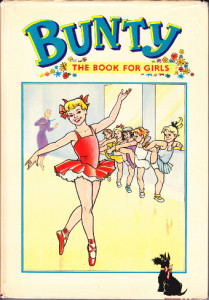
Bunty the Book for Girls 1960

bunty_ann_1960This is the  first Bunty Annual and it is very well put together and has a pretty presentation. There is a dust jacket where the main picture stands out from it’s white frame. In the picture the title character Bunty is doing ballet with Haggis outside the picture. The back of the cover has Bunty representing  a montage of months. Including the covers, there is 128 pages, inside the book there are 12 picture stories, 9 funny strips, 8 text stories, and 10 features. There is a contents page, although it does miss out on one story “There will Always Be a Boko”. It is a colourful book, with 62 pages in full colour. Majority of the stories are about characters that reader’s will recognize from the weekly issues; The Four Marys, Moira Kent, Lyn Raymond, Toots etc. The stories cover a variety of themes, such as adventure, animals, ballet, career girls, historical and war. The features often have a tie in to the story such as “Well Done Girls” talks about women’s jobs during the war right after the war based story Lance Corporal Sally. According to the writing inside the cover, the copy that I have belonged to Aileen Beattie dated 1959. (For just the list of contents click here)

Picture Stories & Funny Strips

The Dancing Life of Moira Kent     (Pages: 7-14)

Artist: Ron Smith

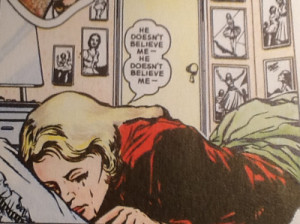
Moira Kent was the  regular ballerina character in Bunty’s early years.  The story starts with Moira finishing  a tiring dress rehearsal. On her way out she doesn’t stop to sign autographs, as she has a headache, she is then unfairly reprimanded by her grandfather for this. He reminds her that she wouldn’t be where she is without her fans and she promises not to ignore them in the future. If Moira was arrogant and ungrateful about her fans, a reprimand may be in order, but this isn’t the case here! While it is nice to appreciate those that support you, I don’t like if there is a sense of entitlement by fans.

Things get worse for Moira, as unknown to her, a girl in hospital writes to her asking for her autograph but she never receives the letter.  Mr Miller, the young girl’s father, a shoemaker, arrives at Moira’s house with new ballet shoes. He tells her, his daughter Gwen asked him to make them for her because she felt bad about bothering Moira for an autograph.  He tells her she doesn’t deserve the shoes, as she hadn’t bothered to reply to Gwen. Then both Mr Miller and Moira’s grandfather criticize her and refuse to listen to her protests of never receiving a letter. Moira is understandably upset about these events, so much so that she can’t concentrate at rehearsals. After confiding in the choreographer, Morgan, they take the rehearsal to the children’s hospital and Moira present Gwen with an autographed photo. It’s then that a nurse who was supposed to deliver the letter realizes it’s still in her pocket. Mr Miller and Grandfather look surprised, but if there is any apology from them, we don’t see it. Instead the Grandfather concludes that, that’s the mystery solved, as if he had investigated any other possibility other than Moira ignoring the girl! The men don’t come across great in this story particularly the Grandfather, but Moira doesn’t do herself any favors by not standing up for herself more.
Bunty_1960_Moira Kent

Sunshine Susie in “Girls will be Boys”     (Page: 15)

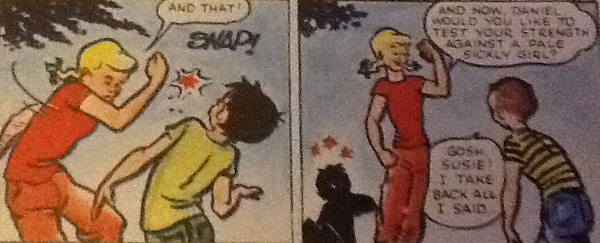
This humour strip is more progressive than the previous story. Susie makes fun of her friend Daniel’s attempts to become a ‘He-Man’, she challenges him to a fight but he says he doesn’t want to fight a sickly girl like her. But when a bully comes along it’s Susie that takes him out and Daniel takes back what he previously said.
Bunty_1960_Susie

Elvirita: The Wishing Well     (Pages: 21-22)
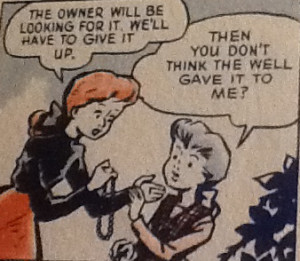
Bunty 1960_ElviritaElvirita a Spanish orphan, is telling stories of a wishing well to neighbourhood children. Rosita, one of the children takes her stories seriously and shows her an old well where she wishes for a puppy. Later she finds a pearl necklace by the well and says the well must have given it to her to buy a puppy. Elvirita tells her that someone must have lost it and they take it to the police station. The owner of the necklace is so grateful for the return of her necklace that she get Rosita a puppy as reward. I like the art style it is simple and sort of cartoonish but not so much that it can’t tackle more serious matters.

Pauline and the Little Nipper    (Page: 23)

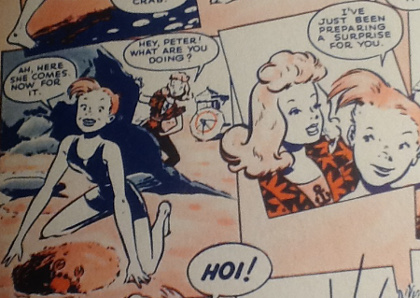
Pauline (a pin-up looking girl) is at the beach. Peter tries to play a trick on her, he plans to get her to put her hand in a hole with a crab in it, but she’s not having it and pushes him into  the hole with a crab instead. I do like the art although, when just looking at it at first I didn’t realize Peter was meant to be a boy, he looks very feminine.
Bunty_1960_Pauline

The Four Marys     (Pages: 26-31)

Artist: James Walker

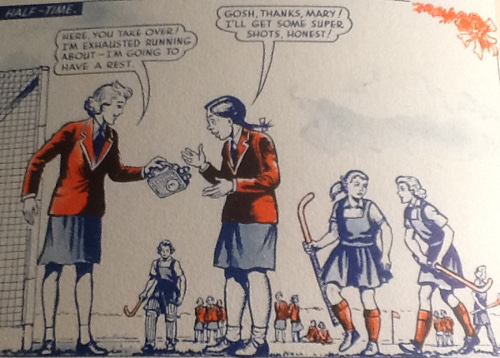
It wouldn’t be a Bunty Annual without the Four Marys. In this story Mary Radleigh receives a cine camera for an early birthday present. Both her and Cotter film a hockey match which Simpson and Field are playing in. Cotter leaves the camera down during the match, forgetting to switch it off. Meanwhile June a girl that was constantly beating Simpson is injured. Simpson is accused of deliberately tripping her up and is sent to conventry. Only the other Marys stick by her. When Radleigh gets her film back the truth is revealed as  it shows June actually fell over goal post. All the third form apologise to Simpson.
Bunty_1960_4 Marys

These early Four Marys stories are quaint! I like the distinctive art and in a lot of ways the girls are more caricatures, particularly Cotter, which isn’t a bad thing, they all  have an individual look which they lost in later stories. They are also shown to have flaws, Radleigh is quite lazy, while Cotter is clumsy and forgetful. I’m glad that later stories they start using nicknames as calling each other Mary all the time most have been confusing.

There Will Always Be a Boko     (Pages: 33-37)

Artist: George Ramsbottom

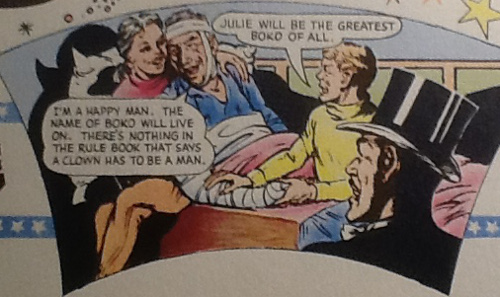
Boko is a legendary clown, whose name is passed down through the circus. The current Boko’s biggest fans are his children, Mark and Julie. Mark worries he won’t live up to the Boko name when it is his turn to take it on. The next day while Julie practices bare horse riding and Mark practices his clown act, but he is too stiff. Then a fire breaks out. Boko runs in to rescue two tiger cubs. There are some nicely drawn action sequences here.

He collapses after the effort and he makes Mark promise the name of Boko will still go on tonight. Mark promises but he is nervous. That night the new Boko is introduced,  when Boko hears the laughter from his bed, it helps speed up his recovery, raising his spirits. When the new Boko comes in he says he is proud of Mark but it is revealed to be Julie. Old Boko is surprised but Mark says he just hasn’t it in him to be a clown. The father  gets over his surprise and is proud of Julie, he says after all there is no rule that the clown has to be a man. We don’t spend a lot of time with Julie so there is no foreshadowing that she has a talent for clowning but in someways this is better as it makes the reveal in the ending more surprising.
Bunty_1960_Boko

Pat Among the Ponies     (pages: 40-47)

Another story involving a fire and animal rescue. This time it is at Moordown Riding School, where a storm breaks out and lightning strike sets the stables on fire. Pat Farley, a student, rallies the girls in her dorm to go rescue the horses. Snip, Pat’s favourite pony is injured during the fire. He goes blind and Major Matthews says he will have be gotten rid of, but Pat convinces him to let Snip stay if she looks after him. On a trek Pat guides Snip. Bad luck for the girls as a another storm, causes water to rise. The girls try to guide their ponies across but they are too scared. Snip blind to the danger is led calmly by Pat and the other horses follow his lead. Snip is hit on the head with a log but manages to get out. When they get back to the stable Snip can see again (the magical trope of – bonk to the head cures all!)

Hetty in “Catch as Cats Can      (Page: 48)

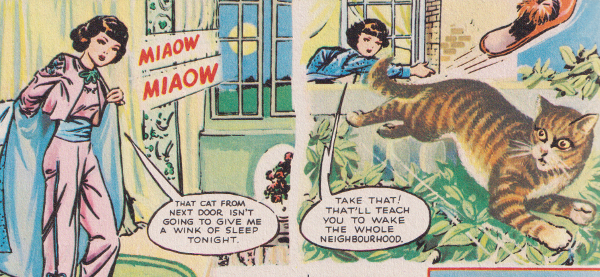
A short funny strip as Hetty, can’t get to sleep because of cat mewing outside she tries shooing him away, when that doesn’t work she feeds him thinking he’s hungry, unfortunately he just brings back more friends for food. Really nice colouring in this one, it is a painted style.
Fan-Fan and Her Friends – Peter’s Christmas     (Pages: 49-51)

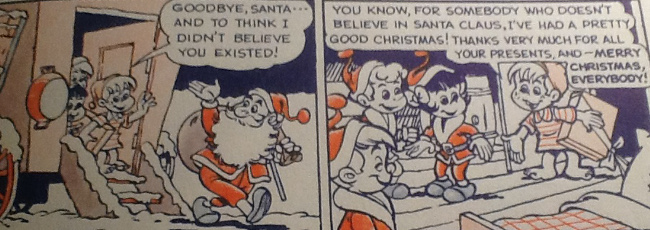
A Christmas story!  I assume they don’t put a lot of these type of stories in because it would tie it more to one season, but I still associate the annuals with Christmas, as they were regular present under the tree so I like when there is one. The characters also look very cute. In this story Peter doesn’t believe in Santa as he never comes to his caravan. Sammy decides to fix this by dressing up as Santa and gives him a toy train. Peter is delighted but confused when another Santa turns up and soon figures out what’s going on when a third Santa is revealed to be Fan Fan. Peter is upset and doesn’t believe in Santa again, but then a kindly old man who overheard the kids talking earlier arrives.  Peter believes him to be the real Santa Claus and has a good Christmas.
Bunty_1960_fan fan

Tess of the Timberlands    (Pages: 58-62)

This is good adventure/action story. Tess Wilson lives in Oregan, on her way to give her dad lunch, she sees a great Eagle snatch a kid goat. She does a daring rescue up the mountain for the goat. When she becomes trapped on narrow ledge the mother goat, who has tracked down her baby, shows Tess the way to safety.


Toots: Mind Your Manners     (Pages: 63-64)

Art: Bill Ritchie

A long lasting humour strip. Toots tries to unsuccessfully teach baby some manners. But in the end it is Toots that accidentally makes the most mess at the dinner table.

Kay Hamilton, Show Jumper     (Pages: 65-72)

Kay is competing at a novice horse jumping event with Sunset. She is beaten by Pat Martin and his horse Shamrock, while she takes the loss graciously, Jim Scott one of the grooms is suspicious and thinks he recognizes Shamrock as an older ‘Class A’ horse redyed.  The two try and investigate at another competition. Pat is not happy with their suspicions and decides its time to clear off, but he also wants to take Sunset as she is the most promising novice he’s seen. That night when robbers try and kidnap  Sunset, Kay and Jim try and stop them. They are captured and tied up but Kay manages to break free of the bonds with Sunset’s help. They break out and go to investigate a cottage nearby, where they figure they were being taken to.  There it is revealed Pat is involved. He locks Kay into Shamrocks padlock, and she is nearly trampled but luckily Kay manages to calms him by whistling. After escaping the padlock, Shamrock chases Pat down and he is taken away by the police.

Lyn Raymond, Air Stewardess     (Pages: 75-80)

Artist: Ron Forbes?

Lyn Raymond is on a stopover in Paris and treats herself to some lipstick. On the flight back to Britain, the pilot informs her there is suspected jewel thief on board, and they have a description. Lyn decides to drop her lipstick to give her an excuse to look at the passengers more closely. Which works except for one grumpy passenger with a newspaper over his head. She finally gets a look at him and he matches the description. She points him out to police on landing but they can’t find diamonds on him. Lyn goes back onto the plane to look for her lipstick, which she seems to have actually lost now. She finds it next to the suspected jewel thief’s seat. Later talking to the police they say they will have to release the man as they have no evidence only he was found with lipstick marks on his hand.  That gives Lyn the idea to examine her lipstick and she discovers the diamonds been hidden in the tube, giving the police the evidence they need.

Little Miss Moffat    (Page:84)

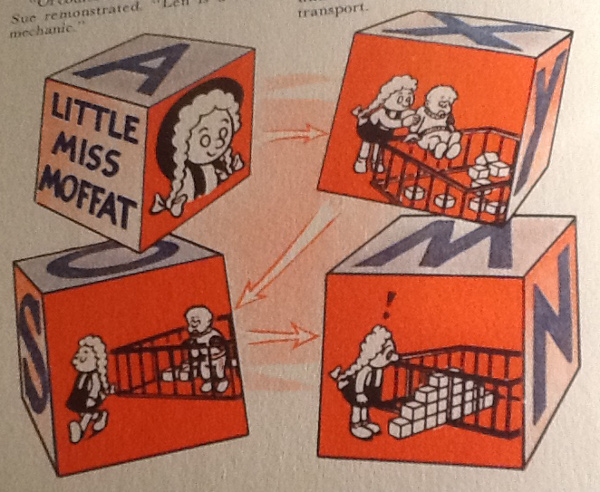
A very short word free, humour strip, inserted into text story. It makes interest use of framing.
Bunty_1960_Moffat

Her Doctor Had 4 Legs    (Pages: 86-91)

Artist: Ron Forbes?

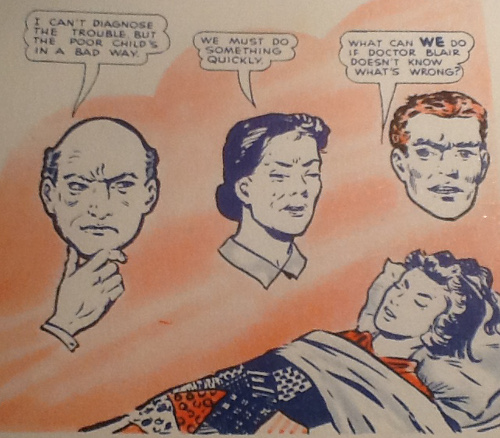
Peggy Brooks father brings home a dog Flash to train as champion sheep dog. He is annoyed to see Peggy and Mrs Brooks breaking the rules letting the dog in the house as if Flash is to become a champion he can’t be a pet. Later that night Peggy wakes to Flash barking and her father scaring a burglar away. The next day Peggy seems sick, her parents think its over tiredness but later she collapses. She keeps getting sicker and the doctor can’t figure out what is wrong with her. A week later though Peggy starts feeling better, it is the doctor that discovers Flash has been sneaking in amd sleeping on her bed. It turns out Peggy had been sick with worry about the burgler but with Flash she feels safe. After all is revealed Mr Brooks says she can keep Flash as a pet and he will get a new dog to train as a champion.
Bunty_1960_4 legs

I find this the weakest story, Mr Brooks is painted in a harsh light, but he has spent money on the dog to make a champion, not to be a pet. Peggy’s illness seems a bit far fetched, to get that sick over a burglary attempt and then there is the very convenient cure!

Babalou     (Page: 98)

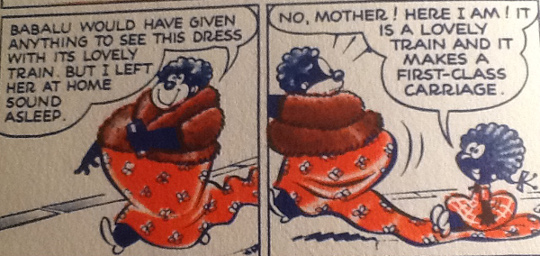
This is one of those funny strips that is  product of it’s time that isn’t politically correct in it’s representation. As Babalou’s mother gets new dress, Babalou takes the train part of the dress more literal.
Bunty_1960_Babalou

Pert Gert and her Neighbours    (Page: 101)

Gert generously lets her neighbours borrow food, but they are soon taking advantage of her kindness. She eventually has to put up a sign that says “Closed – Food Stocks Exhausted”

Maid Marian    (Pages: 102-107)

Maid Marian and Sarah her friend and handmaid, are playing bait to the Sherrif and his men. While the Sherriff believes himself to be clever enough to not fall for the bait it turns out the women were just a distraction so Robin Hood and his Merry Men can get into position and take their money. Later the Captain comes up with a plan to enlist Rolf of Navarre to challenge Robin in an archery match. Rolf dresses as an ex-soldier and wanders into Sherwood forest. Marian acts as judge, Rolf wins Robin’s silver arrows. Marian discovers afterwards that Rolf had tampered with Robin’s bow.

Then the sheriff sets up a competition assuming Robin won’t be able to resist trying to win back his silver arrows. At first it looks like he hasn’t shown but playing the fool Robin accepts the challenge. Recognizing Robin’s skill, the Sheriff commands his men to attack but luckily Marian cuts the ropes on the tent the men were hiding in, collapsing it on top of them. Robin and Marian celebrate the return of the silver arrows that night. Bunty would later have a series where Maid Marian led the Merry Men in Robin’s absence, and also a series about their granddaughter Robina Hood. It seems to be a popular myth to be looked at, and it is also nice to see it from a female perspective.
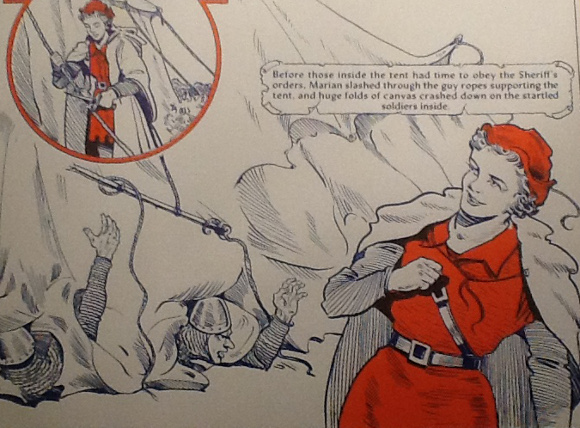
Bunty_1960_Maid marian

Bess Makes a Dress    (Page: 112)

A funny strip about Bess, who  throws a tantrum because she wants material to make a dress. Dad gives in, thinking he can bring her to grand mannequin party competition and she will be put off when she loses and is laughed at but to his surprise she wins first prize in the “fantasy” category.

Debbie’s Dream Dress    (Pages: 113-117)

Debbie and Grace are members of the junior Red Cross and good friends despite their differences in wealth. On the way to class Debbie admires a dress she would like to wear to a party, but could never afford. The next day on the way to party Debbie wears her old worn dress. While in the taxi a young girl runs out in front of it. Debbie gets out to tend to the girls, she tears strips off her dress in order to bandage her. The girl’s mother comes rushing along and Debbie tells them to take the taxi to the hospital, while she returns home. The woman later tracks Debbie down and tells her that her daughter, Sadie, will be alright and she gives her a new dress to make up for the one she tore up. It’s the dress she previously admired from the shop,  it turns out to be the woman’s shop. Debbie is the hit of the party.  What a  set of coincidences, down to the unlikelihood that the mother would leave her child in hospital, go to her shop and happen to pick out Debbie’s dream dress in the right size and deliver it to her in time for her to get to the party!

Parachute Nurse     (Pages: 120-124)

Artist: Ron Forbes?

Susie Peters works in a hospital at Beaver Creek an isolated Mountie post in North West Canada. Susie is disappointed that the only paper available at the local shop is the Farmer’s Gazette as she has no interest in reading about prize bull Rajah being sold. Soon it is very much her concern as the two men delivering the bull, are trapped in a blizzard, they are sent supplies but that night, one of the men Steve is injured by wolves, so Susie will have to parachute down to tend to him. When they flyover they see the pack of wolves have returned, the pilot says she won’t be able to jump now but she says she’ll do it anyway and he needs to fly his plane low after to scare the wolves, she lands expertly. As she tends to Steve the wolves still aren’t giving up Rajah the bull tries to fight them off while Susie makes a giant snowball to scatter them.

That night Susie has a plan prepared for the wolves. She has made little food parachutes, the wolves fight over the meat not knowing its been dosed with medicine. One the roads clear they get to the hospital. Susie gets her picture in the Farmers gazette for saving Rajah. She orders two dozen copies for her families and friends. Always good to see another brave, quick- thinking  proactive protagonist who is good at her job

Changing Places

  • Changing Places–  Bunty:  #1806 (22 August 1992) – #1820 (28 November 1992)
  • Reprinted: Bunty #2210 (20 May 2000) – #2224 (26 August 2000)

Plot

Lady Anne Bannerman meets Anne Brown on the train to her new boarding school. The two hit it off so when Brown suggests that for a laugh they could switch places for a little bit as they have similar names Bannerman agrees. Soon Bannerman isn’t happy when she hears Brown getting people to call her Lady Anne. She confronts Brown telling her its time to reveal the truth but Brown is not going to switch back as she knows Bannerman’s secret.  Anne’s brother was fired on accusations of being a thief and her family paid off employees to keep it hidden. So Bannerman is blackmailed into keeping quiet.

changing places 2

Not only does Brown use the Lady title to her benefit, she also makes Bannermans life difficult, she makes her give her all her money, copies her work and she doesn’t want her having any friends. She isn’t happy when Bannerman becomes friendly with scholarship girl Eileen. She forces Bannerman to blow her off. Of course all the girls think Bannerman is a snob trying to stay close with a “Lady”.   Other than two girls Lucille and Myrna, everyone is fed up of “Lady Anne’s” boasting

Other than dealing with Brown’s nastiness, Bannerman has to figure out  how to stop people finding out the truth when problems arise. Such as when her Great-Aunt decides to visit, she has to meet her outside the school, or when Anne Brown’s parents visit and she has to hide in the bushes until Brown comes back. Another close encounter is on a school trip when Bannerman runs into old classmates. She introduces them to Anne Brown so when classmates see Brown waving them off as well as Bannerman they just think Bannerman is sucking up except for Eileen who is suspicious. She is not ready to give up on Bannerman as she finds her quite the different person on the hockey field and thinks there is something up with Brown and Bannermans friendship. Brown decides Eileen is getting too close and frames her for stealing a bracelet so she gets suspended.

changing places 3

Even when Bannerman gets a chance to go home she doesn’t get a break as Brown forces her to invite her along. Although her parents aren’t fooled by Brown’s compliments and wonder why their Anne is friends with her. Things get worse for Bannerman as she is sent to coventry . Meanwhile Brown isn’t happy when during a charity run Lucille and Myrna tells a photographer from the local newspaper that Brown is a lady. Bannerman tells her not to worry nobody will know her locally. It seems she’s wrong as a friend of Jamie, her brother sees the paper and sends a clipping to him. Jamie arrives in time to overhear Brown trying to blackmail his sister into stealing things.  They’ve attracted a crowd from the school so Brown spitefully tells them that Jamie is a thief, but he corrects her as he was cleared of all charges that morning. Brown is expelled and Anne is able to tell the head about Eileen being set up and let’s Lucille and Myrna she isn’t interested and having people like them as friends.

changing places 1

Thoughts

A common trope of a girl being blackmailed in order to protect their family,   The Honourable S.J., Sandra’s Sad Secret, Be Nice to Nancy and others follow this theme. There are a few differences in this story though. Anne Brown is similar to S.J. in personality but she is not a wealthy person using her influential powers to get her on way and take advantage of those with less than her. Instead it is the person with money, Anne Bannerman that is trying to protect her family. Another difference is that they’ve switched identities so not only does Bannerman have to do what Brown says she can’t even be herself. Being tricked into being someone else has appeared elsewhere often more in a historical context such as The Imposter. Still a combination of things make this story work well even if it’s not doing a lot of new things.

Obviously Brown hasn’t thought of a long term plan or problems that arise from being someone else. In one instance a teacher finds their work is copied off each other, Brown tells Bannerman she can take the blame, but she points out that will go on Brown’s report card. So Bannerman is able to come on up on top in that instance. Bannerman does try to look out for other pupils such as when flowers are going to be presented to a duchess, she lies to Brown saying she knows her and that Brown will have to hide while a young pupil gets to give the flowers to her instead.

changing places 4

Bannerman’s parents seem like nice people so it’s surprising that Anne didn’t confide in them but considering how they handled Jamie’s accusations maybe they wouldn’t have been the best! I can understand they felt they were helping covering up for Jamie and didn’t want to risk the family reputation but it made him look guilty and like they didn’t trust him.

It’s quite lengthy at 15 episodes, and can be formulaic in that a situation comes up where the girl’s true identity may be discovered, Bannerman is reminded of her family problems and Brown gets money/work from Bannerman. But it’s nicely done, the art is good, everyone having distinct looks and it is well paced.

Hurley Curly

Plot

Curly O’Hallaron was keen to play hockey, but it was an adjustment after playing hurling before. Two girls Doreen and Roberta plot to get rid of Curly from the school team.

hurley curly

Notes 

  • Text story

Appeared

  • Hurley Curly – Bunty: #230 (9 June 1962) – #243 (8 September 1962)
  • Reprinted – Debbie: #90 (2 November 1974) – #103 (1 February 1975)