Category Archives: Lucky Charm

Pavement Ballerina

Plot

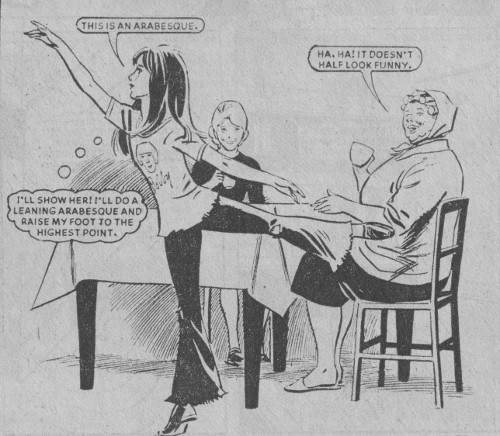
Tessa Turner, grows up poor, but has a talent for dance. A meeting with a homeless woman, Rosie, who tells her she is a former ballerina and will teach her to dance, changes her life. She begins to take her lessons on the street, though other people think that Rosie is a con artist, Tessa finds out that she was in truth a famous ballerina, that was believed to have died in a concentration camp during World War II.  With her mother and Rosie’s help Tessa gets a place in a dance school and in turn she secures Rosie a job there as a teacher.


Notes

  • Art: Andy Tew
  • Art Lucky Charm Cover: Ian Kennedy

Appeared

  • Pavement Ballerina – Bunty: #905 (17 May 1975) – #926 (11 October 1975)
  • Reprinted – Lucky Charm: #14 (1981)

Little Miss Frozen Face

Plot

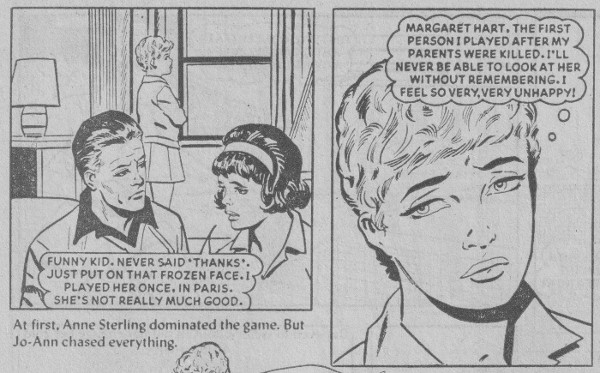
Jo-Ann Morton, a rising tennis star, earns the name “Visage Glacial” (Frozen Face)  in France after she wins the Europa Junior Tournament while her parents died in a crash and she quickly goes on to compete in another competition. Unknown to all the gossipers, Jo-Ann’s aunt had not told her the news during the match and afterwards told her that her father left  lot of debt and embezzled money from a children’s home, so she would need to compete to earn her keep and to make her her father’s good name wasn’t ruined.

Jo-Ann plays but she no longer has a love of the game, and never showing happiness on her face only builds her Frozen Face reputation. Her aunt continues to exploit and blackmail her. She makes a friend with Sir Sam Haigh, a millionaire mill owner, but due to his appearance her aunt Maud thinks he’s a commoner. Finally having a friend to confide in Sam helps clear her father’s name and expose the real culprit, her Aunt Maud. Free from her, Jo-Ann can finally begin to live her life again and play tennis for her own enjoyment.


Notes

  • Story Art: Mario Capaldi.
  • Art Lucky Charm Cover: Ian Kennedy

Appeared

  • Little Miss Frozen Face – Bunty: #784 (20 January 1973) – #803 (2 June 1973)
  • Reprinted – Lucky Charm: #17 (1982)

Trudy Ten-Legs

Plot

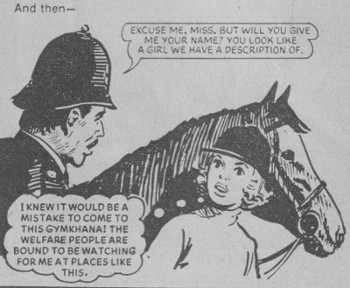
Trudy Ross earns the nickname “Trudy Ten-Legs” as she’s hardly ever seen without her uncle’s two horses, Chief and Hero. When her uncle (who she lives with) dies, she has to figure out a way to keep the two horses. Avoiding authorities, she finds places to stay and  begins earning money by taking part in competitions. She takes on two hunt dogs and finds friends that help her, providing food. She runs into trouble with two snobby girls, who are not happy with a scruff winning competitions.

When Chief is sick, to save him she turns herself in and gets sent to an Approved School with Hero, but while Chief has recovered from illness he is pining for Trudy and Hero, so she runs away to reunite with him.  When she stops a girl, Maude, from whipping her horse, the police catch up with her. Her day in court turns to her favour, as Maude’s father, a lawyer, actually is appalled by his daughter’s behaviour and comes to Trudy’s defense. Due to confusion over her leap year birthday, Trudy is proved to be 16 and therefore she could leave school when she wants. She goes on to get job at stable with Mr Grampton, the owner of the hunt dogs and a helper to Trudy, and then she becomes junior top show jumper.

Notes

  • Art: Dudley Wynne
  • Art Lucky Charm Cover: Ian Kennedy

Appeared

  • Trudy Ten-Legs – Bunty: #632 (21 February 1970) – #651 (4 July 1970)
  • Reprinted – Lucky Charm: #6 (1980)

Sandra and the Runaway Ballet [1961]

  • Sandra and the Runaway Ballet – Judy: #86 (02 Sep. 1961) – #106 (20 Jan. 1962)
  • Reprinted – Judy: #387 (10 June 1967) – #408 (4 November 1967)
  • Reprinted as Sandra of the Castle Ballet – Lucky Charm: #2 (1979)
  • Art: Paddy Brennan

Plot

Picking up from the Sandra of the Castle Ballet story, Sandra Wilson and the rest of the class are still at the island castle, with the holiday season at a close, Madame Sierra collapses from exhaustion. Her doctor advises her she needs complete rest for six months, so she heads for Switzerland, leaving the school in the care of an old friend, Sarah Lester. She has placed the school in the wrong hands, as Sarah, a good dancer but never a star, is jealous of Madame Sierra’s success and wants to ruin the school. She acts lazy not showing up to practices, she doesn’t teach the girls anything, cancels practices as punishment and they find their dancing getting worse. Knowing that this can’t continue, Sandra comes up with the plan for the class to runaway to London to get jobs on stage for experience and use their earnings for ballet lessons.

Needing money for their trip, one of the girls Marion convinces her father Mr Pickford, who runs the holiday camp, to give them the money to go. As they had been entertaining the holidaymakers he actually had money set aside for them, so he tells them they earned it. There good start doesn’t last long as a policeman sees them board the train and is suspicious and alerts Sarah Lester. When they get of train in London there are more police waiting for them. They split up and most of them manage to evade the police, but 2 girls are caught until Sandra manages to cause a distraction and they get away. They end up at a rough boarding house and while practicing ballet, and disaster strikes when Rose takes a fall when a banister breaks. Rose is badly injured and has to lie in plaster for several weeks, Lois volunteers to stay back and look after her while the other girls go look for work. The girls have no luck the first day, and when they get back seems they missed a caller description matching Sarah. It seems their luck is turning when the caller returns and it is Marion’s aunt with news of an audition, but their luck doesn’t last long as Sarah is on the hunt and tracks them down to the audition. She is determined none of them will be ballerinas. Sandra, Pearl, Alicia and Marion all pass the first part of the audition but when they have to audition with a male partner, Sarah has gotten to him first. Ramon an old friend of Sarah’s makes the girls look clumsy,and they lose out on the part. Knowing where they are now, Sarah will continue to make trouble for them.

Sandra is not giving up so easily, she comes up with an act the girls can tryout for variety theatre. Sarah meanwhile has manipulated their landlady to get them thrown out. They get new lodgings but Rose can no longer stay with them and goes to hospital. The girls have no luck at auditions, but after performing at hospital Sandra realises that they have been too tense at the auditions. They succeed at their next audition when Sandra helps them relax, making them believe they are not being watched. But Sarah is ready to stop them again, she gets the chorus girls that the Castle Ballet girls might replace, to confront the girls. They manage to call police and get to the theatre with a little delay and have a successful performance resulting in a month’s contract.

After nights of being booed on stage, they finally find out that Sarah has been the one making trouble for them, including hiring the roughs to boo them. Undeterred they have now earned enough  money to get lessons from reputable teacher, Madame Bartok. At the dance school they see an old class picture with Madame Sierra and Sarah. Sandra wants to investigate further and tracks down the old teacher, Madame Markus. Nina Sierra and Sandra had been good friends until after an audition for a touring company that they both wanted, Nina got picked and Sarah vowed revenge. Sandra figures out Sarah is ruining their career chances as part of her revenge. Meanwhile, the girls get a letter from Madame Sierra demanding they return to school with Sarah. Not wanting to anger Madame Sierra most of the girls agree to go back with Sarah until Sandra returns and tells them the truth of Sarah’s past.

Taking more drastic measures, Sarah hires some people to kidnap Sandra. They lock her in a boat but Sandra does risky thing of setting fire on oil on the water next to boat and escapes back to theatre when the coastguard come to rescue her. Rose is still in hospital during all this and while she should be walking,she won’t even try as she is disheartened believing she’ll never dance again. Sandra comes up with the idea to spend their money on pavlova ballet slippers to encourage her and Rose does start to recover. With their time in the Victory theatre finishing, Sarah  is up to her tricks again to get them to spend last of their money. Things are looking bad for the girls and then Madame Sierra shows up with Sarah, not listening to their protest, she demands they go back to school. But she slips Sandra a note to trust her, she pretends to leave the girls with Sarah,but sneaks back and hears all her revenge plan. She banishes Sarah and having recovered enough she stays on to teach the girls again. A few weeks later Rose returns, then Madame brings Edmund Lawrence of a prestigious ballet company for the girls to audition for. He chooses Sandra, so her time at the Castle Ballet ends, but she is off on new adventures.


Notes

This would be last time Sandra’s story involved Madame Sierra’s Castle school. Of course they don’t spend a lot of time actually at the castle in this story, but the girls are together throughout and show their closeness, when all are genuinely happy for Sandra’s success in the end, which contrasts to Sarah and Nina’s friendship. Sandra being the main character is driving force for moving the plot forward and coming up with solutions, getting them to go to London, helping them succeed at audition, tracking down Sarah’s old teacher. When Sandra is unknowingly kidnapped and the girls may have to dance with her, they concede that no one can dance the part as well, while they don’t give up and make do with a substitute, there is relief when Sandra reappears in time for the performance. Sandra certainly is the star of everything! It is good to see some of the other girls have some character as well though, Pearl and Alicia don’t go along with the rest of the girls who are going to go back with Sarah and we see Rose struggle through her own crisis after her injury.

There are some questionable actions by some of the adults in the story. Mr Pickford is in support of his daughter Marion and the girls scheme, but never tells Madame Sierra the problems that Sarah is causing. Initially they plan to say at Rose’s aunts boarding house but as its full they have to make do with the rougher one, Rose’s aunt never inquires after them. Although we never see Rose’s aunt so its unclear if she was expecting or interested in helping the girls in the first place. Sandra does some risky things such as setting fire near boat, she was locked in, lucky it works out in her favor! The story does keep things exciting and quick-paced. Sarah is a sneaky antagonist, she manages to cause a lot of trouble for the girls in London, before they find out she in the city. Luckily she is exposed for what she has done. While readers probably would have expected that the girls would win in the end, it is more surprising that Sandra leaves the school,ending an important chapter of her life.

I mentioned in the previous Sandra post it was odd that the change of title to “Sandra of the Castle Ballet” was for just a short period. In the Lucky Charm reprint it is called “Sandra of the Castle Ballet” and does have that story arc but the majority of reprint is the Runaway Ballet story. It is interesting that the Secret Ballet/Castle Ballet title was dropped after her first return, and the story titles then changed per story arc, after the Runaway Ballet, the next issue starts with Sandra and the Frightened Teacher. No matter what the title Sandra remained a popular character appearing in different sequels, reprinted stories as well as annuals and picture libraries throughout the 1960s, 70s and 80s.

List of  Sandra stories

They’re No Match for Mo! (1977-78)


Plot

Mo Miles, the daughter of a rag-and-bone man, is an ace tennis player. She is invited to join a posh tennis club after finding a valuable ring lost by a club member. Nonetheless, she and her father meet constant discrimination from the snobby club members, even when she starts winning tournaments for them. However, Mo can prove she is a match for all opposition, both on and off the tennis court.

Notes

  • Artist: Colin Merrett
  • Translated into Dutch as “Geen Partij voor Patty” (No Match for Patty), Debbie Parade Album #27.
  • Reprinted as “Nellie Never-Give-In”, Lucky Charm #12.

Appeared

  • They’re No Match for Mo! – Bunty: #1031 (15 October 1977) – #1050 (25 February 25 1978)

Janet the Janitor

Plot

Janet Taylor assistant janitor at Easthampton school was appointed forewoman of a special class a class of problem pupils – provided that she also did her janitorial duties.

Notes

  • Art: John Leonard Higson

Appeared

  • Janet the Janitor – Judy: #691(7 April 1973) – #721 (3 November 1973) [no episode issue #717]
  • Reprinted – Lucky Charm: #28 (1984)

Other Appearances

  • Janet the Janitor – Judy Annual 1975

The Children’s Champion [1964]

  • The Children’s Champion – Bunty: #348 (12 September 1964) – #369 (06 Feb. 1965)
  • Reprinted – Bunty: #842 (02 March 1974) – #863 (27 July 1974)
  • Reprinted – Lucky Charm #16 (1982)
  • Translated into Dutch: Debbie Parade Album #15

Plot

In 1868, Hester Langley, daughter of rich titled parents, is feeling dissatisfied with the lavish life her family is living. One night, after another boring party, Hester can’t sleep  and goes downstairs to get a book. She hears a disturbance and decides to investigate herself rather than get a servant. She finds Annie, a young orphan who has sneaked in for someplace warm to sleep. Though not familiar with preparing meals, Hester does manage to heat up some soup for Annie and she questions her about her life. She is distressed to hear that a nine year old sleeps in back alleys, hasn’t eaten for days and only gets scraps when she does eat. Hearing there are many more like her, Hester wants to come to Stepney and see for herself, right away. After persuading her servant Polly to lend her some clothes, her and Annie set off. Hester is horrified with what she sees in Stepney and she returns home with a plan to enlist her father and wealthy friends to help the poor children. Annie thinks she’s very lucky to have met  Hester and calls her “Miss Angel”. Lord Langley in the meantime has woken and questioned Polly, when Hester arrives home he is not happy with her plan. He is not going to have his daughter mixing with the “scum of London”. The Langleys kick Annie out and fire Polly. Lady Langley insists Hester must bathe at once in case she’s picked up germs. But Hester isn’t going to be persuaded from her mission  and if her parents won’t help she is determined to give the London waifs a home herself.

Hester sets off the next day with the money and jewellery that she has and is joined by Polly. The only place they can afford to rent is a stable, and the landlord takes advantage of their desperation, but Hester and Polly clean it up nice.  Her parents get worried when she doesn’t return home, but Lord Langley doesn’t want to call the police because of the scandal it would cause, so he goes looking for her, himself. Annie has gathered all her friends to come to their new home, but then Lord Langley arrives and demands Hester comes home. She won’t budge and her new scheming landlord sees an opportunity to make  money off Lord Langley saying he will kick them out of the stable for a fee, and Hester won’t want to sleep on the streets and will go home.  But that plan fails for Langley as he still hasn’t realised how committed his daughter is to her cause. While asleep on the streets a coster (street seller) named Tom Clark, comes across them, he has known hardships before and he rents them his shed. After being cheated out of money by the first landlord, they are needing more money for supplies so, Hester and Annie go to see her kindly godmother Lady Ella Coombes, but she is away on a trip. Although they don’t succeed on getting supplies, they do pick up another stray on their trip, a chimney sweep boy, Billy.

More difficulties befall them when Hester’s bag is stolen. Tom’s wife, Molly, comes to check on them and hearing their story rounds up help from the community and gets some old furniture for the shed. Later, the boy, Jack, that stole Hester’s bag passes by the shed and is offered some soup. Jack recognises Hester as the toff he stole the bag from and now feels terrible about it. He confesses everything and how he is forced to steal for a man called Mr Luther, so that himself and his young brother, Bert, can have a home. Hester offers them a new home with her, but Mr Luther is not happy and tries to get him back. Luckily Tom Clark and his friends help take care of Mr Luther and get Hester’s money returned too. Mr Luther knows he has to leave the area but is only leaving after he has his revenge on Hester. He sets the shed on fire, while they are out. With no home, Hester has no choice but to ask her parents for help. Her father agrees to replace the shed on the condition Hester comes home, but she refuses to leave the children so he disowns her.

For the time-being Tom’s friends let them stay in their sheds though they have to share them with animals. When Hester and Annie come across a sickly lavender seller,Lucy,  Hester doesn’t have any room for her, but later feels guilty and goes back to find her half dead. She gets Lucy to hospital and gives her a reason to fight. She will never refuse a child again. She goes to her parents friends to implore them for money but of no avail. Luckily her Godmother Ella Coombes returns, and is keen to help with the cause. Jack not knowing this, tries to steal money for Miss Angel but is caught. If not for the intervention of Hester and Lady Coombes he would have been sent to prison. Lady Coombes also pays for refurbishment of the shed. But just as their fortunes are looking up, Annie comes down with Typhoid Fever which soon spreads to other children. With the help of Lady Coombes and Mrs Clark they all pull through, but unfortunately Lady Coombes comes down with fever. Coombes son Edward blames Hester for this and wants to destroy what she has built. He destroys their soup making stall, so Hester finds a hard job in hospital. Polly convinces her that she would be better doing that work as the children need Hester with them. Even still money is tight, Hester often kept going with little food. Jack and Annie break into Lady Ella’s house to see her, she is recovering and did not know her son had lied about Hester being not bothered to visit. She is to go to Italy to help with her recovery, but she leaves Hester money to help her waifs, while she is gone.

Edward spreads talk of the money, knowing it will be robbed, Some thieves do ransack the home but don’t find it. Then Lucy falls ill again and Hester spends most of her money to send her to be by the sea. A new boy, Ben joins the home,  he thinks that Hester is a sucker and takes advantage of her kindness. He riles Jack up in order to get him to help steal from pawn shop, but Hester finds out and follows them. Ben ends up knocking her out, luckily she recovers but Ben runs away. The others think she should give up on him, but Hester won’t abandon him. They eventually find him in the sewers, sick, Hester nurses him back to health and he becomes loyal to her. But heartache isn’t over for Ben as it turns out he is not an orphan, but a runaway from an abusive father who takes him back when he sees him out with Hester. Hester tries to earn money to pay Mr Brown for Ben, and she has the support of Ben’s mother, but the father beats Mrs Brown up badly and runs off with Ben. Hester takes in Ben’s younger siblings and comforts Mrs Brown before she dies in hospital. Hester finds Ben and Mr Brown goes to jail for dealing with stolen goods (no punishment in these times for beating his wife to death!).

With things settled for a while, Hester finally has time to start schooling the children. Still Hester keeps on taking in waifs, and their home is getting crowded. Then Tom arrives to tell her the shed is going to be pulled down to make way for a warehouse. Hester  sleeps outside with the children under a makeshift shelter. After some bad rain the Clarks take them all in temporarily, and Hester falls ill with pneumonia. The children all pray in the street for their Miss Angel and catch the eye of a reporter. The Langleys read about their daughters illness in the paper and put their pride aside, to go to her. Luckily Hester has mostly recovered at this stage and the Langleys want her home with them and agree to take in the children too. They help find sponsors for a new children’s home and the Clarks come work for them. Hester is delighted with the new home, but she is not one to rest, that evening she is out looking for more children to help.

Thoughts

There are many of these stories where the wealthy protagonist gives up her charmed life, in order to take care of young waifs in Victorian England (such as Angel, Haven of Hope and other variations like The Double Life of Delia), this was one of the first. While it is popular, Mandy’s Angel  is probably more well remembered (probably helped by it’s sequels and annual appearances). For this reason it is Angel, I will draw most comparisons to when discussing this story, especially as The Children’s Champion seems to be a prototype for it (perhaps it had the same writer?). The children call Hester “Miss Angel” the same as the children call Angela in Angel, though in the former case Hester still is identified both as Hester and “Miss Angel”. In both cases the protagonist has a close relationship with an orphan named, Annie and relies on them to help with other children. They are both very committed to their cause, looking after the children even to the detriment of their own well-being. There are religious tones in both (although more prominent in Angel) Hester thanks God for sending Annie to her, the orphans pray for Hester to get well, in  Angel Angela often asks God to give her strength and courage and it implies she goes to Heaven in the end.

Where they differ, is Angela is more of a martyr, working mostly by herself, her parents believe their daughter is dead, so she is cut off from all those in her previous life,  and of course with only a year to live, she dies at the end of the story but with her parents carrying on her work. While Hester’s parents  disown her,  she does have more help with Polly, the Clarks and Lady Coombes, and eventually her parents come around. We also see more class divisions as Hester interacts with the upper classes to try and get their help. Angela’s parents while dismissive of the plights of the poor weren’t as aggressive as the Langleys, who refer to the children as “diseased” and “scum”. While Angela’s ending was dramatic and pulls at the readers’ heartstrings, I like that Hester continues her work even when the Children’s Home is built. It shows that the work doesn’t stop just because they have nice place to live now and that Hester is still willing to go out on the streets to continue to find children.


While Hester is a bit naive about the plights of poor people, until Annie educates her, she shows dissatisfaction with her wealthy life even before that. She shows courage and willingness to do things herself too, firstly confronting an intruder, and then though never having to cook for herself before, she manages in the kitchen, heating up soup for Annie. Once she knows about the London waifs, she is committed to helping them. I would think that her Godmother Lady Coombes has been a good influence on her, as we don’t see her parents so inclined to help. Lady Coombes is a good ally and also willing to muck in when needed, like helping with Typhoid epidemic, she is someone that Hester obviously admires and has been a positive force in her life. She seems to be the exception among those in Hester’s former life, it is actually the people with little to give that help the most, particularly the Clarks. It’s good to see Annie as Hester’s closest ally too, as she brings the knowledge and experience of a London that Hester did not know about and they develop a good friendship too. It has some stunning art, I particularly like the opening panel for the details of Hester’s clothes and hair before she switches to plainer clothes. The art and a well-thought out story makes this a good read. The story does well concentrating on smaller selection of characters and developing them, certainly as readers we root for them and want them to overcome their obstacles, and are glad to see them get a happy ending.

Lona the Wonder Girl [1975]

  • Lona the Wonder Girl–  Bunty: #926 (11 October 1975) – #951 (03 April 1976)
  • Reprinted as Wonder Girl – Lucky Charm: #18 (1982)
  • Artist: Robert MacGillivray

Plot

Lona Neal was abandoned as a baby and adopted by a group of scientists. They think she will be perfect test subject as even as a baby her endurance and intelligence is evident. The scientists keep her secluded and raise her to be the perfect human specimen.  There experiments can be harsh, such as when she can draw with her right hand, they make a pen that won’t work unless she uses her left hand and when she cries that she is hungry, they don’t respond in order for her  her to learn independence by finding her own food from the fruit trees outside. Only one of the scientist, Dr Hilda, appears to see her more than an experiment, praising her and showing concern at some of the harsher lessons. When Lona’s guardians feel they have taught her all they can, they send her off to an exclusive boarding school to see how she does in the outside world and prove their experiment a success.

Charlton College is a competitive school for the best and brightest. While Lona is smart in many ways, her guardians did not teach her about people and ways of the world.  Therefore the other girls actually think she’s a bit thick, strange and often interpret her special abilities wrongly. Like when she takes part in a swimming competition, she decides to swim under water as it is the clearer path. But the games mistress jumps in to rescue her,  as she thinks Lona must be drowning because no-one could hold their breath that long and the girls all think she lied about being able to swim. Another teacher also thinks she must have cheat on test, because she couldn’t finish it so quickly. The girls in her class wonder how she doesn’t understand slang like “bighead” and “to stick up for yourself”. When Lona gets in bully Mildred’s bad books, the girls are irked that Lona lets Mildred push her around. When things go wrong Lona remembers the lessons her guardians taught her.She always prefers to try peaceful method and thinks if confrontation is needed it should be done privately.

Lona would like a chance to play on the tennis team for an upcoming tournament but is denied because again she is not understood when she says she’s never played against a human (as she had learned to play against a robot, Bertie). She does get her chance though when several of the players come down with the flu. At first she finds people can be harder to play against than a robot, as they are more “deceptive”. When she learns her opponents moves she does end up winning. Finally her classmates are impressed and want her to accept the challenge of bighead school champion Celia. Lona does eventually accept, but thinks when Celia sets time for a match she means 12 midnight rather than 12 noon. She thinks it is not right to brag and therefore midnight is good time as they will be able to play in private. She goes to wake Celia up as she thinks she has forgotten. Celia wakes everyone else up, not interested in a private match. But then Celia gets nervous and doesn’t want to take the chance of losing, so she asks friends to distract Lona. Tricks like shining light in her eyes, don’t work and its clear that Lona will win, until the principal interrupts. While the whole school were behind Lona to win, seeing her not stand up for herself against Celia and call her out on the tricks she pulled, makes them exasperated with Lona again.

Lona has heightened hearing, so when the girls say things about her, they don’t realise she will be hurt by the comments. Feeling very dejected, Lona decides to runaway back home, but is surprised her guardians have abandoned the house. Deciding there are some things she must solve alone, like her guardians taught her, she goes back to the school. Tired from all her walking, she actually sleeps in and is grumpy in the morning. The girls think maybe she is normal after all, but she quickly reverts to her old ways. Mildred is still especially annoyed with Lona, even after she saves the class from lightning. Mildred does notice Lona is desperate for a friend and uses this to play tricks on her, making her do a ton of prep. Lona does start making progress with making friends, firstly a girl with allergies, Fiona, takes Lona’s advise about getting rid of chemicals. This turns out to be a good thing, because it turns out she was having a bad reaction to a nasal spray. She also makes friends with Mary, who encourages her to have more fun. Even the teachers are coming around and she gets a place on the gymnastics team.

Mildred isn’t happy that she is made reserve on the gymnastics team, but also doesn’t take well to Lona offering her place. Mary says Lona needs to be more human and stop always trying to be perfect; she should tell a lie, have fun!Lona begins to doubt herself and her guardians and loses some of her poise She tries to loosen up going to concert with Mary, and it seems Mary was right as more girls are being friendlier to her now. But because of Lona’s heightened senses, the noise and smoke is too much and she runs off. Mildred notices and makes a note of this weakness. She use this to her advantage at the gymnastics display, getting her father to blow smoke at Lona. Lona is also disconcerted as she thinks one of the professors is there but she is mistaken and the the loudspeaker announcing her makes her sensitive. All these things cause Lona to lose her concentration and fall. Then her coach tells her to push everything from her mind, she relies on her lessons and she makes a great recovery.

During the break between events, Mary invites Lona out with her family, Lona is upset when Mary asks her to share the secret of her strength as she thinks now Mary only wants her friendship because of that. Before the next event some girls mock her preparation and again Lona loses her concentration. She has to take some time to dismiss her emotions to recover. Mildred is mad and jealous because despite her mistakes, Lona gets a loud applause.  Her jealously goes so far that she pushes a flower pot on Lona. Lona refuses doctor but soon finds her vision blurring. Still she manages the next event through feel only. The selectors for the British team in the audience are impressed with her talent and recovery, so put her on short list. Mildred is disappointment though her father reassures her she’s the greatest to him. Hearing this Lona feels lonely wishing she had parents that cared for her. Then she spots Dr Hilda but she runs away before Lona gets a chance to talk to her. Mary is blunt, telling her that her guardians have caused nothing but heartache. Marys family propose adopting her, but Lona’s head injury acts up and she is diagnosed with a concussion. At this stage she is tired of being strong and is getting more ill, only the arrival of Dr Hilda encourages her to fight again. Dr Hilda says the other scientists blame her for the failure of the experiment as she was too sentimental with Lona. Lona is determined to prove them wrong, and now with renewed strength, begins to excel at everything, including becoming a swimming and gymnastic champion. While playing violin solo at parents day, Lona is delighted her guardians have come. Her guardians are to take her home but no more experiments, she can come back to the school as a normal girl.

Thoughts

With the Wonder Woman film release, I thought it would be good to look at a British Wonder Girl. [Note: There have been several Wonder Girls in  of the American DC comics the first appearance of the DC Wonder Girl was actually the adventures of a teenage Wonder Woman, another writer thought Wonder Girl was separate person and added her onto the Teen Titans team, so she had to have a new backstory developed, that Wonder Girl became Donna Troy]. I assume DCT  were able to get away with stories called Wonder Girl (and Supergirl) because the characters themselves were different from their American namesakes. Lona does show some similarities to Wonder Woman (film version), she has compassion, wanting to make peace, and shows some naivety of outside world, they are even both unfamiliar with ice cream! But she has more in common with another British Wonder Girl Jay Smith from Mandy. Both Lona and Jay are raised by scientists to be a peak of their abilities. They have heightened senses, endurance, excel at sports and academia. Jay has a good relationship with her guardian Harriet Dene and is happy to put her abilities to the test against others. Though her abilities set her apart she doesn’t feel lonely. Lona on the other hand longs for friendship and though she should be top of everything, her actions are often misinterpreted.

Throughout the story there are flashbacks, which show how she interacted with her guardians, lessons she learned and they also show, even when younger, she was in search for friendship and connections. Dr Hilda is certainly shown to be the most emotionally attached of the guardians, Lona as a younger child even asks her to pretend to be her mummy. Lona is a very sympathetic character, you can certainly see her loneliness (well demonstrated by the expressive art of Robert MacGillivray) and also the conflict of trying to do her best all the time like her guardians taught her. The problem with this, is it isolates her from the other students, they don’t understand her strange ways. The scientists don’t put much stock in teaching Lona social skills or humour, this ends up being her downfall. While they think emotions make her soft and she won’t be able to excel, it is not possible for Lona to completely push aside her emotions and this is her downfall. When finally she knows that Dr Hilda cares, that is what pushes her to do her best, proving the other scientists wrong.

The ending seemed a bit quick, the scientists decide no more experiments as Lona has proven successful across the board, but we never see any reactions from them. Some plot points seem to be dropped too, like Mary’s want to find out the “secret” to Lona’s strength, while Lona suspects her friendship isn’t so genuine, next Mary’s parents are offering to adopt her! These plots are never developed. Also Fiona is never mentioned again, possibly she was still in hospital? As I only have the Lucky Charm version, it is possible that there have been parts edited out of the original which may have developed these plots more. A more satisfying supporting character is Mildred, we see her annoyance then jealousy of Lona build up to the point where she causes injury to Lona. While she never apologizes,  she does look guilty after injuring Lona. While she may want Lona’s skill, she doesn’t appreciate she has something Lona longs for – a loving parent.  The ending is satisfying with Lona now happy, she has a caring family that are proud of her and she has the chance to return to school as a normal girl with friends.

Lucky Charm #25: Catch the Cat! (1976)

catch-the-cat-cover

Lucky Charm: #25

Reprinted from Bunty serial: Bunty: #926 (11 October 1975) – #955 (1 May 1976)

Artists: Hugh Thornton-Jones (cover); Jack Hardee (story)

Special thanks to “Phoenix” for making this entry possible with photocopies

catch-the-cat-logo

Plot (long)

In World War II, the Nazis have just defeated France. Marie Bonnet’s father is mayor of a small French town. Marie’s friends Josee and Burnetta believe the town should do something to resist the Nazis and expect Marie’s mayor father to do something in that regard. However, he believes the Nazis are too strong for that, and submission and obeisance are the only answer if people know what’s good for them. Mum agrees while Marie secretly wants to fight the Nazis, but she has no idea how to go about it.

A scientist friend comes to say goodbye as he has to flee from the Nazis because of his occupation. His daughter Jacqueline leaves Marie a box of her childhood things for safekeeping. Its contents include a prize-winning fancy-dress cat costume and, surprisingly, suction pads. It does not take long for Marie to become really adept with the suction pads.

The Nazis arrive and replace the French flag with the swastika flag on the highest building in town. Dad and Marie greet the new Commandant with a tremendous show of obeisance and servility – much to the disgust of Josee and Burnetta. From then on they call Marie a traitor and are her worst enemies out of all the girls who soon ostracise her at school for her apparent collaboration. They do not realise that Marie has now cemented her plan to resist the Nazis, and those suction pads, cat costume and show of servility are just the thing for it.

catch-the-cat-3-jpg

Next day, the Nazis discover that someone has restored the French flag to the flagpole. The only clue is a card the culprit left behind, which is of a black cat. The Commandant realises there is a new resistance fighter on the block who calls himself “The Cat”. Apart from the gender, the Commandant is absolutely right. Marie’s career as The Cat has been born. And although The Cat’s debut deed of defiance can only last until the Commandant puts the swastika flag back, it has caught the attention of the entire town.

The Cat soon shines as the beacon of hope, pride and fighting spirit of the townsfolk against the Nazis. Marie’s show of servility and friendliness to the Nazis, endorsed by her father, is now the perfect cover for throwing off suspicion and to worm information out of the Nazis. But there is a high price to pay for it – Marie becomes shunned and friendless at school for her apparent collaboration. They do not listen to Marie’s excuses that it is foolish to defy the Nazis and they call her a coward while they try to be defiant. Marie can only take solace at the thought that one day the girls will know the truth about her. For now, though, nobody must know for their own protection.

The Nazis lose no time in printing “Wanted” posters of The Cat (how odd that they include a pretty accurate picture when they do not even know what The Cat looks like at this stage) – and ironically give Marie the job of putting them up! But what’s really despicable and so typical of Nazis is that they take a hostage to force The Cat to surrender; the hostage will be executed if The Cat does not surrender by a certain deadline. The Cat rescues the hostage en route to execution and leaves another calling card.

From then on it is a long, extraordinary career of single-handed resistance work in rescuing Allied soldiers and other prisoners, sabotage, foiling Nazi plots to capture her, recovering items the Nazis have stolen, stealing Nazi top secrets, Robin Hood-style thefts of stealing from the Nazis and giving to the townsfolk, constantly dodging bullets, and all with nothing more than a costume, suction pads, incredible gymnastics skills and amazingly sharp wits that always seem to get her out of every scrape. Where possible, The Cat always leaves her calling card so the Commandant knows who to blame. In the first story it is cards with a cat or cat’s paw, sometimes carrying the words “Vive La France!”. In subsequent stories the signature will change to a scrawl of a cat’s face, sometimes accompanied by “Vive La France!” on whatever surface is to hand. This is probably because it is easier to leave a scrawl than print a business card.

catch-the-cat-5a

The subsequent escapades of The Cat in the Lucky Charm volume are listed below. (Note that I do not have the original run available for comparison, so there is currently no way to determine if the reprint edited or deleted anything in order to fit into the issue.)

1: The Nazis are forcing the local men to build a factory in the woods, and the location is too deep for Allied bombers to penetrate effectively. The Cat helps the Allies destroy the factory by bringing in some flares stolen from the Nazis’ ammunition stores. She uses them to lighten things up on the tallest tower in the complex so the Allied can see where to hit.

2: Marie has to hide a downed Allied airman and then steals a German truck to drive him to the coast (isn’t she a bit young to be able to drive?) where the Resistance can take him to safety. This causes an awkward moment afterwards when Marie has to explain to the Commandant as to how she came into be in possession of a stolen German truck. The Commandant swallows her cover story (she was bringing back a stolen German truck). But his new aide, Colonel Krantz, is suspicious of her, and Marie realises it when she sees Krantz keeping a close watch on her.

2: The Nazis are forcing the townsfolk to pay exorbitant taxes they cannot afford. The Cat breaks into the bank to get the tax money back for the people and offsets it against the market produce so it can be given away free. She then eliminates the Krantz threat by framing him for the bank robbery. Krantz is arrested while the Commandant cannot understand why the townsfolk are looking so happy.

3: A supply train is due to arrive and the Commandant is press-ganging all the people in town to unload it (except Marie, who is excused to work in his office). The Cat hijacks the train before it arrives (she can drive a train too?) and wrecks it. The Gestapo are called, and they send in a Herr Kranzten (later called Herr Kranz), who immediately seizes on a fatal flaw in The Cat’s costume – it does not cover the hands. So The Cat would have left fingerprints all over the controls. Kranzten then starts fingerprinting everyone in town and makes no exception for Marie. The Cat breaks into the office later and destroys all the fingerprint files taken – and also manages to dump a truckload of sand all over Krantzen while she’s at it!

catch-the-cat-4a

Realising The Cat must be a young person, Krantzen has everyone aged 14–30 rounded up, and Marie is among them. They will be fingerprinted again, and the Nazis will take another set of The Cat’s fingerprints from the train to compare with. Marie uses her servility to the Commandant to wangle a release and then heads back to the train to destroy the evidence. Marie decides The Cat will wear gloves from now on – but never does add gloves to her costume. So she continues to leave fingerprints around, which the Nazis never seem to follow up on again.

Krantzen tries another tactic. Recalling The Cat’s recent mission to get a British airman to safety, he rigs up a Gestapo agent, von Gelber, as a phony downed British airman to lead The Cat into a trap. The Cat finds it odd that the airman said he was from a bombing crew while a friendly bargeman, Antoine, says there have been no Allied bombing raids for weeks. However, The Cat unwisely thinks she misunderstood the airman and does not really follow her instincts that something is wrong. So she nearly falls into the trap when Von Gelber pulls a gun on her, but she manages to overpower him and sends them both toppling into the river (a soldier who can’t swim?). She brings him to Antoine for safekeeping. She then leaves a letter for the Commandant that Von Gelber will be returned in exchange for the town having double rations. Both sides of the bargain are met, but The Cat has a hard time getting away after returning Von Gelber (in a rather undignified and terrifying manner) when she slips on the roof tiles and nearly falls to her death.

Krantzen now takes his leave, but before he does he takes the paintings the town is famous for. However, with the help of a loyal Frenchman The Cat intercepts the truck and the paintings are secretly returned to the townsfolk, who hide them until after the war. When the Nazis discover The Cat has foiled their art plundering, Krantzen is stripped of all rank, reduced to Private, and wishes he had never heard of The Cat.

catch-the-cat-4a

5: The Cat is returning home after sabotaging a Nazi supply store by leaving a hose to run and flood the place. She sees a man making queries with Josee and Burnetta about The Cat. They tell him to shove off in case he is a spy, but Marie decides to check it out in case the man is genuine. It looks like word about The Cat has reached British intelligence, because Josee and Burnetta tell Marie that the man has a message for The Cat: London will broadcast a secret message for The Cat at 5 o’clock that evening (funny how they despise Marie as a traitor, yet they give her top secret information!). The message is coded, but Marie understands enough to realise she must meet “The Bulldog” – who is the man, of course. The Cat arranges a rendezvous, but when she gets there, she sees the Nazis capture The Bulldog, who also shoot him in the arm. The Cat manages to rescue The Bulldog and they escape on a motorcycle (so The Cat can ride a motorcycle too!).

Unfortunately the Nazis took The Bulldog’s plans of a local Resistance group – and all the names of the resisters are on it! The Bulldog goes to the resisters get his arm seen to while The Cat goes to get the papers back. She succeeds and flees on a horse, but the Nazis telephone for reinforcements. By the time The Cat catches up with The Bulldog, she, The Bulldog and the Resistance group are in danger from enclosing Nazis. The Resistance group do not trust The Cat and The Bulldog can’t vouch for her as he is unconscious. The resisters almost unmask The Cat when the Nazis open fire. This sends the resisters scattering into the woods. The Nazis try to flush them out by setting fire to the wood, but they get away by river barge. En route, The Bulldog regains consciousness and tells The Cat to stockpile as many weapons as she can for the upcoming Allied invasion of France (which indicates about four years have passed since Marie’s career began). The Cat then takes her leave of the resisters and dives into the river.

When The Cat finds a place to strip off her wet cat suit, she hides the cat suit in a bag and piles firewood on top of it. This will lead straight to her next adventure, which starts on the way home.

catch-the-cat-1a

6: The Nazis are on high alert following The Cat’s latest adventure with the resisters and they are stopping and checking everyone. When they stop Marie, they confiscate the bag with the firewood put it in an army truck. Marie will be in dead trouble once the Nazis search the bag properly and discover her cat costume. She jumps into the truck, but there is a guard inside who pulls a gun on her. When the truck goes over a bump in the road it gives Marie the chance to jump out, but the Nazis still have the sack and take it to their barracks. Marie manages to break into the barracks and get her costume back, but deems it the narrowest escape The Cat has ever had.

Unfortunately Marie soon discovers it is not the end of the story. At school the Nazis order an identity parade of the girls to pick out the one who broke into the guardhouse. The Nazis misidentify a girl named Yvonne as the culprit and she is arrested for deportation to Germany. The Cat has to rescue Yvonne and, knowing Yvonne cannot return to her parents, get her to her grandmother. The Cat snoops in on the Commandant to get more information on Yvonne’s deportation. She overhears what she needs to know, but then finds there are new searchlights waiting for her and guards are surrounding the place. She has to take a very high dive into a swimming pool to avoid being caught. That narrow escape has The Cat realise the Commandant is getting smarter and she must be more careful with him.

In her civilian identity, The Cat slips aboard the train Yvonne is on. They fake Yvonne jumping off the train to draw the guards out, then The Cat disguises Yvonne and puts her on another carriage, telling her to get off at Lavere station where someone will be waiting for her. Yvonne is surprised to find that person is Marie, and Marie claims to know The Cat when everyone thinks she is a collaborator. Marie ‘fetches’ The Cat to smuggle Yvonne to a sympathiser who will take her to her grandmother’s. When The Cat gets back, she has another narrow escape when the railwayman finds her hidden shopping basket and then her. Being Italian, he is only too happy to turn her over. She manages to escape while the railwayman is distracted by a German guard and jumps a train that is going in the direction she wants. On the way home she discovers the train is carrying food parcels for the German garrison. She loosens the retaining pins so the parcels will tumble out for the French to retrieve, and they are most grateful to The Cat.

catch-the-cat-6a

7: From this latest escapade, the Nazis know The Cat has lost a shopping basket, so they put out the alert for anyone who tries to buy one. They soon hear that only one such purchase has been made – by the Bonnets. The Commandant orders a search of the Bonnet house despite their apparent collaboration as he believes nothing is too impossible for the French. When they arrive, Marie has to hide her Cat disguise, and it goes up in the loft. Unfortunately the Nazis begin to search that too! Marie pulls the rug out from under them and then directs them to a ladder downstairs. Foolishly, they both go downstairs, leaving Marie unguarded. She now shifts the costume to her bedroom as the Nazis have already searched there. The Nazis turn up empty and decide it was a false alarm. Boy, oh boy – that was the closest the Commandant has come yet to unmasking The Cat. He later apologises to Marie for the search and gives her chocolate to make amends. What a hoot!

8: That same evening, a friend named Madame Foulard is worried because her daughter Carrie is ill. She needs medicine, but the Nazis won’t release any from their stores. So it’s another mission for The Cat. She breaks into the town hospital, which is under German guard. She grabs as many medicines as she can as she does not know which one is the right one. During the getaway she cuts her hand on a grate, and the Nazis discover this when they see the blood left behind. The alert goes out to bring in anyone with a bandaged hand. The doctor picks out the correct medicine and Carrie is soon on the road to recovery. The doctor also treats The Cat’s hand. But the doctor realises the Nazis may be onto this, so he gives out the order for everyone in town to bandage their hands – too many people for the Nazis to check. Some days later the bandages are off, except for Marie’s. Josee and Burnetta scorn Marie for still having her hand bandaged like that, not realising that they bandaged their own hands for her.

Thoughts

The 1975–6 “Catch the Cat” story was one of the most popular and enduring serials ever to appear in Bunty. The Cat is still one of the best-remembered heroines in girls’ comics. The original Cat story spawned two follow-up serials, one Bunty PSL, Catch the Cat appearances in six Bunty annuals, a Catch the Cat game in a holiday special, and the original story was reprinted in Lucky Charm #25.

All three Cat serials ended on open endings to leave scope for more sequels. This meant the day Marie dreamed of where she would reveal the truth and the bullies who called her a traitor would be silenced never came, which is rather sad. It would have made for some very thrilling panels to see the town liberated, The Cat coming down to cheering crowds and pulling her mask off in front of them and the captured Commandant – and then watch everyone’s jaw hit the ground! The third Cat story had a slightly more definite ending, where Marie is forced to fake the death of The Cat when the Commandant executes a manhunt for The Cat that tears up the whole town. Marie swears The Cat will return. Unfortunately this would reveal to the Nazis that The Cat is not dead after all, which makes things a bit awkward. Maybe Marie should find a new costumed identity. In any case, that is where the regular story of The Cat ends in Bunty.

There are so many reasons why The Cat is so popular. The first is that she is one of the most proactive heroines ever in girls’ comics. That incredible gymnastics ability and suction pads that have her scaling buildings, leaping onto trucks, diving into rivers, getting over fences and so many other feats of agility seem to be almost superhuman. Plus there are those amazing wits of hers. She always comes up with a plan, and whenever she is cornered she always has something up her sleeve to get her out of trouble. Sometimes this stretches the boundaries of credibility, such as The Cat being able to operate trucks, motorbikes and trains at her age. But on the whole it is exciting and admirable. Even Josee and Burnetta say The Cat is too smart to be caught by the Nazis. Indeed, it would take a Nazi of extreme wit and cunning to match The Cat, and the Commandant definitely is not it. He is not stupid or incompetent, but he is not shrewd enough to ever get the better of The Cat and he has been completely duped by Marie’s servility to ever suspect her. Which is course one of the reasons why The Cat never gets caught.

catch-the-cat-2a

Furthermore, the things Marie gets up to against the Nazis are more typical of boys’ comics or Commandos: blowing things up, sabotage, breaking into military complexes, hijacking, robbery, kidnapping, framing enemies to dispose of them and other things that girls are not normally expected to do, especially in the pre-feminist 1940s. Girls must have loved to see action like that in Bunty, which made a change from the more typical stories about ill-used heroines. The writer must have had a lot of experience in writing war stories in the industry. There would be some appeal to boys here as well, what with the heroine being a girl of action and the story having a war setting. Mind you, it cannot be said how many boys actually read The Cat.

And who doesn’t love a good story where Nazis get their comeuppance? Though there never is a defining moment showing the Nazis being pushed out of France, readers smile and cheer again and again as The Cat strikes yet another one over Hitler. Readers love it when the Nazis are left looking sour and furious, and they often wind up in the most embarrassing and undignified situations because of The Cat.

Also, Marie is a sympathetic heroine because what she has to endure as part of her cover: being bullied and ostracised by girls who think she is a collaborator. Marie consoles herself with thoughts that one day they will know the truth, and it would be dangerous for them to know the truth now. But she can’t help but feel lonely and miserable and having no-one who understands. Except for us readers, of course.

For all their bullying, Josee and Burnetta play an odd role in helping The Cat. They despise Marie, yet they always supply her with information, such as telling her London is going to broadcast a coded message for The Cat. Oh really, girls – did nobody ever tell you that loose lips sink ships? And if you think Marie is a traitor, she is the last person you should tell!

It is very odd that everyone always addresses The Cat as a “he”. It may be 1940s sexism, but nobody ever seems to realise The Cat is female, not even people who are in close proximity to The Cat. Whatever the reason, it must also help Marie to preserve her secret. Nobody ever discovers the secret of The Cat and she never gets caught. Of course there are moments when the Nazis come close, but a cat has nine lives after all.


List of Appearances:

  • Catch the Cat! –  Bunty:   #926 (11 October 1975) – #955 (1 May 1976)
    • Reprinted – Lucky Charm #25
  • Catch the Cat! – Bunty: #981 (30 October 1976) – #991 (8 January 1977)
    • Reprinted – Bunty:  #1491 (09 August 1986) – #1501 (18 October 1986)
    • [Artist: Hugh Thornton-Jones]
  • Catch the Cat! – Bunty:   #1148 (12 January 1980) – #1164 (03 May 1980)
    • [Artist: Hugh Thornton-Jones]

Other Appearances:

  • Catch the Cat! – Bunty Annual 1977
  • Catch the Cat! – Bunty Annual 1978
  • Catch the Cat! – Bunty Annual 1979
  • Catch the Cat! – Bunty Annual 1980
  • Catch the Cat! – Bunty Annual 1981
  • Catch the Cat! – Bunty Annual 1982
 

Angel

  • Angel – Mandy :  #529 (05 March 1977) –  #548 (16 July 1977)
  • Art: Dudley Wynne

Overview

In Victorian times, a wealthy young girl, Angela Hamilton, discovers has only a year to live. She decides to dedicate her remaining time to helping the poor waifs of London and earns the name Miss Angel. Despite her story being concluded, the character proved to be popular enough to return in sequels. These sequels were framed by girls reading untold stories from Angel’s diary or in the case of some Annual appearances stories told by the children she helped.

Plot

In Victorian London, 14 year old Angela Hamilton lives with her wealthy parents. While out with her parents she thinks how unfair it is that she has so much, while there are children on the streets suffering such poverty. When she brings this up with her parents, they tell  her not to distress about such things, they want her to be happy and carefree. She plans to use her education and position to help the poor when she is older. But soon after she collapses and the doctor diagnoses her with a rare condition that has no cure, he tells her parents that she only has a year to live. Her parents are devastated by the news but decide they must keep it secret from  Angela so they can  make her last days happy.  Angela overhears them talking and makes her own plans, she pretends not to know anything and then fakes her death, thinking this would be less cruel and drawn out for her parents. Then she will devote what little time she has left to the poor in London.

angel_1

Her first day in her new life, she gets lost on the way to the market. She meets a young boy Alfie and after helping him against some thugs, Alfie shows her the way and she buys him food. He then takes her to his young sister, Sarah,  who has an injured leg. Angela takes her to a hospital where they bandage her leg but refuse to give her a bed. The lodgings where Angela is staying also refuse to let her bring in two dirty urchins with her. Angela, Alfie and Sarah end up under the railway bridge for the night with other children.  One of the children asks Alfie who she is, Alfie says her name is Miss Angela but he reckons she should be called Miss Angel.  The next day Miss Angel finds better accommodation in a big stables. Starting with the small group of children she soon adds more to her group. A humpback named Annie she rescues and also gives her more confidence by encouraging her musical talent and teaching her to play the violin.  Usually each child she rescues has other problems other than a need of food and shelter, such as Harry who is very prideful and doesn’t like to take charity or Mary who is distrustful and  seemingly deaf making communication difficult. Miss Angel always comes up with a scheme to help the children. Also Angel helps them in practical ways, teaching them skills they can use to work and earn money after she is gone. As time goes on Angel gets weaker and knows her time is short.

angel_2

One day Miss Angel and the kids come across the Hamiltons, as Angel hides Julia Hamilton encourages her husband to buy flowers from Alfie as she remembers Angela being an advocate for such children. When Alfie tells them of Miss Angel and her work she tells him to send her to their home to get spare  blankets and warm clothes for the Winter. Angel knows the children will need such things but wonders how to get them without revealing she is alive. A child gives her the idea to cover herself in spots so she can cover up and say she has a rash. After this Angel continues her work helping not only those in the stable but others in the street too. One day she helps a drunk man, who turns out to be a doctor who turned his back on medicine after a mistake led the death of a patient. Angel helps him sober up and after convincing him to return to medicine, she has found a helpful ally.

Coming to the end of her time, Angel visits her old home one last time. Concerned Alfie follows her and gets her back to stablehouse after she collapses. When Dr Shaw exams her he understands her condition and breaks the news to Annie and Alfie that she will not live long. Alfie thinks if they had money for medicine she would live longer, so he goes to the house he saw Angel visit. He tells the Hamiltons of Miss Angel and how he thinks she is their daughter. The Hamiltons are surprised but come to the stable house and are reunited with Angela. They stay by her side for 3 days until Angela passes away. Before she goes her parents tell her that along with Dr. Shaw, they are going to continue her good work. After the funeral the Hamiltons give over their house for as a home for Angel’s waifs and erect a statue in memory of Miss Angel.

angel_3

Thoughts

I can see why this is a popular story the art is beautiful and the story is well told. It doesn’t shy away from the tragedy, of the situation, Angel gets progressively sicker and weaker as time goes on and there is no miracle cure found in the end.  While each issue tends to focus on a ‘waif of the week’ that Angel can help, it doesn’t come across as repetitive. One reason is we can see the passage of time, while earlier stories sees her help fight of thugs, later stories see her struggle to carry a basket. Often the person she is helping also ties in with her situation, such as when a previously well off boy, Phillip, who has fallen on hard times comes to the stables, the others give him a hard time. Angel knows she has not much time left and comes up with a scheme to get Phillip accepted as she knows the children will have to rely on each other when she is gone. Another good episode is when she sees her parents, it is hard for her not to go to them, but in the end she knows she is happy with her new family.

Perhaps one problem is the character can be a bit too noble and self sacrificing, in fact a lot of the people she takes in or befriends are a little too good and conscientious. Her parents are equally good people although at least they show some flaw as in the beginning they do not think to concern themselves with lower classes. Angel’s only flaw appears to be her illness, otherwise she is a good, unselfish person who is also shown to be smart, talented and can easily pick up a scrub brush or wash clothes despite never having needed to before. While it may make her character unbelievable to be so good, these saintly qualities of Miss Angel do fit in with the religious undertones of the story.  Often characters thank God or ask God to give them strength, one character swears on a bible in front of Angel to prove that she will less reckless with money. Just before Angel dies she hears the laughter of children and a light shines down on her implying an ascension into heaven. Also the statue erected in the honour and her nickname of Miss Angel all point to her heavenly and saintly attributes.

angel 4

The character proved to be so popular that even her death didn’t stop new stories coming out about her.  She returned twice in the Diary of Angel where her diary (that was kept in a museum) would be read by a girl and was full of untold stories that happened in the last year of her life, she also appeared in several annuals. There were many other stories about champions of the poor, Angel was not even the first. The Children’s Champion (Bunty) appeared in 1974 and had a wealthy girl, Hester,  leaves her home to help the poor on the London streets. The difference here is she leaves her home because her parents disapprove of her work and actually disown her. Although they do come around in the end. Another Haven of Hope (Bunty again) appeared in 1979, had Hilary turn over her house to the poor after her parents die. Unlike her other wealthy counterparts, while good hearted, she could also a bit too trusting and naive, falling for the schemes of a young boy working for the Beadle. While these stories were popular they don’t seem to have made the impact that Angel did. Maybe readers preferred more tragedy in their stories and coupled with Dudley Wynne’s art, is why Angel became more popular and well remembered.

List of Appearances:

  • Angel – Mandy :  #529 (05 March 1977) –  #548 (16 July 1977)
  • Reprinted – Mandy: #923 (22 September 1984) – #942 (02 February 1985)
  • Reprinted-  Mandy : #1256 (9 February 1991) – #1269 (11 May 1991)
  • Reprinted – Lucky Charm #7 (1980)
  • Angel – Mandy: #780 (26 December 1981) [special Christmas story]
  • Angel Diary–  Mandy: #781 (2 January 1982) – #806 (26 June 1982) ?
    • Reprinted as The Diary of Angel – Mandy #1080 (26 September 1987) – #1092 (19 December 1987)
  • Angel – Mandy: #1197 (23 December 1989)
  • The Diary of Angel–  M&J:   #01 (18 May 1991) – #15 (24 August 1991)

Other Appearances:

  • Angel – Mandy Annual 1979
  • Angel – Mandy Annual 1984
  • Angel – Mandy Annual 1986
  • Angel and the Box of Comforts – Mandy Annual 1988
  • AngelMandy Annual 1994
  • Angel – Bunty Picture Story Library #355

Translations:

  • Angel (1977 series), reprinted and translated to Dutch as “Angela” (not Angel)  – Debbie #16 (1979)